Short on time?
Pick an AI to summarise this article:
Pick an AI to summarise this article:



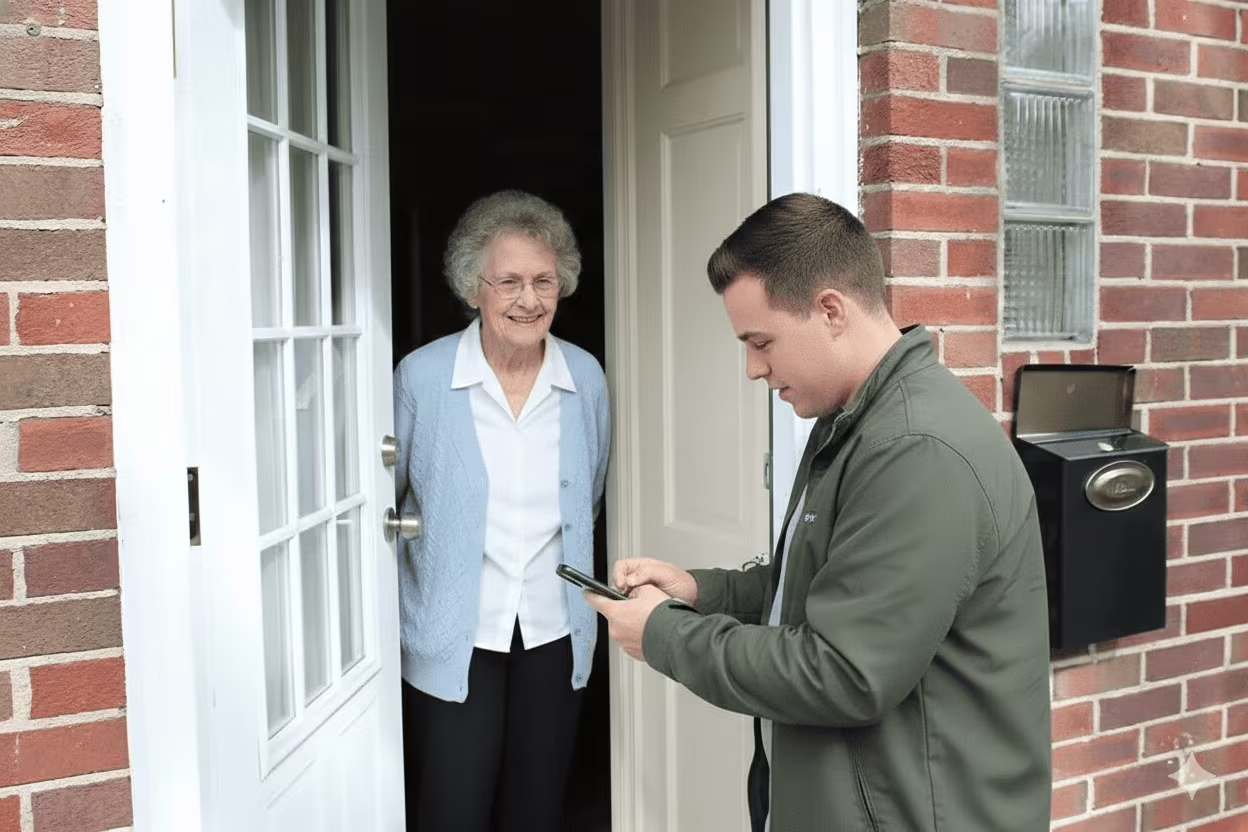
You knock on a door. Someone answers. Thirty seconds later you're back on the path, and unless you write something down right then, that conversation is gone. It doesn't matter whether you're canvassing for a candidate or canvassing for a solar install. The doorstep only gives you one shot at the data, and once you've walked away, whatever you didn't capture is gone for good.
Political campaigns have leaned on five specific data points for years, covered below. Field sales teams selling broadband, roofing, or solar are learning a version of the same lesson. It usually takes a few months of reps writing outcomes on paper, texting notes to a manager, or trusting memory until the end of a shift. The mistakes look different on the surface, a missed follow up instead of a missed voter, but the underlying failure is identical.
I always tell growing teams the same thing. Fix what you're capturing before you worry about what to build on top of it. Simple, consistent fields at the door beat a sophisticated dashboard sitting on messy data, every time. Shopping for reporting tools before agreeing on what a rep should record is doing it backwards. You would not be the first team to make that mistake.
This piece covers both sides of that discipline. It walks through the five voter data points that have anchored political canvassing, then what changes when the person at the door is a prospect instead of a voter.
For political canvassing, five data points matter most at the door. Track these consistently, and you'll know exactly where a campaign stands at any given moment.
This one is simple: Who does the voter support, and how committed are they to them? If you feel like you have no chance of convincing to vote your direction, politely excuse yourself and carry on canvassing. Remember, time is votes in the political game, value yours!
What are the expected votes cast in this election? Not every voter will vote. Often you can determine how many voters will vote by looking at past similar elections. If there was 60% turn out in the last city election and there are no added factors this time to change the situation, you might figure that about 60% would vote in the city election this time.
Always look for interested voters to do more. Ask them if they might be interested in getting involved in the campaign. Remember you will have lots of upcoming events where bodies promoting your campaign message are needed.
Are there any potential issues that might prevent a supporter from casting their ballot. Candidates often times get elected off the back of one particular issue or bill they are pushing. Figure out early on what resonates most with your voters and what doesn't. You can turn the mic up on the positive policies and perhaps hide the others under a bushel.
If a supporter is wavering, what can we do to make them more solidly support us? It might be further information on a particular policy. Showing them public statements to reassure that our candidate is genuinely committed to a policy. Maybe a phone call, or visit, from the candidate themselves will bolster your canvassing efforts.
A political canvasser tracks supporter level and turnout likelihood. A commercial canvasser needs a different list, but the underlying rule doesn't change: capture it in a field, not a paragraph.
Here's what that list looks like for a field sales team, and why it matters more the moment you add a second rep. One person can hold data in their head. Five reps across multiple territories can't, and neither can the manager trying to make sense of what they're all reporting back.
Contact outcome. Every door produces one of a handful of outcomes: not home, not interested, interested, or converted. Build this as a required field with fixed options, not a note a rep types from memory back at the car. A rep who has to select from four options logs it in seconds. But a rep who has to describe what happened in a sentence either skips it or writes something a manager can't search later.
Disposition or objection. When someone says no, the reason matters more than the no. Price, timing, and needing more information all point to different follow up actions, so this deserves its own field too. Lump all three into a single "not interested" bucket, and you lose the one piece of information that tells you whether the objection is worth a second visit.
Follow up need and timing. If a prospect wants a callback next week, that detail is worthless sitting in a rep's head. Capture when and how to reconnect at the point of the conversation, not after the shift ends. A follow up that isn't logged the moment it's promised is a follow up that quietly stops happening.
Property or household context. This is the field that changes by vertical. A roofing rep logs storm damage. A broadband rep logs current provider and availability. A solar rep logs roof angle and shading. Whatever the detail, it belongs in a structured field a manager can filter on, not a paragraph a manager has to read one by one. This is also the field you'll get wrong first if you let reps write whatever seems relevant instead of agreeing on a fixed list in advance.
"One of the biggest upgrades for a growing team is shifting from manual list sharing to clearly defined data capture, with clear fields and consistent options instead of open text. It removes the admin of cleaning up messy records later, and it makes the data usable the moment it's collected." Aoife Murphy, Customer Success Manager, Ecanvasser
None of this works if reps are filling in a free text box instead of selecting from a list. Ecanvasser's Custom Fields exist for exactly this reason: consistent options at the point of capture, so the data is usable the moment it's collected instead of needing cleanup after the fact. This matters even more if you're switching canvassing apps. Without structured fields, historical lead data doesn't carry over cleanly, and you end up rebuilding the same free-text mess in a new tool.
Capture those four fields consistently, and something changes for the manager on the other end:
I've watched this shift play out the same way across dozens of teams. Once data capture is consistent, managers stop finding out what happened at the end of the week and start seeing it the same day. That single change, seeing instead of guessing, is usually what turns a canvassing operation from reactive to proactive.
Messy capture breaks this rollup before it ever reaches a manager. A missing outcome field means a door counts as covered when it wasn't. An objection logged as free text can't be filtered, so a manager has no way to see that half of this week's "not interested" responses were actually about price. The rollup is only as good as what got captured at the door.
This is where the payoff shows up for you as a manager, not just for the rep filling in the field. With clean data, you can spot which rep needs coaching before their numbers slide for a month. You can see that a territory is underperforming and reassign it while there's still time in the quarter to fix it. None of that is possible if the underlying data was never structured to answer those questions in the first place.
Once the fields are consistent, the next question is what to do with the rollup. That's covered in our guide to field sales KPIs, and in our breakdown on what a manager should see on a field sales dashboard.
Three patterns show up again and again in growing field teams.
All three trace back to the same root cause. Nobody agreed on what "good data" meant before the team started scaling.
Each of these problems compounds the others. Disconnected tools make delayed visibility worse. Delayed visibility hides the fact that your fields are outdated. By the time it's obvious something's wrong, you've usually lost months of data you can't go back and fix.
"Struggling teams scale effort. Successful teams scale systems, visibility, and decision making. The teams that get this right treat data as the asset, not the byproduct." - Aoife Murphy, Customer Success Manager, Ecanvasser
A broadband field sales team once assigned weekly canvassing lists by email, with reps writing outcomes on paper and reporting back at the end of each shift. Overlap between reps and missed addresses were common, and managers had no visibility until end of week reports arrived, often incomplete. After moving to structured, time bound digital assignments with fixed outcome fields, the team eliminated overlap between reps. Daily coverage and conversion data replaced end of week guesswork, and managers could reprioritize high value areas the same day.
37% of CRM users report losing revenue directly because of poor data quality.
That number is a useful gut check. Inconsistent field data capture isn't a small operational detail. It's a revenue problem with the same root cause as a messy CRM: nobody agreed on what to capture, so nobody can trust what comes out the other end.
{{faq-1}}
{{faq-2}}
{{faq-3}}
{{faq-4}}
Whether you're running a campaign or a commercial field sales team, the lesson is the same. Data captured inconsistently at the door is data nobody can use later. Build the right fields once, and every conversation your team has becomes something a manager can actually act on, the same day it happens rather than the same month.
That's true whether you have three canvassers working one neighborhood or fifty reps spread across a region. The scale changes. The discipline that makes the data usable doesn't, and the teams that get it right early tend to spend a lot less time cleaning up records later.
Ready to see what structured canvassing data looks like in practice? Book a 15 min call or start a 7 day free trial to see how Ecanvasser turns every knock into usable data.
The fields differ, but the discipline doesn't. Political canvassing tracks supporter level, turnout likelihood, and policy interest. Commercial canvassing tracks contact outcome, objection reason, and follow-up timing. Both fail in the same way when reps capture information inconsistently or rely on memory instead of logging in real time.
At minimum, capture contact outcome (not home, not interested, interested, converted) and the reason behind any objection. Add whether and when a follow-up is needed, plus any property or household detail relevant to your industry, such as roof condition or current provider.
Build fixed fields with preset options instead of open text boxes, and make the key fields required before a rep can save an interaction. Consistency comes from the form's structure, not from asking reps to remember to be thorough. If a field can be skipped, it will be, especially at the end of a long shift.
Ecanvasser’s real-time tracking completely transformed our field operations. Through the dashboard, we can plan efficient routes, customize interactions, and monitor our canvas stops in real time to support our team the second they need help. The "verified drops" feature adds an extra layer of accountability, while the reporting tools make it seamless to track hourly visit rates and optimize performance on the fly.




Scale your operations, empower your reps, and deliver predictable, profitable growth with Ecanvasser.