Short on time?
Pick an AI to summarise this article:
Pick an AI to summarise this article:


Most field sales teams still operate with limited visibility. Managers can see pipeline numbers and closed deals inside a CRM, but they often have very little insight into what is actually happening in the field. They cannot easily see which territories are underperforming, where reps are losing time, or which outreach activities are driving revenue.
That is where field sales analytics becomes critical. Modern field sales analytics goes beyond reporting dashboards and end-of-week summaries. It gives teams real-time visibility into field sales data, territory performance, route efficiency, rep activity, and outside sales performance metrics while operations are still happening.
Traditional CRMs were built for desk-based sales workflows. Field teams need analytics built around movement, territory coverage, live reporting, and real-world execution.
Analytics should help managers make decisions while reps are still in the field, not after the week is over.
And that’s exactly what I’m going to show you in this article.
We’ll break down the best KPIs by role and how to track them.
Field sales analytics is the process of collecting, analyzing, and acting on field sales data to improve performance, territory management, and operational efficiency. It helps teams understand what is happening in the field in real time, not just what appears later in a CRM or sales report.
Field sales analytics typically focuses on:
Unlike generic sales analytics, field sales analytics is built around physical movement and real-world engagement.
This data gives managers visibility into how teams perform across territories, routes, and customer interactions while operations are still happening.
Traditional sales analytics, on the other hand, often focus on:
Field sales teams need much deeper operational visibility. That includes tracking territory saturation, monitoring contact rates, measuring rep efficiency, and identifying underperforming zones before revenue starts to decline.
At its core, field sales analytics connects field activity to revenue outcomes.
Field sales metrics and KPIs are closely related, but they are not the same thing. Metrics track activity and operational performance, while KPIs measure whether those activities are contributing to broader business outcomes like revenue growth, retention, or territory efficiency.
Common field sales metrics track door-to-door activity like:
On the other hand, KPIs measure direct impact on the business’s bottom line.
Common field sales KPIs include:
Too many field teams focus heavily on activity metrics without understanding whether those activities are actually producing strong results. High volume alone does not guarantee efficient field performance or long-term revenue growth.
A metric becomes a KPI when it directly influences revenue, retention, or operational performance. The strongest field sales teams track both operational activity and business outcomes together so they can connect field execution to measurable ROI.
Most sales analytics systems were built for inside sales teams working from desks, not mobile reps working across territories all day. They can track pipeline stages, closed deals, and CRM activity, but they often miss the operational reality of field execution.
That creates major visibility gaps for field managers. Reporting is delayed, field activity is incomplete, and territory performance is difficult to measure accurately. Many teams still rely on manual data entry at the end of the day, which reduces data quality and adoption from reps who are constantly on the move.
As a result, managers can see revenue in the CRM but still have no idea what’s actually happening in the field.
Traditional systems also struggle to provide:
The best field sales teams do not track KPIs just to build reports. They use analytics systems to improve execution in the field, identify operational problems early, coach reps more effectively, and make smarter territory decisions over time.
Strong field sales analytics creates visibility across both rep performance and territory performance. Managers can see where conversations are happening, where conversions are slowing down, which routes are inefficient, and which zones are producing the highest-quality customers.
The goal is not simply to collect more field sales data. The goal is to understand what that data is actually revealing about team performance and operational efficiency.
Contact rate is often the strongest early signal in field sales analytics. It shows how many doors, visits, or outreach attempts actually turn into real conversations.
When contact rates start falling, the issue is usually connected to one of three areas:
Good reps in bad territories still struggle. Low-density areas, poor lead quality, or oversaturated zones can reduce contact rates quickly, even when reps are performing well operationally.
This is why strong field teams monitor contact rate trends closely across different territories and time windows instead of evaluating reps in isolation.
Conversion rate measures how effectively reps turn conversations into meaningful outcomes like appointments, signups, or sales.
This KPI usually reflects:
High contact rates combined with weak conversion rates often point to messaging or coaching issues. On the other hand, weak contact rates and weak conversion rates together usually indicate larger territory or targeting problems. That same split does more work during a rep's first 90 days, where it is the fastest way to tell a rep problem apart from a territory problem before you act on either.
The best field sales teams use conversion analytics to diagnose where performance is breaking down instead of simply measuring top-level output.
Territory analytics has become one of the most important parts of modern field sales management. Some territories generate high activity but poor long-term revenue, while others consistently produce stronger retention and customer lifetime value.
High-performing teams analyze:
Many teams discover that their highest-volume territories are not actually their most profitable. Long-term territory quality matters far more than short-term spikes in sales activity.
High-performing teams also compare retention by territory, not just short-term sales volume. Some zones generate strong immediate conversions but weaker long-term customer value.
Most pipeline loss happens after the initial interaction. Leads go cold quickly when reps delay follow-up or managers lose visibility into next steps.
That is why follow-up speed has become a critical field sales KPI. It measures operational responsiveness and helps teams identify delays before opportunities disappear.
Live field reporting has made this much easier to track. Managers can now spot stalled follow-ups in real time instead of relying on end-of-day updates or incomplete CRM activity.
The strongest field reps are usually not the reps with occasional spikes in performance. They are the reps who consistently produce strong results across different territories and time periods.
Consistency is one of the clearest indicators of sustainable field performance. It also creates better coaching opportunities because managers can identify repeatable behaviors instead of chasing isolated wins.
Elite reps are typically more efficient, not simply more active. They manage conversations better, qualify opportunities faster, and maintain stronger follow-up discipline over time.
At the leadership level, rep consistency also impacts overall acquisition costs. Teams with stable performance patterns typically operate more efficiently across territories and require less reactive management.
The best field sales teams use analytics to make operational decisions in real time, not just review performance at the end of the month. Strong analytics systems help managers diagnose problems early, improve territory performance, coach reps more effectively, and reduce wasted field activity before it impacts revenue.
This is where field sales analytics becomes much more than reporting.
Managers are constantly evaluating operational questions like:
Modern field teams rely on live dashboards, real-time analytics, and operational visibility to answer these questions while reps are still in the field. Instead of waiting for end-of-week reports, managers can identify performance issues as they happen and adjust quickly.
This type of performance diagnosis is what separates high-performing field teams from teams that simply track activity.
For example, high contact rates with weak conversion rates often point to scripting or objection-handling problems rather than territory issues. On the other hand, low contact rates with strong conversion rates may indicate that reps are targeting the right prospects but operating in low-density territories.
High-performing managers also look beyond short-term sales numbers. Some territories generate strong initial conversions but weaker long-term retention. Others produce fewer sales overall but create much higher customer lifetime value.
Operational visibility helps managers identify these patterns early so they can adjust territories, routing, staffing, and coaching decisions before performance declines spread across the team.
Many field sales teams focus heavily on rep performance while overlooking the operational impact of territory quality. In practice, I’ve seen territory problems appear weeks before revenue numbers actually start falling. Strong territory analytics helps managers identify those signals early and adjust before performance declines spread across the team.
Even strong territories lose effectiveness over time. Falling contact rates, repeated household interactions, and slower conversions are usually early signs that a territory is becoming oversaturated.
I’ve worked with teams that improved consistency simply by rotating territories every 6–8 weeks instead of repeatedly sending reps back into exhausted zones.
High-density areas do not always produce the best outcomes. In many cases, I’ve seen fewer doors generate higher revenue because the territory quality and targeting were stronger.
Some high-volume zones also create weaker long-term retention when reps prioritize speed over qualification and customer fit.
Most field teams underestimate how much productivity gets lost through inefficient movement between stops. Poor route planning increases travel time, reduces conversations, and limits territory coverage throughout the day.
Modern territory management and route planning systems help teams improve rep movement efficiency while identifying underperforming zones before revenue begins to decline.
Historical reporting tells managers what already happened. Real-time field sales analytics helps them change outcomes while operations are still happening.
That difference has become increasingly important for modern field teams. Managers can now spot dead zones, identify stalled follow-ups, reallocate reps mid-shift, and optimize routes while teams are still active in the field. Coaching also becomes far more effective when performance issues are visible in real time instead of days later.
I’ve seen teams improve conversion rates simply by adjusting territory coverage and follow-up timing during live shifts rather than waiting for end-of-week reporting.
Field analytics is meant to be operational, so everyone can adjust right away. If your approach is retrospective, it’s time for a change.
Modern real-time field tracking and dashboard reporting systems give managers much stronger visibility into rep activity, territory performance, and operational bottlenecks as they develop, not after revenue has already been impacted.
A field sales analytics system only works if reps actually use it in the field and managers trust the data enough to make decisions from it. Most teams already have plenty of numbers. The real problem is visibility.
A lot of field teams obsess over activity volume because it feels productive. More doors knocked. More visits logged. More hours in the field.
But activity without context hides problems.
A rep knocking 120 doors with weak contact rates tells you something very different from a rep knocking 70 doors with high conversions and strong retention. The best teams focus on operational signals like:
That is the data that actually shows where revenue is coming from and where performance is starting to slip.
One of the biggest mistakes I see is inconsistent reporting between reps and territories. One rep logs every outcome properly. Another logs half the day from memory later that night. Very quickly, managers lose trust in the reporting.
Strong teams standardize:
This becomes critical once multiple teams are working across different territories. If the data is inconsistent, territory comparisons become almost useless.
Spreadsheets break down fast in field sales. Managers need live visibility across reps, routes, territories, and follow-ups without chasing updates manually.
That is why modern field teams rely on centralized dashboards, mobile CRM tools, and real-time field sales reporting. Everyone works from the same information instead of fragmented reports across different systems.
The biggest improvement I usually see after centralizing reporting is speed. Managers spot problems faster. Reps get support faster. Follow-ups happen faster.
The best managers do not use analytics to micromanage reps. They use it to diagnose problems early.
High contacts with weak conversions usually points to messaging issues. Falling contact rates often signals territory saturation. Slow follow-up times normally indicate process breakdowns somewhere in the workflow.
Good coaching becomes much easier when managers can see operational patterns clearly instead of relying on assumptions or end-of-week summaries.
Field sales analytics is becoming more predictive and operationally intelligent. Teams are starting to use predictive territory scoring, AI-assisted lead prioritization, automated performance alerts, route optimization, and conversion forecasting to improve field execution in real time.
But most field teams still struggle more with operational visibility than advanced AI. Clean field sales data matters far more than flashy automation.
The teams getting the best results are usually the ones with strong fundamentals first: reliable field tracking, clear territory management, centralized reporting, and consistent operational visibility across the entire sales team.
Ecanvasser customers bring those systems together into one connected operational view.
Want real-time analytics? Run field sales with the most scalable, transparent platform. Explore our pricing or book a demo.
{{faq-1}}
{{faq-2}}
{{faq-3}}
{{faq-4}}
{{faq-5}}
Improve your field sales KPIs with Ecanvasser. Book a demo.
The key rep-level KPIs are Contact Rate, Conversion Rate, Lead Generation, and Follow-Up Completion. These show how effectively canvassers turn door knocks into conversations and outcomes. Without them, you’re only tracking activity, not performance.
Traditional KPIs often focus on calls made, emails sent, or pipeline size. Field sales canvassing KPIs measure real-world activity: conversations at the door, turf coverage, and speed from contact to close. They’re built around territory and face-to-face engagement, not desk-based selling.
Canvassers need to see how their actions perform at the door. Managers need a system-wide view of coverage, consistency, and retention. Combining both levels shows you where to coach, where to reassign turf, and how to scale efficiently.
By tracking territory coverage and customer outcomes, you can spot zones or reps with higher cancellation rates. This data lets you retrain, reassign, or refine messaging before churn spreads. One team cut attrition from 34% to 23% by enforcing better KPI tracking.
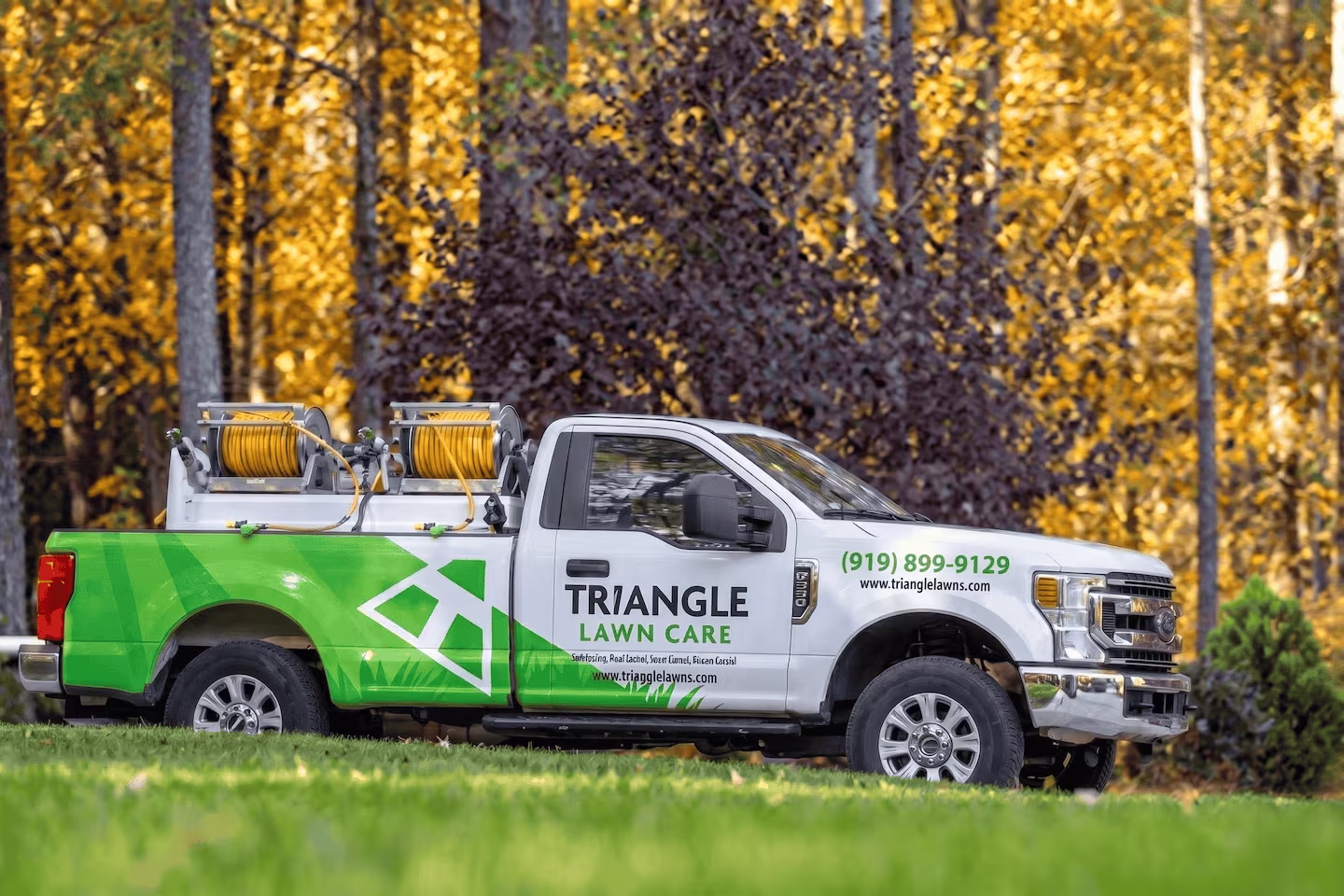
Ecanvasser’s real-time tracking completely transformed our field operations. Through the dashboard, we can plan efficient routes, customize interactions, and monitor our canvas stops in real time to support our team the second they need help. The "verified drops" feature adds an extra layer of accountability, while the reporting tools make it seamless to track hourly visit rates and optimize performance on the fly.




Scale your operations, empower your reps, and deliver predictable, profitable growth with Ecanvasser.