Short on time?
Pick an AI to summarise this article:
Pick an AI to summarise this article:

.svg)

Field sales teams don’t struggle because of effort. They struggle because of a lack of structure.
Reps are out in the field, knocking doors, covering ground, and having conversations. But without a clear system behind them, that activity doesn’t always translate into results. Territories overlap, high-potential areas get missed, and managers are left trying to piece together what’s actually working.
Sales territory planning brings structure to that chaos. It defines where reps focus, how work is distributed, and how performance is measured. Done right, it becomes the system that drives consistency, accountability, and growth across your field team.
In this guide, we’ll walk through how to design sales territories step by step, how to assign them effectively, and how to manage them as you scale. You’ll also get a practical template you can use to build and refine your own territory plan.
Sales territory planning is the process of dividing your market into defined segments and assigning those segments to sales reps. It determines who is responsible for which accounts, areas, or prospects, and how your team focuses its time in the field.
In practice, it goes beyond simple geographic splits. Strong territory planning combines geography with factors like customer type, opportunity size, and conversion potential. This ensures each territory is built around real revenue opportunities, not just clean lines on a map.
For field sales teams, a territory becomes the unit of work. It defines where reps go each day, which doors they knock, and how they prioritize their efforts. That structure directly shapes activity, performance, and outcomes.
Territory planning is also how you decide where revenue comes from. It determines which areas get coverage, which opportunities are prioritized, and how effectively your team turns effort into results. When territories are designed well, reps work more efficiently, managers gain visibility, and performance becomes easier to scale and predict.
Sales territory planning has a direct impact on how your field team performs every day. It shapes productivity, determines how well your market is covered, and influences the predictability of your revenue.
When territories are designed with structure, teams see improvements across key areas:
These gains matter even more in today’s environment. Markets are more fragmented, opportunities shift quickly, and field teams often operate with limited visibility. Without a clear territory strategy, inefficiencies build, and performance becomes harder to manage.
Small improvements in territory planning can lead to meaningful revenue lift. Better alignment between reps and opportunities increases conversion rates and creates a more consistent pipeline.
With the right structure (and tools like territory mapping), teams can turn territory planning into a reliable driver of growth.
Sales territory planning often looks solid on paper. The issues show up when teams try to execute in the field.
Many teams start by drawing clean, simple boundaries. The map looks organized, but performance suffers because it ignores how reps actually work. Territories need to reflect opportunity, movement, and daily activity, not just visual clarity.
Splitting territories evenly feels fair, but it rarely is. A compact, high-density area can generate far more revenue than a large, spread-out one. Strong territory planning focuses on conversion potential rather than just geographic size.
Markets shift quickly. Customer demand changes, new opportunities emerge, and some areas slow down. Annual territory planning cycles can’t keep up with that pace, which leads to outdated coverage and missed revenue.
Even well-designed territories break down without visibility. Managers need to know which areas are being worked, how reps are performing, and where results are coming from. Without tools like real-time field tracking, teams rely on assumptions instead of data.
High-performing territories are designed around how reps actually work in the field. They create structure, reduce friction, and make it easier to turn activity into results.
Strong territories share a few consistent traits:
These elements work together to create a territory that supports consistent performance, not just coverage.
When territories are designed well, rep behavior improves immediately:
That consistency builds momentum. Over time, it leads to better results across the entire team.
Strong territory design starts with a clear process. Each step should help you connect market opportunity, rep capacity, and revenue goals into one practical plan.
Before you draw territories, define what your team needs to achieve. Your goals shape every decision that follows, from how you segment the market to how you assign reps.
A team focused on growth may prioritize new regions, untapped neighborhoods, or high-opportunity accounts. A team focused on efficiency may redesign territories to reduce travel time, eliminate overlap, and help reps cover more ground. A team focused on expansion may need to balance current customers with new prospects in emerging markets.
The best territory plans connect directly to business strategy. When your goals are clear, your territories become easier to design, explain, and measure.
Once your goals are clear, the next step is to understand where the real opportunity lies. Strong territory planning is built on data, not assumptions.
Start by reviewing historical performance. Look at where deals have closed, where conversations happen most often, and how different areas perform over time. This gives you a baseline for where your team is already successful.
Then go deeper into conversion rates. Some areas may generate a lot of activity but convert poorly, while others produce fewer conversations with stronger outcomes. That difference is critical when designing territories.
Focus on identifying high-value areas—places where demand, density, and conversion potential come together. These are the areas that should shape your territory structure and resource allocation.
With a clear view of your market, the next step is segmenting it into manageable, high-potential groups. This is where sales territory design becomes more strategic. Instead of treating your market as a single large area, break it into segments that reflect how your team actually sells.
Segmentation helps you focus effort where it matters most. It also makes it easier to assign territories that align with opportunity, not just location.
Most teams use a combination of factors:
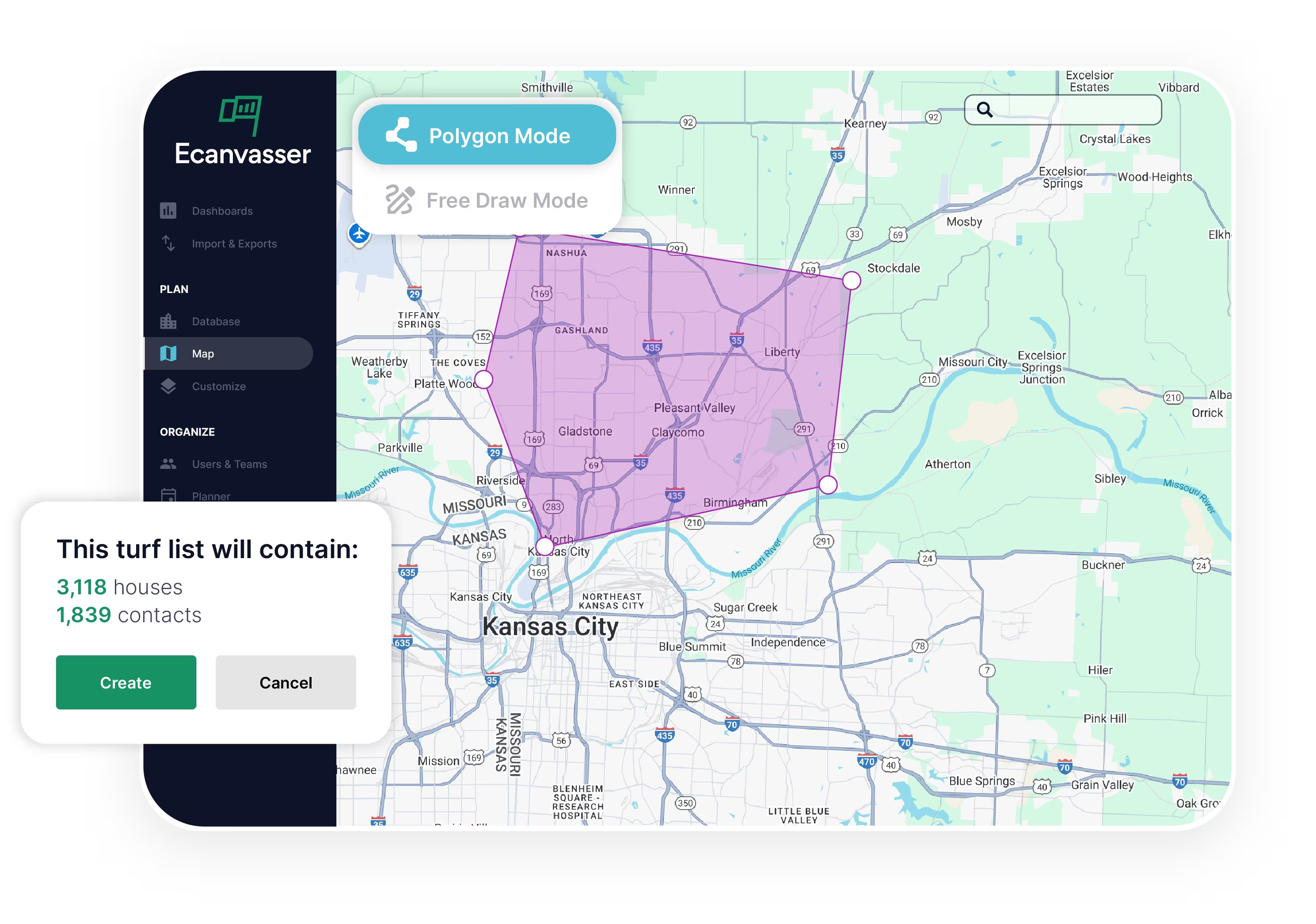
A strong sales territory design uses the right mix of these inputs. It creates territories that are practical to work, aligned with demand, and easier to scale as your team grows.
Before finalizing territories, you need a clear view of your team’s capacity. Each territory should reflect what a rep can realistically cover, given time, effort, and sales complexity.
Start by understanding rep bandwidth. How many doors, accounts, or conversations can a rep handle in a day or week? Then factor in workload, including travel time, follow-ups, and administrative tasks. These factors all impact how much ground a rep can effectively cover.
The goal is realistic coverage. Territories should be sized so reps can fully work them without rushing or leaving gaps. When capacity aligns with territory design, performance becomes more consistent and easier to manage as your team grows.
Designing balanced territories is where planning turns into performance. When thinking about how to balance sales territories by rep, the goal is to distribute opportunity evenly—not just split the map evenly.
A territory with more density and higher conversion potential can generate far more revenue than a larger, spread-out area. That’s why balance comes from how a territory performs, not how it looks.
To create balanced territories, focus on the factors that directly impact a rep’s ability to succeed:
Movement also plays a key role. Territories should allow reps to work efficiently, with a clear path through their day. Strong route planning supports this by reducing wasted time and keeping reps focused on high-value activity.
When these elements are aligned, each rep has a fair and achievable path to hitting their targets.
Once territories are designed, the next step is assigning them in a way that sets your team up for success. Understanding how to assign territories to sales reps comes down to aligning the right people with the right opportunities.
Start by matching rep experience to territory complexity. Newer reps perform best in structured, easier-to-work areas where they can build confidence and consistency. More experienced reps are better suited to complex or high-potential territories that require stronger judgment and adaptability.
Clear ownership is critical. Every territory should have a single, defined owner so reps know exactly where to focus and managers can track performance accurately.
When assignments are intentional, performance becomes more predictable. Reps understand their path to success, and managers gain a clearer view of what’s driving results.
Territory planning shapes how work actually happens in the field. The difference between a strong and weak territory shows up quickly in a rep’s day-to-day experience.
A poorly designed territory creates friction at every step. Reps spend time moving between scattered opportunities, often covering ground that doesn’t convert. Targeting feels inconsistent, and there’s no clear flow to the day. Effort is high, but results are unpredictable because the territory doesn’t support efficient selling.
A well-designed territory creates flow. Reps move through a defined area with purpose, working high-potential prospects in a logical sequence. Conversations happen consistently, and progress builds throughout the day. There’s a sense of momentum because each interaction connects to the next.
That difference matters. When territories support how reps actually work, performance becomes more consistent and easier to scale across the team.
A strong plan becomes much easier to execute when it’s documented clearly. This sales territory planning template gives your team a consistent way to define territories, track activity, and align on what success looks like.
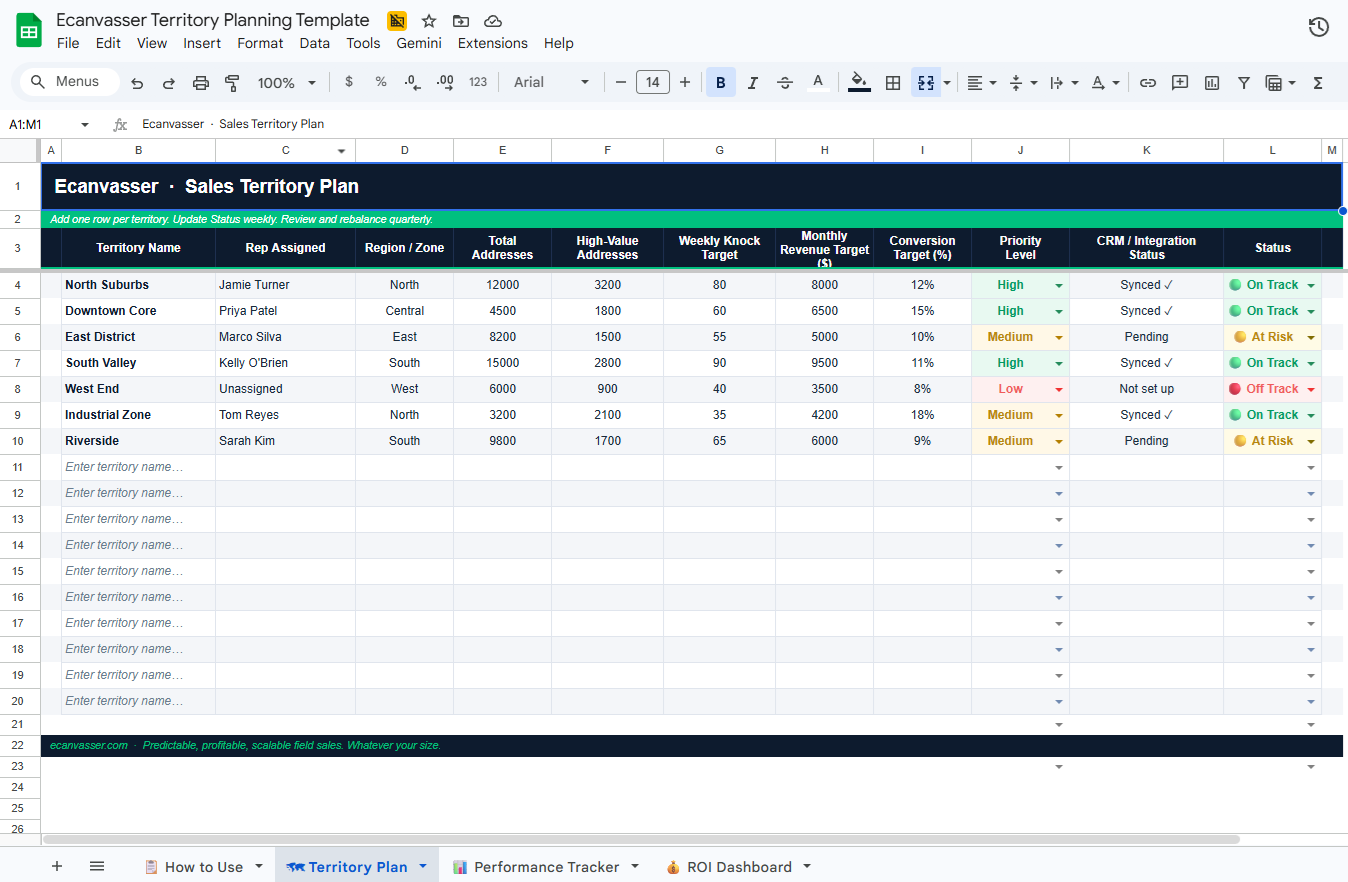
You can access and use the full template here. Just click File > Make a copy to edit it.
The structure is simple, but it reflects how field teams actually work:
This format creates alignment across your team. Everyone works from the same structure, which makes performance easier to track and improve.
Use the template weekly to plan routes, set activity targets, and stay focused on high-value areas. Review it quarterly to adjust territories, rebalance workloads, and refine your strategy as conditions change.
Many teams manage this process using a field sales software, which keeps data centralized and ensures updates in the field are reflected instantly across the team.
Sales territory management is what turns planning into results. Designing territories is the starting point, but performance comes from how those territories are executed, tracked, and improved over time.
Planning defines structure. Management keeps that structure working in the real world.
In practice, sales territory management means staying close to what’s happening in the field. Managers need visibility into activity, coverage, and outcomes to guide performance and make informed decisions. Without that, even well-designed territories lose effectiveness.
Ongoing optimization is key. As markets shift and teams grow, territories need to be adjusted to reflect new opportunities and challenges. Small changes—like rebalancing workload or refining coverage—can have a significant impact on results.
Tracking and iteration bring it all together. When teams consistently track activity and outcomes, they can identify patterns, spot gaps, and improve performance with confidence.
Over time, this creates a system that evolves with your business. Sales territory management becomes less about maintaining a plan and more about continuously improving how your team sells.
Territories perform best when they’re actively managed and refined. As your market changes and your team grows, your territory structure should evolve with it.
Regular reviews keep your territories aligned with real performance:
These moments are opportunities to improve efficiency and capture more revenue from the same market.
The need for change usually shows up in performance data and rep experience:
These signals point to an imbalance in opportunity, not effort.
When you adjust territories based on real data, you create a system that stays aligned with how your team actually sells. Over time, this maintains consistent performance and supports sustainable growth.
Measuring territory performance is what turns activity into insight. Without clear metrics, it’s difficult to understand what’s driving results or where to improve.
Most teams track outcomes, not inputs. They focus on revenue but miss the activity that drives it. Strong territory management connects both, so you can see how effort translates into results.
Start with a few core metrics:
These metrics work together. Coverage shows whether the territory is fully utilized. Conversions highlight the quality of interactions. Revenue per territory ties everything back to business impact.
Tracking inputs like doors knocked and conversations adds another layer. It helps explain why some territories outperform others and where adjustments are needed.
When you measure both activity and outcomes, territory performance becomes clear. You can identify what’s working, fix what isn’t, and improve ROI with confidence.
A UK-based field marketing agency used Ecanvasser to grow from 80 to 300 sales per week. They scaled with improved territory mapping that functions as a connected system.
Teams can design and assign territories with precision and clear ownership. Reps follow structured routes using route planning, while managers track activity through real-time field tracking. Every interaction is captured in the field sales app, giving full visibility into coverage and performance. This replaces manual tracking with a system that connects activity to outcomes, making ROI visible at the territory level.
Build your sales strategy with the power of a platform built for high-volume canvassing and effective scaling. Explore our pricing or request a demo.
{{faq-1}}
{{faq-2}}
{{faq-3}}
{{faq-4}}
{{faq-5}}
Ready for better results? Plan and execute with Ecanvasser.
Sales territory design is the process of structuring territories based on factors like geography, opportunity, and rep capacity. It ensures each territory is practical to work and aligned with revenue potential, not just mapped for simplicity.
A sales territory planning template should include key fields like territory name, assigned rep, opportunity metrics, coverage plan, and activity targets. This creates a consistent framework for planning, tracking, and optimizing performance across your team.
Territory planning focuses on designing and assigning territories. Sales territory management focuses on executing, tracking, and optimizing those territories over time to improve performance and ROI.
Sales territory planning improves productivity, coverage, and revenue predictability. It ensures reps focus on the right areas, reduces wasted effort, and creates a system that supports consistent, scalable performance.



Scale your operations, empower your reps, and deliver predictable, profitable growth with Ecanvasser.