Short on time?
Pick an AI to summarise this article:
Pick an AI to summarise this article:



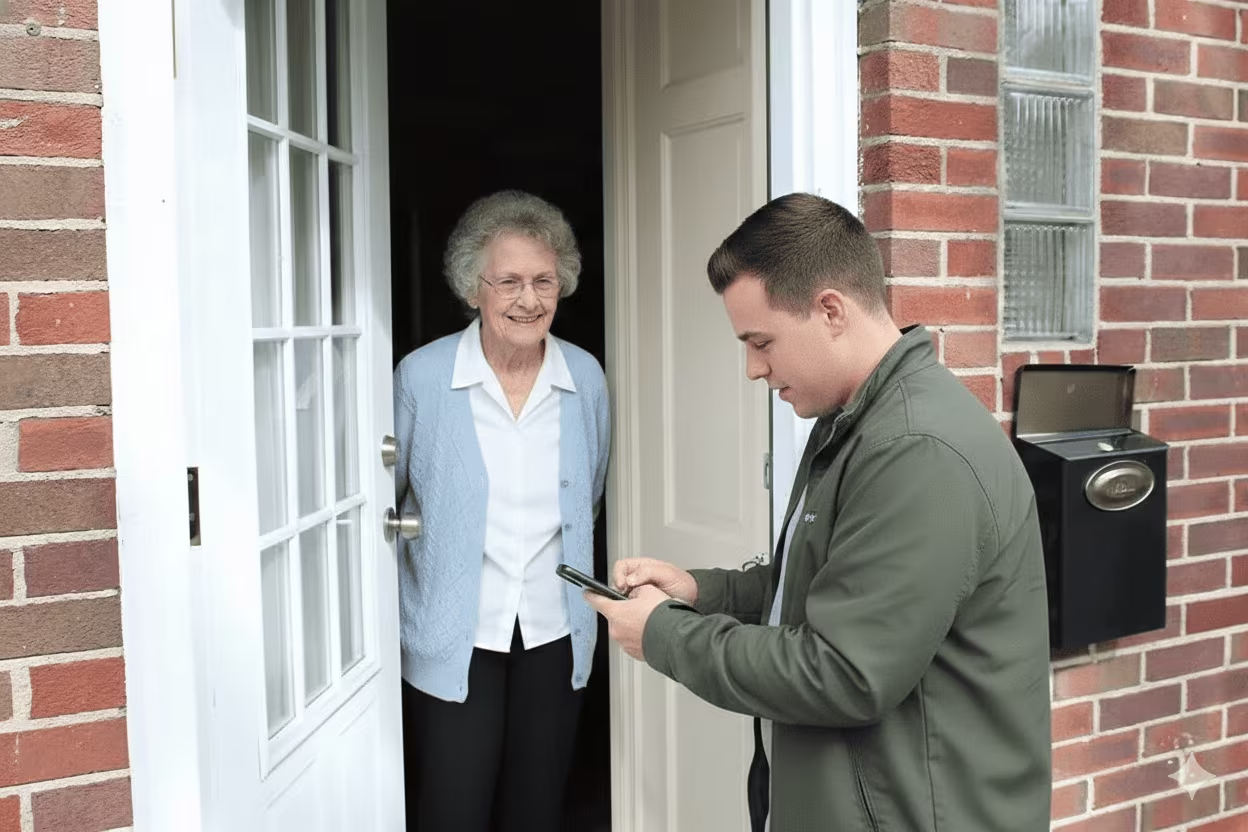
A rep knocks, the conversation goes well, and the homeowner asks about costs. That question is the whole sale, and your rep usually has to answer it standing in a driveway, from a price sheet, on a phone with one bar. Get the number right quickly, and you have a deal. Fumble it, and the homeowner says they will think about it.
CPQ software solves that problem. The letters stand for Configure, Price, Quote, and the category has grown quickly: it was worth USD 3.46 billion in 2025 and is projected to reach USD 10.89 billion by 2033. If your CRM rep has not pitched you one yet, they will.
The catch is who these platforms were built for. Nearly all of them assume a seller at a desk, with a live connection, an approval chain a few doors down the corridor, and days rather than minutes to get a quote in front of a buyer. None of that describes a residential field team. The category can still work for you, but the criteria you judge it on have to change, and nobody has written those criteria down.
Ecanvasser does not sell a CPQ, which is why this guide can be straight with you. What follows covers what CPQ software actually does, what quoting looks like at a door, what to look for in CPQ software for field sales, which tools are worth a demo, and the one thing no CPQ will fix.
The category is real and solves a real problem. Whether it solves yours depends on one question: does your sale match the shape this software assumes?
Let’s break CPQ down into its three main parts:
Your team already does all three, with a price sheet and a rep's memory. Configure price quote describes a process you already run. CPQ software automates it.
Standard CPQ software carries four assumptions baked into its architecture:
None of those hold in a driveway. A homeowner who says "send it over and I'll take a look" is usually a homeowner you have lost. The next company knocking that street will price it on the spot.
The distance between "I can email that to you" and "here is your number" is the gap this category has not closed.
Stop only asking which CPQ is best. You should also ask how much of your quoting problem is a pricing problem, and how much is a field problem.
If we’re talking about wrong numbers, misapplied discounts, forgotten add-ons, that’s a pricing problem, and a CPQ helps. Quotes that never get logged, patchy follow-up, no way to tell which territories produce quotes that close…these all point to a field problem, and a CPQ will not touch it. Most teams have some of each, and the mix tells you what to buy first.
Teams usually come to us having already been sold on a CPQ by whoever sells them their CRM. By the time we are talking, they have worked out that the number was never the thing going wrong. The rep could always get to a price. What they could not do was prove where that price came from, or find it again three weeks later.
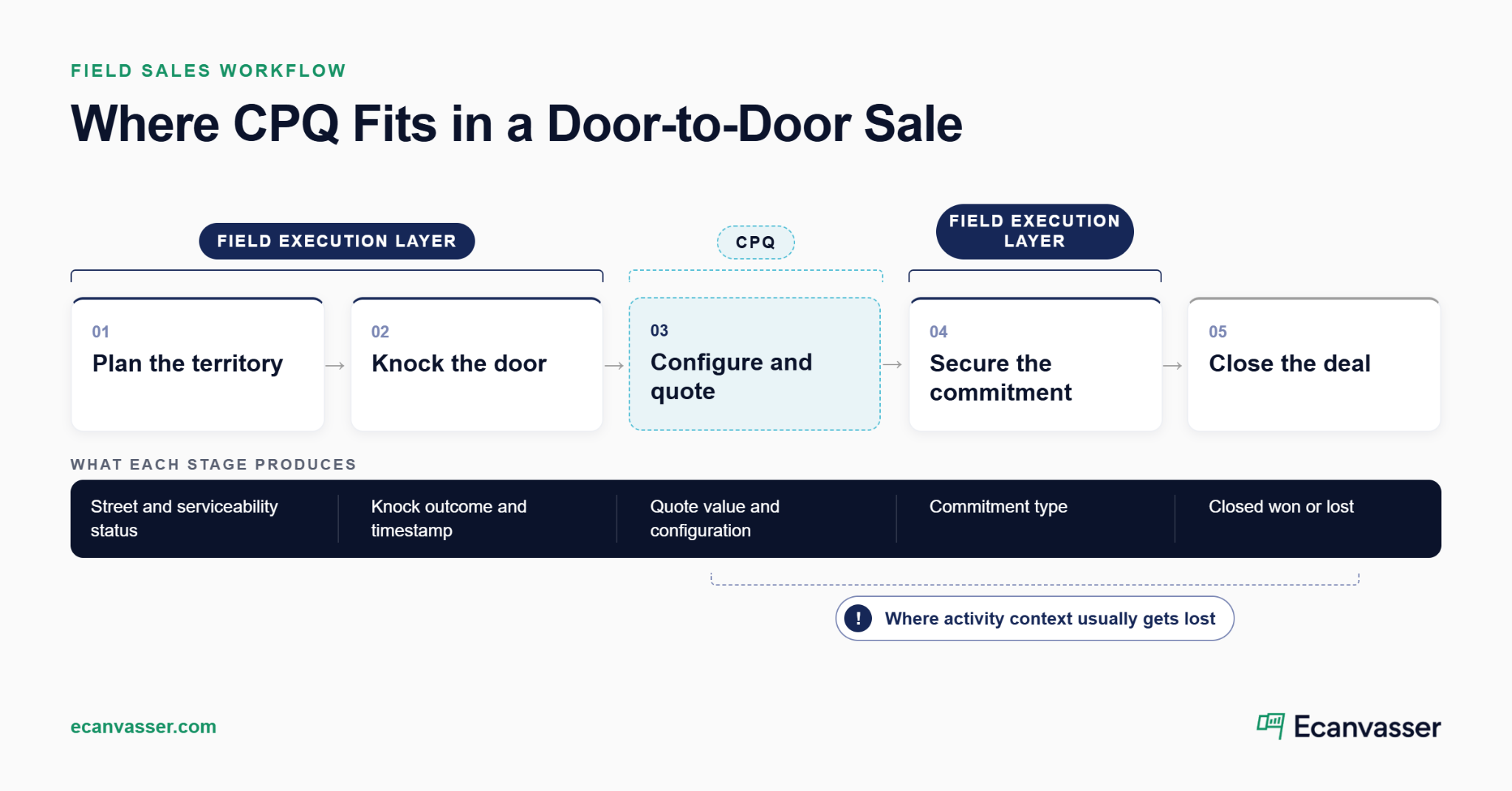
The criteria in the next section only make sense once you have looked hard at the interaction they have to survive. Three things matter: the moment itself, what has to be true before it, and what has to happen after it.
Configure, price and quote happen inside a single conversation. Often inside two minutes. Standing up. No discovery call, no proposal review, no procurement committee. Your rep is reading the customer's face while entering the configuration.
That compression changes what "good software" means. A tool that takes eight taps to produce a number is not eight taps slower. It is a rep staring at a phone during the part of the conversation that decides the sale.
A CPQ assumes the opportunity is already qualified. At a door, qualification and quoting collapse into each other, and four things have to be settled before a number means anything:
A quote against an address you cannot service is worse than no quote. It enters your pipeline looking like progress, then dies quietly two weeks later. Territory and serviceability data sits upstream of every quoting decision you make.
A number the customer likes is not a sale. Depending on your vertical, you need a signature, a deposit, a booked survey, or all three, and you must be able to capture each one where your rep is standing.
Some sales close in the doorway and some genuinely cannot. Solar is the clearest example, where the decision involves a household conversation and a finance application. What protects those sales is not a faster quote. It is a booked appointment before your rep walks away.
No vendor volunteers most of what follows. Treat these as demo questions, ranked by how often each one kills adoption.
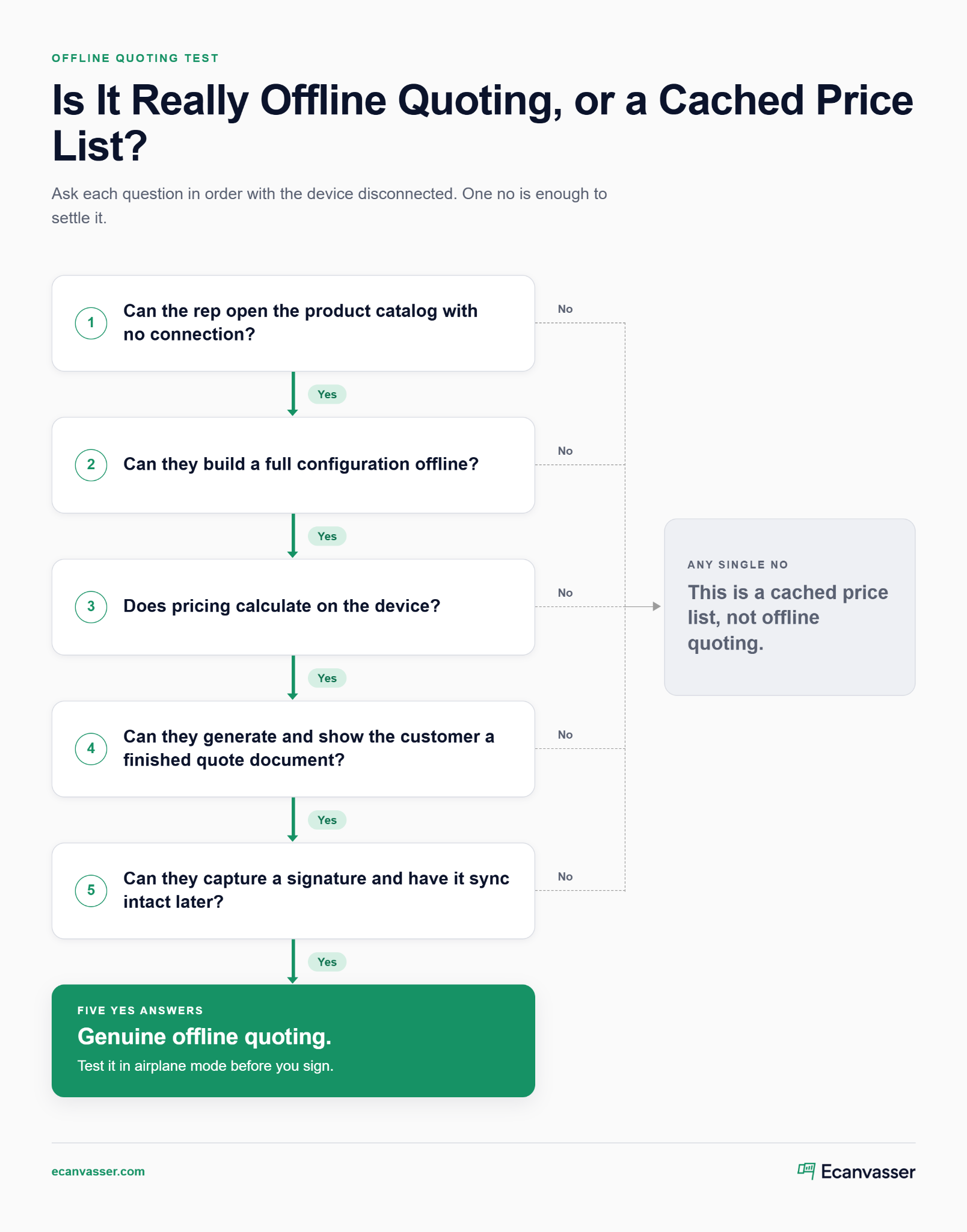
Caching a price list for offline viewing is not the same as generating, pricing and signing a complete quote with no connection. Most platforms do the first and call it offline support.
Ask the specific version. Can a rep configure, price, and sign a quote in airplane mode, and have it sync intact afterward?
This is not an edge case. As of June 2025, about 59.5% of rural US road miles were covered by at least one provider's 5G-NR service at 35/3 Mbps, against 99% of urban road miles.
Ecanvasser's offline canvassing captures notes, signatures, photos, and forms with no connection, then syncs on reconnect. Hold a CPQ vendor to that standard.
A tool your reps will not open is worth nothing, no matter its pricing logic.
Run a real test. Hand the app to your fastest and slowest reps, give them a genuine configuration, and time both. Then repeat it in a bad-signal area. Watch for these:
The demo is always run on a laptop by someone who built the demo. I have never seen that predict anything. What predicts adoption is whether a rep who has been out since eight in the morning will still open it at four in the afternoon.
Most CPQs route out-of-policy quotes to a manager for sign-off. That works when the manager is at a computer, and the customer is not in the room. At a door, a twenty-minute approval has already cost you the sale.
You have three options:
Whichever you pick is a policy decision, not a software one.
Enterprise implementations run for months and often need a consultant. For 40 reps selling three tiers, that is a mismatch. Ask how long a comparable customer took to go live, and who configured it.
The opposite risk is real. A tool simple enough to configure in a week may not handle your pricing rules, and finding that out after rollout is expensive. Model your two hardest quotes during the trial.
There is no field sales quoting software category, strictly speaking. No CPQ on the market is purpose-built for residential door-to-door sales, so you are looking for the closest fit rather than the perfect one. Group them by architecture rather than by rank, because that decision narrows the list faster than any feature table.
Salesforce Revenue Cloud and HubSpot's quoting tools put quotes where your pipeline already lives, with no integration work. That is a genuine advantage.
The trade-off is licensing. You pay per user on top of CRM seats you already pay for, and timelines assume an admin. Neither offers meaningful offline quote generation. Good fit if you are committed to one ecosystem and have someone to run it.
"When we merged with another broadband company, it was just so easy to onboard new staff, knowing that there wasn't going to be an extra cost, because we have unlimited licenses." - Scott Kean, Field Sales Manager, Truespeed
DealHub, PandaDoc, Qwilr and QuoteWerks deploy faster and cost less to start. Document generation and e-signature are strong across all four, and the buyer experience is usually better than what a CRM produces natively.
They are cloud-dependent by design, and their pricing logic is lighter than an enterprise engine. Good fit if your quotes are reasonably simple but your paperwork is slow.
Mobileforce makes the clearest offline claim in the category and deploys in weeks, not months. On the offline requirement specifically, it is the closest architectural fit you will find.
Be aware of who it was built for. Its field is B2B field service: manufacturing sites, trade shows, equipment distributors, technicians raising work orders. The configuration model may be heavier than a home services team needs. Worth a demo, specifically to stress-test the offline claim against your own workflow.
Every tool above treats the quote as the beginning of the record. In field sales, the quote is in the middle.
None of these platforms can tell you which territory the quote came from, how many doors preceded it, or whether the address was serviceable. They were not built to know. Worth weighing against total cost of ownership before you sign anything.
You can buy the best CPQ software on that list and still not know whether your field operation is working. Here is why, and where the gap gets closed.
Look at a quote in your pipeline. Here is what is missing:
A pipeline of quotes with no activity context is not one you can coach against or forecast from. You see the output and never the input, so you cannot tell a good territory from a lucky one.
A field execution layer captures door-level activity. The CPQ or CRM then receives clean, structured records rather than whatever a rep remembered later.
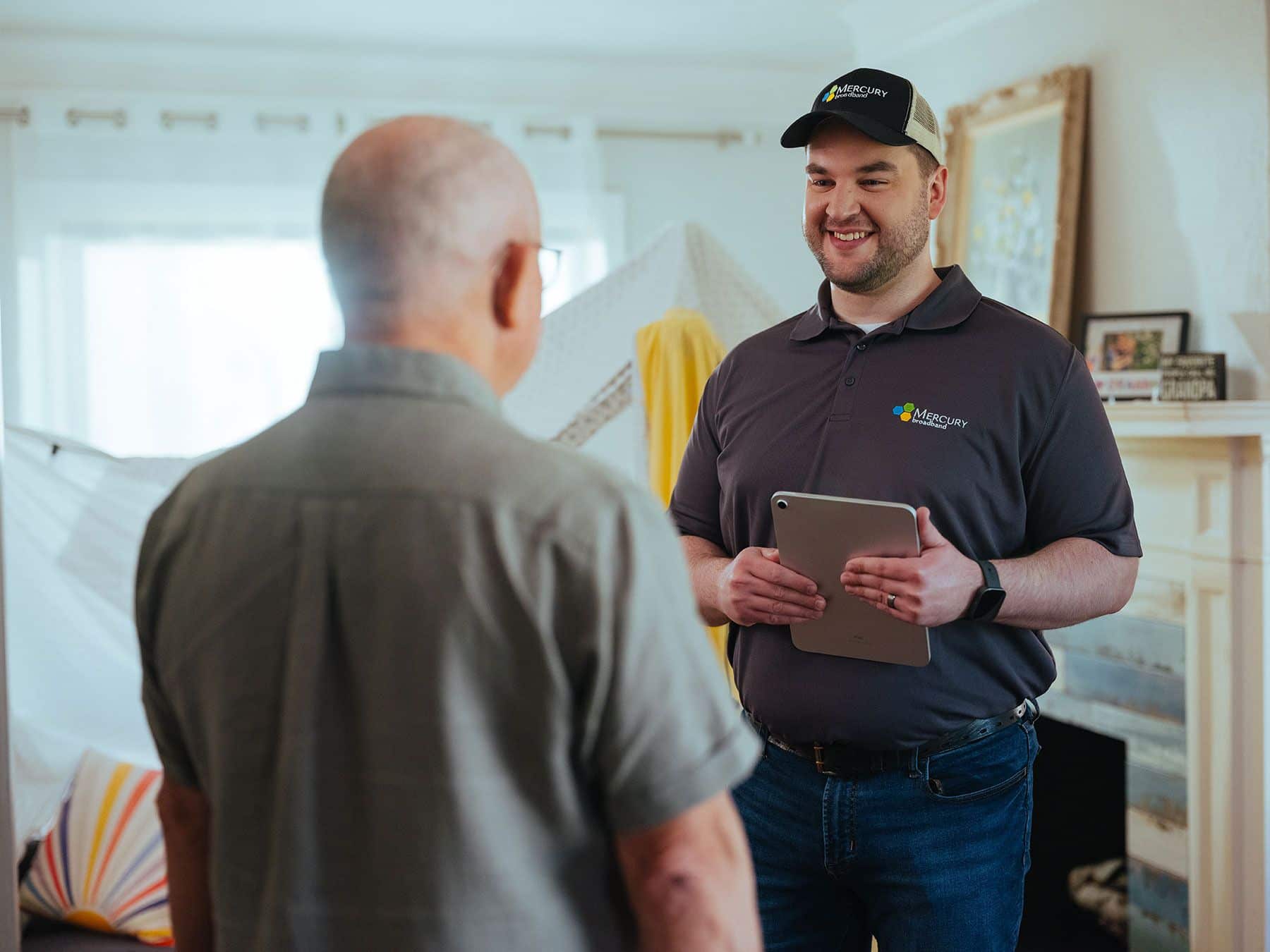
Mercury Fiber, a US broadband provider serving rural communities, was building out its door-to-door channel on tools that did not fit its location-based data model. It moved to Ecanvasser for offline capability and for activity tracking that ties knocks and location to outcomes. The team can now set realistic benchmarks and prove door-to-door ROI internally, including visibility into what they call offline impressions.
"Once we configured Ecanvasser for our peculiar use case, we have been benefiting from a reliable, intuitive, easily adopted, out-of-the-box SaaS solution. We are now seeing continuous improvements and new features without any further investment." - Gavin Langlands, Business Analysis and Change Management, Ringtons
Ecanvasser connects to 5,000+ apps including Salesforce and HubSpot, with a RESTful API where no connector exists. Activity and outcomes then read together in one dashboard.
Put the same questions to each side:
Two systems that both claim to integrate with everything often meet only through a third tool. Nobody mentions that until implementation. Get it in writing.
Fix the field data first. Then fix the quoting.
A CPQ layered onto a field operation with no activity visibility gives you faster quotes and exactly the same blind spots. A field layer with clean door-level data makes whatever quoting tool you choose afterward measurably more useful. It also tends to reveal that the quoting problem was smaller than it looked.
The final word: Ecanvasser does not sell a CPQ and we are not trying to talk you out of one. We capture what happens at the door and present it cleanly, so the tools behind it have something real to work with. Book a demo to see how that works on your territories.
{{faq-1}}
{{faq-2}
{{faq-3}}
{{faq-4}}
Ecanvasser is the most scalable field sales software. We don’t penalize you as you grow. Explore our pricing.
CPQ stands for configure, price, quote. It automates three steps: assembling what the customer is buying, applying your pricing rules to it, and producing the quote document. Field teams already do all three manually with a price sheet and a calculator. CPQ software replaces that manual process with automated rules, so the number comes out right without a rep working it out.
It depends on which problem you have. If reps quote wrong numbers, misapply discounts or forget add-ons, a CPQ helps directly. If reps quote accurately but activity goes unlogged and follow-up is patchy, a CPQ will not fix that. Work out which of the two is costing you more before you shop, because the answer changes what you should buy first.
Very few platforms genuinely can. Most cache a price list for offline viewing and describe that as offline support, which is not the same thing. Ask whether a rep can configure, price, produce and sign a quote in airplane mode, then sync it intact. Mobileforce makes the clearest offline claim in the category. Test it against your own workflow before signing.
Ecanvasser’s real-time tracking completely transformed our field operations. Through the dashboard, we can plan efficient routes, customize interactions, and monitor our canvas stops in real time to support our team the second they need help. The "verified drops" feature adds an extra layer of accountability, while the reporting tools make it seamless to track hourly visit rates and optimize performance on the fly.




Scale your operations, empower your reps, and deliver predictable, profitable growth with Ecanvasser.