Short on time?
Pick an AI to summarise this article:
Pick an AI to summarise this article:



Per-seat pricing has pushed plenty of field sales teams toward building their own software. Licenses that look reasonable at 20 reps become a serious line item at 200, and an in-house developer looks like the cheaper option.
At first, the numbers hold up. A canvassing app ships in six weeks, reps adopt it, and the savings look real. Then an Android update breaks the map screen. The developer who built it has moved on. Two regions quietly go back to paper, and nobody can say what data was lost in between.
That's the real cost of custom sales software. The first release is rarely the expensive part. The real expenses come later: keeping the app working on both iPhone and Android, paying for maps, handling data captured offline, and getting reps to use it. Meanwhile, every new feature the sales team asks for waits its turn in the development queue.
This guide takes the build option seriously. It covers what an in-house tool costs to run, which features are harder than they look, when building is the right call, and how to replace a build that isn't working. The goal is a build versus buy sales software decision based on real costs, not a promising first demo.
You didn't set out to run a software project. Custom field sales software usually answers one of three pressures, and each is fair.
The pricing math deserves a closer look, because it drives more build decisions than any feature gap. At 20 reps, per-seat licenses barely register. At 200, with seasonal hires and turnover, the annual bill rivals an engineer's salary.
That's a pricing problem, and it has a pricing fix. Ecanvasser prices by lead volume rather than headcount, so cost is tied to the size of the territory being worked. Users are unlimited. Seasonal hires, new regions and replacement reps add no license cost, and nobody spends time juggling seats. Territory insights also stay intact through high turnover, and spend stays easy to forecast against revenue opportunity.
Triangle Home Services saw the difference firsthand. The team found competing platforms "outrageously priced" for a growing field operation. It then canvassed over 20,000 homes in just over a month, with software costs flat throughout the growth.
I've been in the room when a per-seat quote lands and someone says, "We could just build this." It's a fair reaction. The fix is usually a different pricing model, not a development team.
Maybe your process really is unusual. You might have three acquired brands running three systems under one parent company.
Older field tools were rigid, and that frustration was earned. Configuration has come a long way since, and you'll test your workflow against it later in this guide.
If you already pay engineers, the build can feel almost free. Their salaries are already in the budget, so the first version seems to cost nothing extra.
That first version really is cheap. It's also rarely where the real cost lives. Every sprint your team spends on the field app is a sprint they don't spend on your core product or improving critical operational infrastructure. It works the other way too. When the core product or operational infrastructure needs attention, the sales team's requests wait.
The next section puts numbers on what happens after launch.
Your build estimate covers the first release. Does it cover year three? Running field sales software is a permanent line item, and it lands on your budget every year the app is in use. Three costs grow quietly once reps depend on the app, and none of them shows up in a sprint plan.
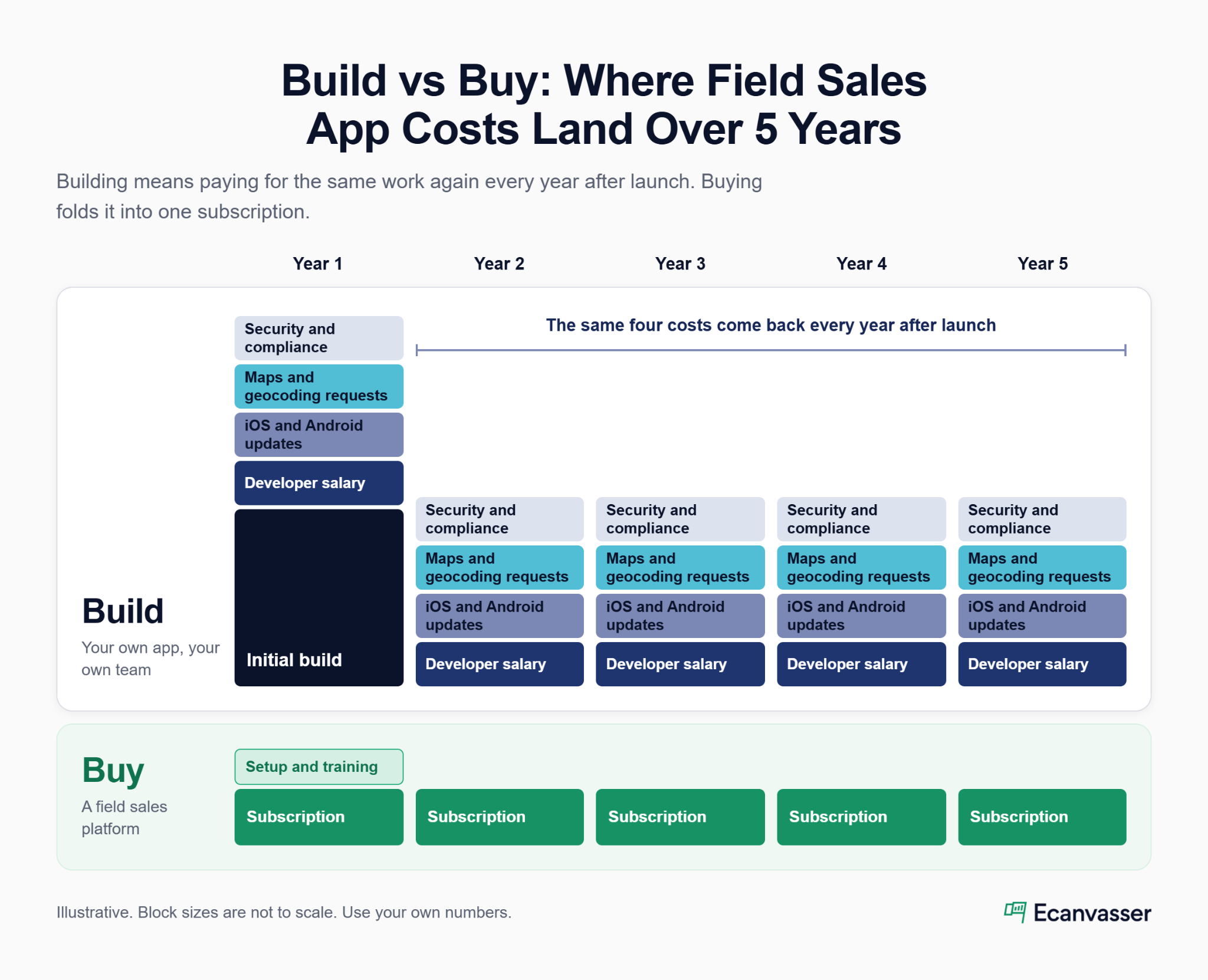
Your reps carry iPhones and Android phones, so your field app is really two apps. Even a cross-platform codebase has to follow two sets of platform rules. Both change on their schedule, not yours.
Here's a concrete example from Google Play Console Help. Starting August 31, 2026, new apps and app updates must target Android 16 (API level 36). Fall behind, and you can't ship updates through the store.
Someone has to do that work every year. The median annual wage for US software developers was $135,980 in May 2025, per the US Bureau of Labor Statistics. That's base pay, before benefits and overhead.
And when the one developer who built it leaves, the knowledge leaves too.
Every address pin, turf boundary and route runs on paid mapping APIs, billed per request. Google Maps Platform includes 10,000 free Geocoding requests a month, then charges $5.00 per 1,000 at the first paid tier.
Run the math for a mid-size team. Thirty reps geocoding 150 addresses a day, over 21 working days, make about 94,500 requests a month. That's roughly $420 a month on geocoding alone, before map loads, routing or place search. Treat it as an illustrative estimate, not a benchmark.
A platform spreads those costs across thousands of teams. An in-house build pays list price on every request.
The highest cost of an in-house build is actually lost time. An internal team fits sales requests in between everything else the business needs.
Consider a sales leader who needs a new visit status and a renewal report before the spring push. The request joins the IT backlog behind a billing migration and a security patch. By the time it ships, the season is over, and reps have spent it working around the gap.
On the flip side, a software vendor's full-time job is improving the product, and every customer it serves feeds that roadmap. If you’re using Ecanvasser, a lot of this configuration comes out of the box with the click of a button.
A demo on office wifi hides the hardest problems. These three features look simple in a spec and turn difficult the first week reps hit a real street.
Rural streets and apartment basements are where a field app proves itself.
Picture a rep who logs twelve doors with no signal. The app has to store every interaction, sync it later, and resolve conflicts if a manager reassigned that turf in the meantime. Get it wrong, and you lose data from the areas you most need to understand.
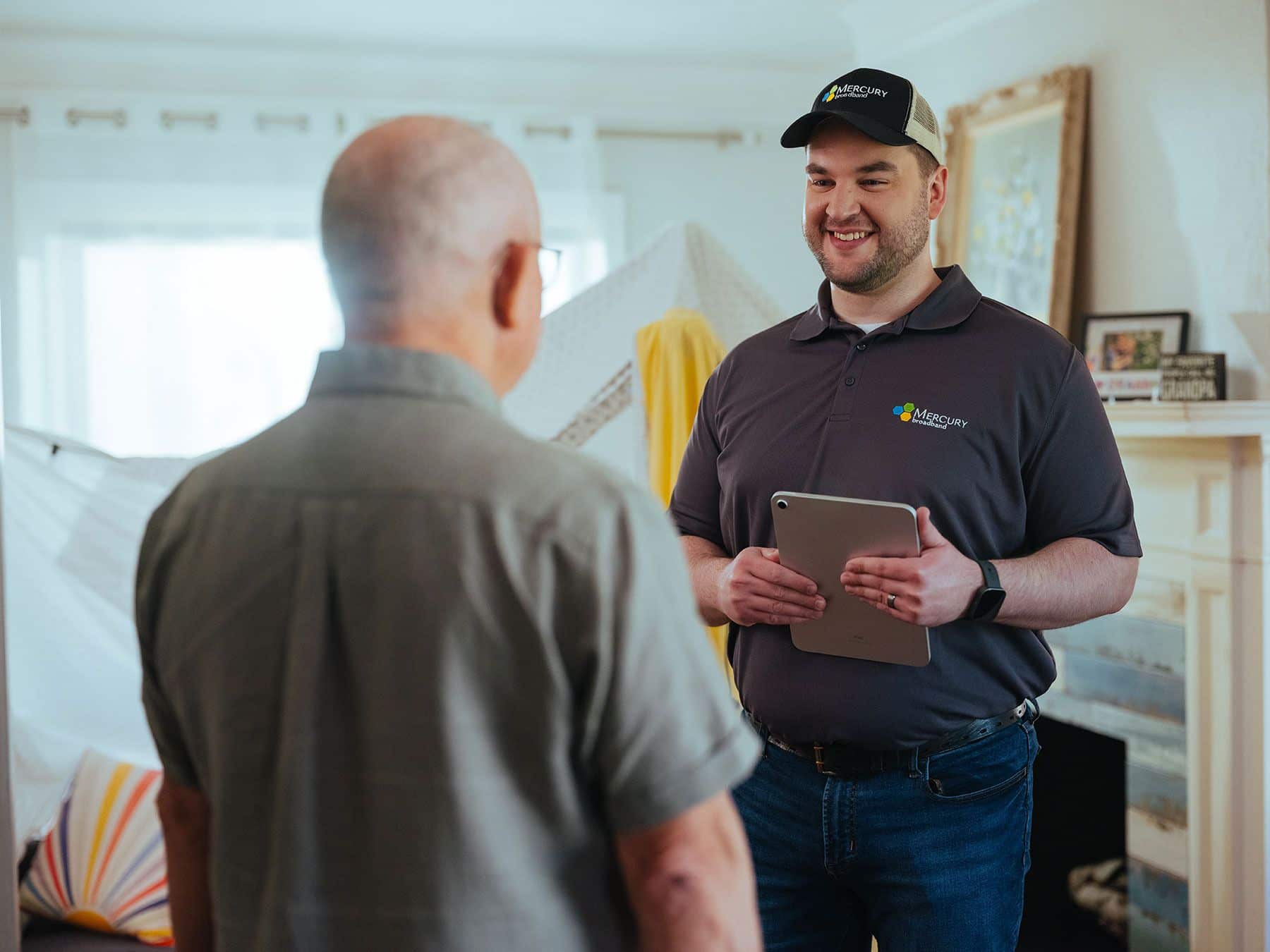
Offline-first is an architecture decision you make on day one. Adding it later is painful. Mercury Fiber relies on offline capture to work its rural, low-connectivity territory.
Territory logic sounds like drawing shapes on a map. In practice, it means assigning turf and controlling when lists are visible. It means stopping two reps from knocking the same door. It also means keeping each knock's history attached to the address after a rep leaves. That history makes the tenth visit smarter than the first.
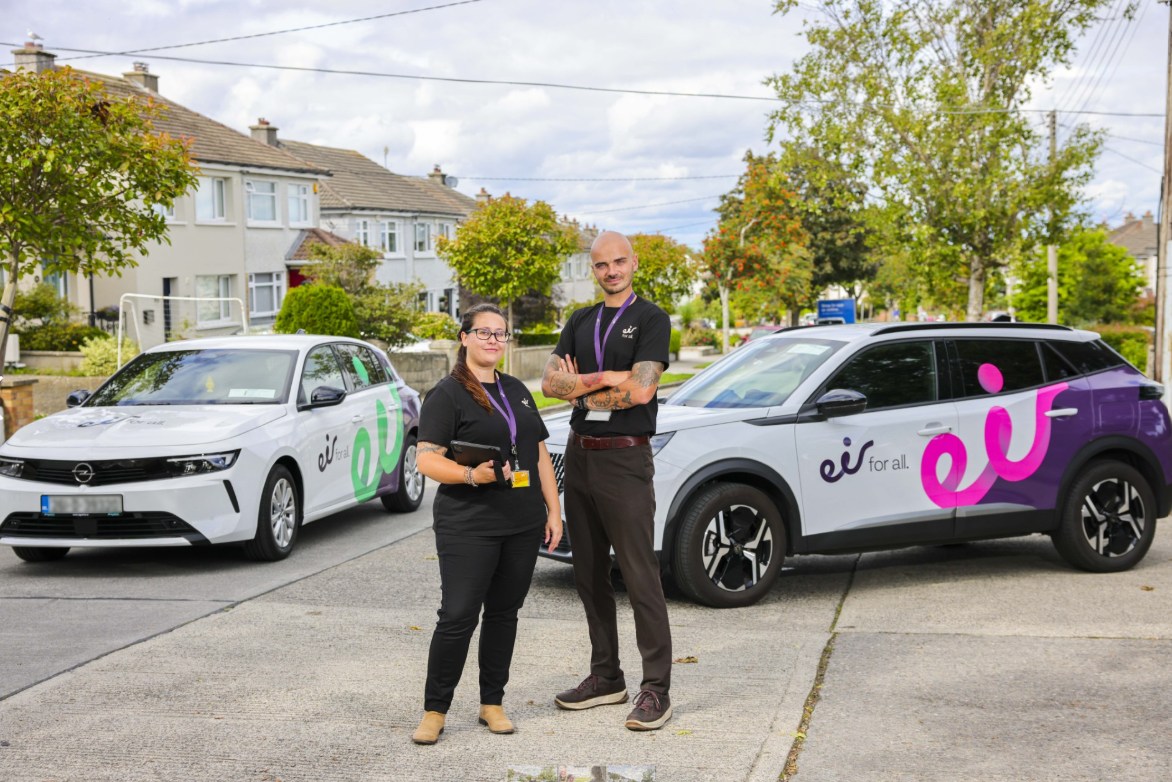
The most valuable field data often lives in a rep's notebook. Before Ecanvasser, eir ran field sales from Excel. The team called it "just a step above pen and paper." Contract end dates sat in reps' notebooks, so follow-ups slipped. With territories mapped and existing customers excluded, eir's reps stopped knocking on customers' doors. They started revisiting leads as contracts neared renewal.
Your dashboards are only as good as what reps enter at the door. If logging a visit takes too many taps, reps skip it, and every report downstream is wrong. That makes adoption the real engineering requirement.
eir's previous tools struggled on exactly this point. They were overly complex and required duplicate data entry. Ringtons, which you'll meet below, tracked adoption from the first day of rollout.
[blockquote] "I focus on making it easy for new users to get started: clear training flows, simple first-day tasks, and minimal complexity upfront. That means faster adoption, less resistance, and more consistent usage in the field. If it's easy on day one, it sticks long term." Aoife Murphy, Customer Success Manager, Ecanvasser
Sometimes building is the right answer.
Here's how to tell if you're in that group.
If only one of these fits, a hybrid approach usually wins. You keep the parts that make you different and hand off the plumbing every field team needs. The next section shows how that works.
Buying carries a real cost too. You depend on the vendor's roadmap for anything you can't configure or build on top of. If a feature you need isn't planned, you wait or work around it. Weigh that against an internal backlog, where sales requests compete with every other priority in the business.
The build cases I respect all have one thing in common. Someone's full-time job is the software, not the sales team.
Your build vs buy field sales software debate probably skipped the options in the middle. Work through them in order, starting at the top of the list. Each step costs less to maintain than the one after it, so only move on when you've hit a real limit.
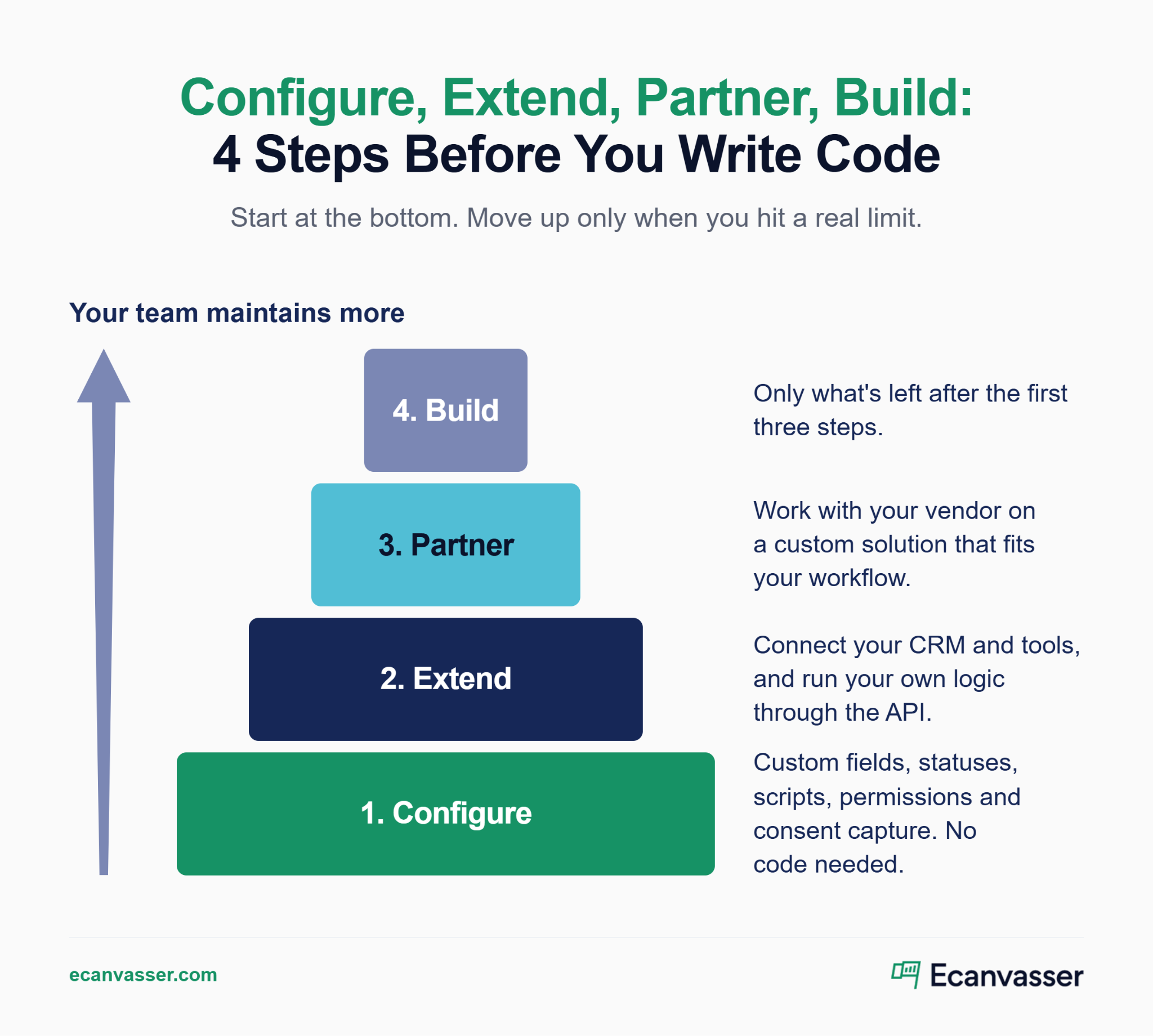
Notice what happens to maintenance at each step. At the extend step, your engineers own one small service. The mobile apps, the maps bill and the offline sync engine stay with the platform. Your team's time goes to the logic that makes you different. At the partner step, the vendor builds and maintains the solution, and it keeps improving as other customers use it.
Some gaps will survive all three steps. If so, you'll know exactly what you're building and why.
Maybe the app already exists, and your reps are working around it. Replacing something your own team built is harder than switching vendors. Someone's work is being retired, so plan the move with respect.
An in-house app can cover the basics and still leave you blind.
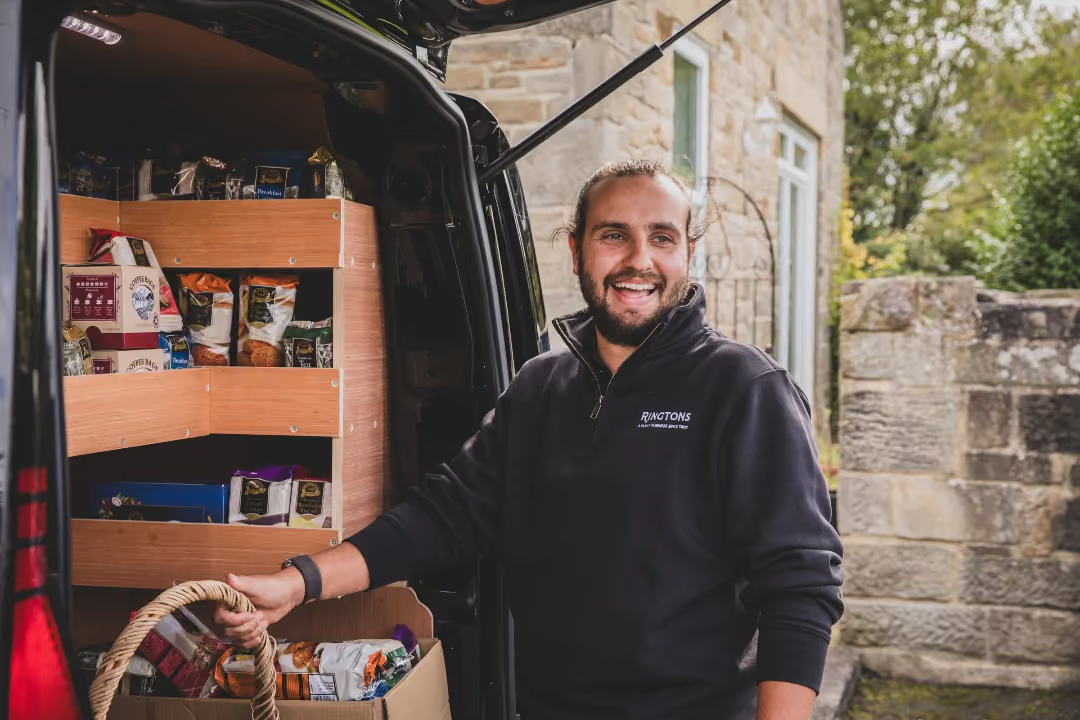
Ringtons runs 230 van routes serving over 360,000 homes. Its canvassers relied on a bespoke in-house app plus paper. The app captured minimal data, with no lat/long address verification. Managers couldn't see who was in the field, and paper capture left no auditable consent trail.
That trail matters in the UK. The Information Commissioner's Office says you must record who consented, when, how, and what they were told.
After moving to Ecanvasser, Ringtons gained real-time visibility, doorstep digital consent, verified addresses, turf assignment and offline capture. It saw adoption data from day one.
"Once we configured Ecanvasser for our peculiar use case, we have been benefitting from a reliable, intuitive, easily adopted, out-of-the-box SaaS solution. We are now seeing continuous improvements and new features without any further investment." Gavin Langlands, Business Analysis and Change Management, Ringtons
This sequence protects your data first and your reps second, so the old tool stays running until the new one has proven itself in the field.
I'd rather see one region live and clean than five regions live and half-used. Adoption data from that first region tells you what the rest of the rollout should look like.
Before you commit engineers, ask one question. Is your reason for building really a pricing problem?
If per-user fees are what's driving the conversation, start with the pricing model. Under lead-volume pricing, the headcount argument for building largely disappears. Then test your workflow against configuration and the API, and bring any remaining gap to your vendor. Build only what's left. That's an honest way to run a build vs buy field sales software decision. It also keeps custom sales software focused on the parts that make you different.
{{faq-1}}
{{faq-2}}
{{faq-3}}
{{faq-4}}
Want to see the numbers for your own team? Try the ROI calculator, or book a 15-minute call. Bring your build spec, and we'll test it against configuration and the API together.
It depends on your team size and scope, so there's no honest single number. Start with the recurring costs covered above: at least one maintaining developer's salary, per-request mapping fees, and the time sales requests spend in the development queue. Add them to your build estimate for every year you plan to run the app.
Yes. Configure fields, statuses and workflows first, without code. Then connect your other tools through integrations, and build your unique logic as a separate service that calls the platform's public API. You end up maintaining one small service instead of a full mobile app. If a real gap remains, ask the vendor about a custom solution before building from scratch.
It depends on your data volume and how many regions you run. Export your knock history and contacts first, then put one region live on the new platform. Watch adoption data for a couple of weeks before rolling out further. While you're evaluating, ask any vendor how you'd export your data if you ever left.
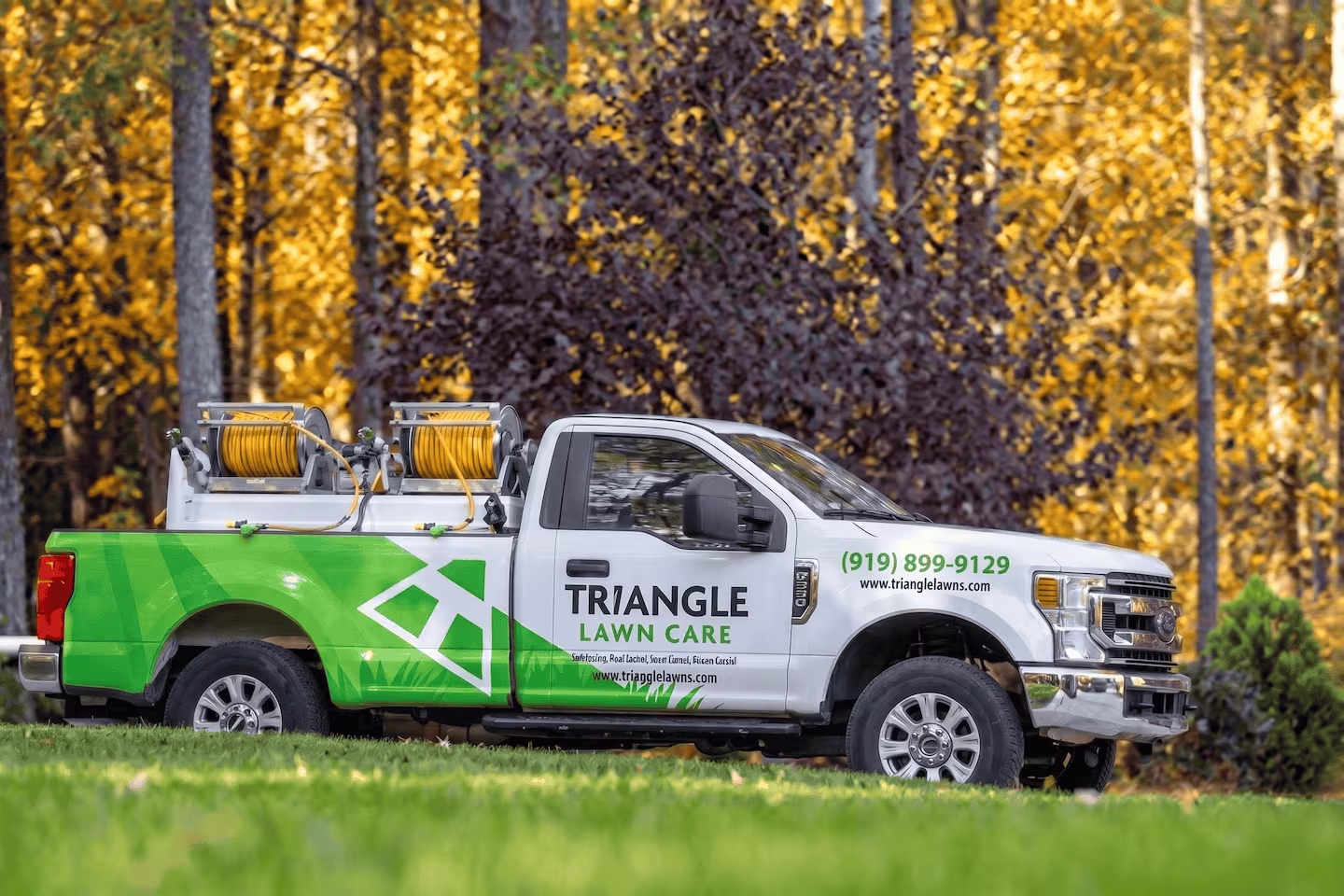
Ecanvasser’s real-time tracking completely transformed our field operations. Through the dashboard, we can plan efficient routes, customize interactions, and monitor our canvas stops in real time to support our team the second they need help. The "verified drops" feature adds an extra layer of accountability, while the reporting tools make it seamless to track hourly visit rates and optimize performance on the fly.




Scale your operations, empower your reps, and deliver predictable, profitable growth with Ecanvasser.

.svg)