Short on time?
Pick an AI to summarise this article:
Pick an AI to summarise this article:



You added eight reps last year. Revenue moved, but nowhere near eight reps' worth. Nobody on your leadership team can tell you which part of the operation ate the difference, and every answer you get points somewhere else. The reps need more coaching. The territories need rebalancing. The CRM needs another integration.
That gap between effort and output is why you need a clear model for field sales acceleration. In Salesforce's 2026 State of Sales report, 57% of sales professionals said their sales cycle is getting longer. You are trying to speed up while the ground shifts underneath you.
Here is the trouble with almost everything written on this subject. It was written for inside sales. The frameworks assume a pipeline of named opportunities sitting in a system, and they optimize how those opportunities move through stages. Your reps do not start with opportunities. They start with addresses.
Field sales acceleration runs on a different logic, and it runs in a specific order: visibility, then territory discipline, then data quality, then speed. Let’s take a look at these layers up close.
You have almost certainly read the standard playbook already. It is not wrong. It is modeling a completely different constraint from the one your team lives with. That mismatch is why the advice never quite lands on a Tuesday morning.
Most sales acceleration writing organizes itself around the velocity equation: number of opportunities, multiplied by average deal value, multiplied by win rate, divided by cycle length. Three of those four inputs assume a set of known, named opportunities already sitting in a system.
Your team does not begin there. It begins with addresses, and most of them will never become opportunities. Finding out which ones will is not a step before the work. It is the work.
That is also why "shorten your cycle" advice falls flat on a residential team. Your cycle is rarely the expensive part. Everything upstream of it is.
A rep has a finite shift. Inside it sits a finite number of doors they can physically reach. Only a fraction of those are qualified, and only a fraction of those are home.
Four things eat into that number before anyone has said a word at a doorstep:
Every one of these is an operational problem. None of them is a selling-skill problem. That distinction matters, because it explains why coaching harder never moves the number. Field sales productivity is capped by the shape of the day long before it is capped by the quality of the pitch.
Ask five vendors what this term means, and you will get five feature lists. That is a symptom of a category that borrowed its definition from somewhere else and never checked whether it fit. A definition built for door-to-door and territory-based teams looks different, and it changes what you measure.
Field sales acceleration is the practice of increasing the qualified conversations a rep has per shift, while shortening the gap between a conversation and your business acting on it.
Accept that definition and your metrics change. You stop tracking acceleration in cycle days. You start tracking qualified conversations per shift, and decision latency: how long it takes for something learned at a door to reach the person who can act on it.
It also reframes the software question. A field sales acceleration platform is not a separate category you bolt onto your stack. It is whichever system owns the four layers below, which in practice is your field platform rather than your CRM.
The four layers are visibility, territory discipline, data quality, and speed. They are not pillars standing side by side. Each one is the input to the next:
I have watched more field teams lose a year to buying speed first than to any competitor. Speed is the layer that feels like progress, which is exactly why people buy it before the three layers that make it work.
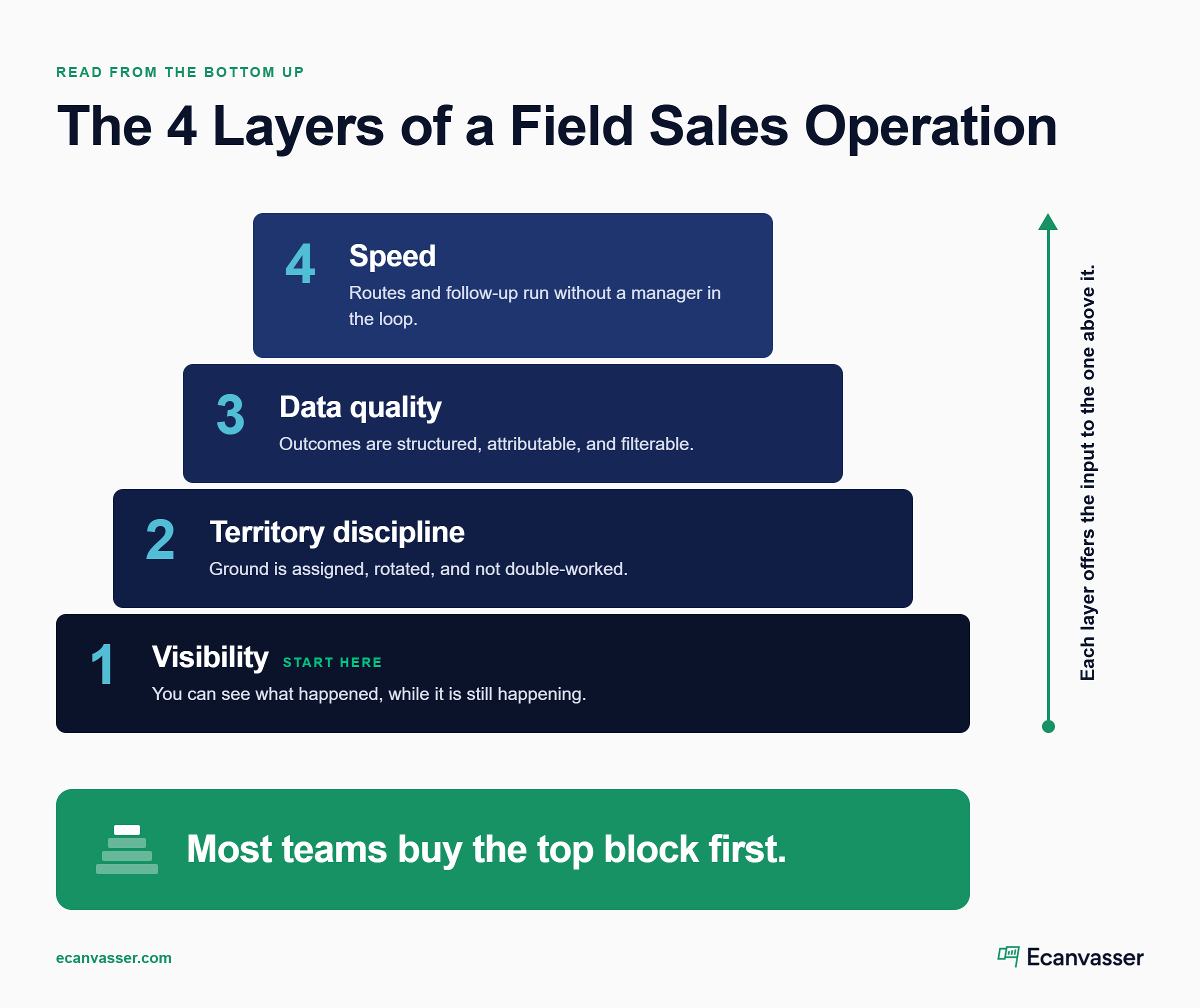
Neither of these two layers will impress anyone in a board meeting. They produce no demo moment, they are not what a vendor leads with, and they are the reason the other two layers work at all. If your team is stuck, the honest answer is almost always here, not further up the stack. Both are also the layers where the fix is operational rather than technological, which is why they get skipped.
Visibility is a latency problem, not a surveillance one. The point is not watching your reps. The point is that the answer arrives before you have to make the decision. Your system should be able to answer three questions without anyone having to go and ask:
A manager who has to chase those answers is already a week behind whatever went wrong. Real-time field tracking closes that gap by attaching outcomes to locations as they happen.
eir, the Irish telecommunications operator, runs a field sales team of more than 500 people. Before moving to Ecanvasser, they assigned territory lists weekly by spreadsheet. Reps worked overlapping areas with no coordination, and managers found out about problems at the end of the week rather than during it. Time-bound digital list assignments removed the overlap and replaced end-of-week reconstruction with live daily progress. The change that mattered was not better reporting. It was that decisions could be made on Tuesday instead of Friday.
Activity is doors knocked. Coverage is whether the ground got worked properly. Your team can post record activity numbers while leaving a third of a territory untouched and knocking another third twice inside a fortnight.
Structured rotation prevents exactly that. It stops a team burning through its best doors in the first two weeks, then working a depleted patch for a month while the numbers slide. Territory management sets the boundaries, and time-bound lists control when each one opens and closes without a manager reassigning anything by hand.
A door knocked too soon after the last knock is not a neutral event. It is a negative one, and it removes that address from your addressable set for months. Your territory is a finite asset, and it depletes at a rate you control. Treat over-knocking as a scheduling decision with a cost attached rather than a courtesy issue, and the case for rotation makes itself.
"We love real-time tracking and reporting so we know that we only knock on the doors of the houses we can service and we can see whether we knocked them last week, last month or six months ago. We can then make a schedule to reduce over knocking and get that timing right for potential customers" Emma Pearce, Head of Marketing, Lightning Fibre
These are the two layers you came here for. They are also the two that get bought first and only deliver last, which is the inversion at the center of this whole article. Neither one is difficult once the ground beneath them is stable.
Data quality is decided at the moment of capture, not in the reporting layer. Structured fields with consistent options beat free text every time, and not because free text is lazy. Free text cannot be counted.
The test is simple. If you cannot filter on it, it is a note, not data.
A sequencing point gets missed here. Outcome data only means something once you can attribute it to a stable territory assignment. Fifty "not interested" logs tell you nothing if you cannot say which streets they came from. Or whether two reps were working the same block. Clean capture feeding dashboards and reports is what turns a week of activity into a decision you can defend.
Now, and only now, speed. Two automations move a field team's numbers more than anything else:
A UK field marketing agency running fiber campaigns moved to structured territory rotation and real-time field tracking. Over six weeks, weekly sales climbed from as low as 80 to 90 to a consistent 300 or more.
The tripling came from territory structure, not from more reps or more hours. Our guide to field sales enablement software covers the full buying framework for this layer, including what to ask in a demo.
Hiring is probably the first lever you reached for. It is also the one most likely to make things worse. Headcount multiplies whatever process you already have, including everything leaking out of it. This is not a people problem, and it is not a motivation problem.
Say a fifth of rep time goes to reconstructing what happened rather than making something happen. That is a fixed proportional tax. Adding ten reps buys ten reps' worth of selling and ten reps' worth of the tax. The tax compounds, because reconciliation work grows with the number of people generating it.
At ten reps, a manager holds the whole operation in their head, and the leak is invisible. At forty, there is no head big enough, and the same proportional gap is four times the absolute cost. Our field sales manager guide covers what breaks at each of those thresholds.
Adding reps to a process that already leaks is the most expensive way I know to find out you had a process problem. You never discover it at ten reps. You discover it at forty, when the same gap costs four times as much.
Adding software is the standard response to a productivity problem, and it reliably makes things worse. Each tool was justified on its own. None of them were justified together.
Gartner's 2024 survey of B2B sellers found that half feel overwhelmed by the amount of technology their job requires. Overwhelmed sellers are 45% less likely to attain quota.
Consolidation is not a cost exercise. It puts the four layers in one place, so data moves between them without a person carrying it from one system to the next.

You have the sequence. What you need is your position in it, and that takes about an afternoon to establish. Here’s how.
Work down the table. Stop at the first row where the honest answer is no.
The first no is the layer you are on. Everything above it is premature, and money spent there will not return until the layer below is fixed. That rule is worth more than any tool comparison. Skip it, and you will buy the fourth layer three times.
{{faq-1}}
{{faq-2}}
{{faq-3}}
{{faq-4}}
Find the lowest layer that does not hold, and fix that one. Not the one your team complains about loudest, and not the one with the best demo.
There is a commercial point buried in the sequence too. Acceleration that costs more per rep every time you hire is not acceleration, it is a rising bill with better dashboards attached.
Work out what your current setup costs as you scale with our ROI calculator. Or start a free trial, and we will walk through which layer your team is on.
Field sales acceleration is the practice of increasing the qualified conversations a rep has per shift, and shortening the delay before your business acts on what was learned. It covers four layers in sequence: visibility into field activity, disciplined territory assignment, structured data capture at the door, and automation of routing and follow-up.
Sales acceleration was built for inside sales, where the constraint is moving known opportunities through pipeline stages faster. Field teams do not start with opportunities. They start with addresses, and their binding constraint is how many qualified doors a rep can reach in a shift. The frameworks look similar on paper and optimize different things in practice.
Your CRM records what happened. It rarely owns territory assignment, route sequencing, or GPS-verified activity logging, which are the layers acceleration actually depends on. Most teams run both: a field platform that owns execution on the ground, feeding clean data into the CRM that owns pipeline and reporting.

Ecanvasser’s real-time tracking completely transformed our field operations. Through the dashboard, we can plan efficient routes, customize interactions, and monitor our canvas stops in real time to support our team the second they need help. The "verified drops" feature adds an extra layer of accountability, while the reporting tools make it seamless to track hourly visit rates and optimize performance on the fly.




Scale your operations, empower your reps, and deliver predictable, profitable growth with Ecanvasser.