Short on time?
Pick an AI to summarise this article:
Pick an AI to summarise this article:



Your second market opened six weeks ago. You did the sensible thing and copied the structure that already worked. Same roles, same ratios, a manager you promoted from the first team. Both dashboards look healthy.
Then a customer calls to complain that two of your reps knocked on her door in the same week. Neither of them worked for the same manager.
The structure you copied was built to describe who does what inside one team. It was never asked to describe where one team stops and the next one starts. Nothing in it says who owns the three streets where the two territories meet, so nobody does.
This guide is about that second problem. It assumes you already run a working field team. If you are still building the first one, start with our guide to building a field sales team that scales.
What follows covers the four structural models and how each behaves when two of them run side by side. Then span of control and what it actually measures, how to divide one map between several teams, and how separate brands share a playbook while reporting separately. Knowing how to structure a field sales team stops being a question about an org chart at this point. It becomes a question about a map.
Almost everything written about sales team structure describes one team getting bigger. Add a manager around six reps. Specialize around fifteen. Bring in operations support past twenty. That advice is sound, and it runs out at a predictable moment: when a second team exists.
Inside one team, structure answers who does what. One manager holds the whole picture, so gaps get closed informally before anyone notices them.
Across two teams, structure has to answer a different question: who goes where. That is a question about ground, and nobody is holding the picture anymore. A distributed sales team rarely fails because the model was wrong. It fails because the model was never asked to describe a boundary.
Three questions arrive the day your second team starts work.
The first two are territory questions, covered below under dividing one map. The third is a playbook question, and it comes after that.
Inside sales absorbs a weak sales org structure because everyone is in the same room. A manager overhears half a bad call and fixes it before lunch. None of that is available to you.
Alexander Group's benchmark data shows how big the difference is. Inside sales models let a manager carry 20% to 80% more reps than field models do, because in-person supervision does work that structure otherwise has to do.
In field sales, structure does the job that physical proximity does everywhere else. Put two teams in two cities, and you have removed that proximity twice over.
Adding a second team changes the job. Structure stops being an org chart and becomes a set of rules about who goes where. Those rules usually get written down about a year later than they should.
Four models come up in every guide to sales team structure, so we cover them properly here. Which is best in the abstract is not a useful question, because the answer changes with your deal size and your cycle.
The useful question is which one survives being run twice, side by side, on adjacent ground. A sales organization structure can work beautifully in isolation and fall apart the moment its twin opens next door, usually for the same reason: the model has no vocabulary for its own edges.
The rep runs the full cycle inside a defined area. Prospect, pitch, close, retain. No handoffs.
Island passes the test better than any other model, because the repeating unit is small. One rep, one patch. A second team means more patches, and the design does not change to accommodate it.
The weakness is the one everybody names. Your ceiling is your weakest rep, and across two teams that compounds, because you now have two managers with two different tolerances for it. Island fits under about ten reps per team.
The process splits by stage. Canvassers set appointments, closers run them, account managers keep the customer.
Inside one team, a handoff is a process problem, and you tune it. Between two teams, it becomes an ownership problem because the canvasser and the closer report to different managers and are measured on different numbers.
Appointment quality drops, closers complain about wasted drive time, and nobody owns the drop. The canvassing manager is hitting their appointments-set target. The closing manager is missing their close rate. Both are telling the truth. The fix is a single metric spanning the boundary, such as appointments that convert, reviewed by both managers in the same meeting.
A pod is three to five people who own a patch together, usually a prospector, a closer, and sometimes support. Quota is shared.
This model passes the test most cleanly, because a pod is portable. Staff one and you know how to staff five. A new market becomes a hiring exercise rather than a design exercise.
The trade-off is worth naming. Individual performance is harder to read inside a pod, and shared quota lets a weaker rep coast on a strong partner longer than you would like.
Teams organized by product line, vertical, or brand rather than by geography. This is the model other guides skip, and it creates the problem this article solves: two of your teams can legitimately want the same address.
It is the right call when the offers are genuinely different. Pest control and solar are not the same conversation, even at the same door.
It is the wrong call when one buyer is approached twice by the same parent company. To the customer, that reads as disorganization, and two different brand names make it worse, not better.
Here is how each model behaves once a second team is running on adjacent ground.
You want a number. The number that circulates is six to eight direct reports for a front-line field manager, and it is a reasonable place to start.
It is also close to meaningless on its own, because a span of control states what you expect a manager to do, not how many names fit under a box. Two managers with eight reps each can be doing completely different jobs. Build your sales team hierarchy on the job, not the count.
Four things move the number:
The player-coach case catches people out most often. You keep a quota on your best manager because they are excellent at selling, then wonder why coaching is thin. For what the role covers once the quota comes off, see our field sales manager guide.
The trigger is not a headcount. It is a time allocation.
Alexander Group puts average coaching time for first-line sales managers at 16%, roughly four hours in a forty-hour week, against a best-practice figure of 28%.
Four hours is not much to start with. If your manager carries fourteen reps, those hours have not been squeezed; they have gone, and coordination has replaced them. The observable symptom is a manager who cannot tell you what their reps did last week without pulling a report first.
"Ecanvasser gives us very good indicators of high performers versus low performers. It's very easy to see people that are out on time knocking doors, and people that aren't. It keeps everybody honest in the relationship." Alan O'Reilly, Head of Sales Optimisation, eir
A field manager coaches reps and owns coverage inside one area. A regional manager or director owns the boundaries between areas, whether the standard is applied the same way in each, and where the next team goes.
If your new layer coaches the same reps at one remove, you bought cost without capability. The test is whether that person can answer a question no front-line manager can, such as whether two areas differ because of the market or because of the manager. Our guide to the field sales director role covers the job once enterprise field sales pushes you past two layers.
Territory advice is written almost entirely at the rep level, where it largely solves itself within one team. One manager holds the map. When two reps drift into the same street, that manager notices within a day.
Nobody holds the map across two teams. The boundary has no natural owner, so it has to stop being a shared understanding and become a data property. A distributed sales team needs that boundary somewhere other than a meeting that happened in March.
A boundary described in a meeting is a memory, and memories degrade. A boundary drawn on the map inside the system your reps open every morning holds, because a rep cannot be assigned ground belonging to another team.
Three things make that real:
Without it, overlap stays invisible until a customer complains. Our guide to territory integrity across field teams covers enforcement, and territory mapping handles assignment.
"Ecanvasser has transformed the way we manage our field teams. Its mapping and data tools have given us clarity and control, making our operations more efficient and customer-focused. We have seen significant improvements in operational efficiency and team coordination since adopting the platform." Caellum Daly, Sales Administrator, Panda Recycling
Four decisions need to exist in writing before two teams share a map. They take an afternoon.
Skip these, and you do not avoid the decisions. You make each one individually, under pressure, in the middle of an argument about a specific address. For the rebalancing mechanics underneath them, see our sales territory planning guide.
Brand-based and vertical structures guarantee this case, so decide it in advance rather than case by case.
A workable rule: one team is the default owner of every address. A second team needs an explicit reason and a recorded handoff to take it on. When both have a claim, the tiebreaker is the customer's most recent contact date, not whoever asked first.
Recency wins because of what you are protecting. The risk is not internal fairness. It is a homeowner knocked on Tuesday being knocked again on Thursday by a different logo from the same parent company.
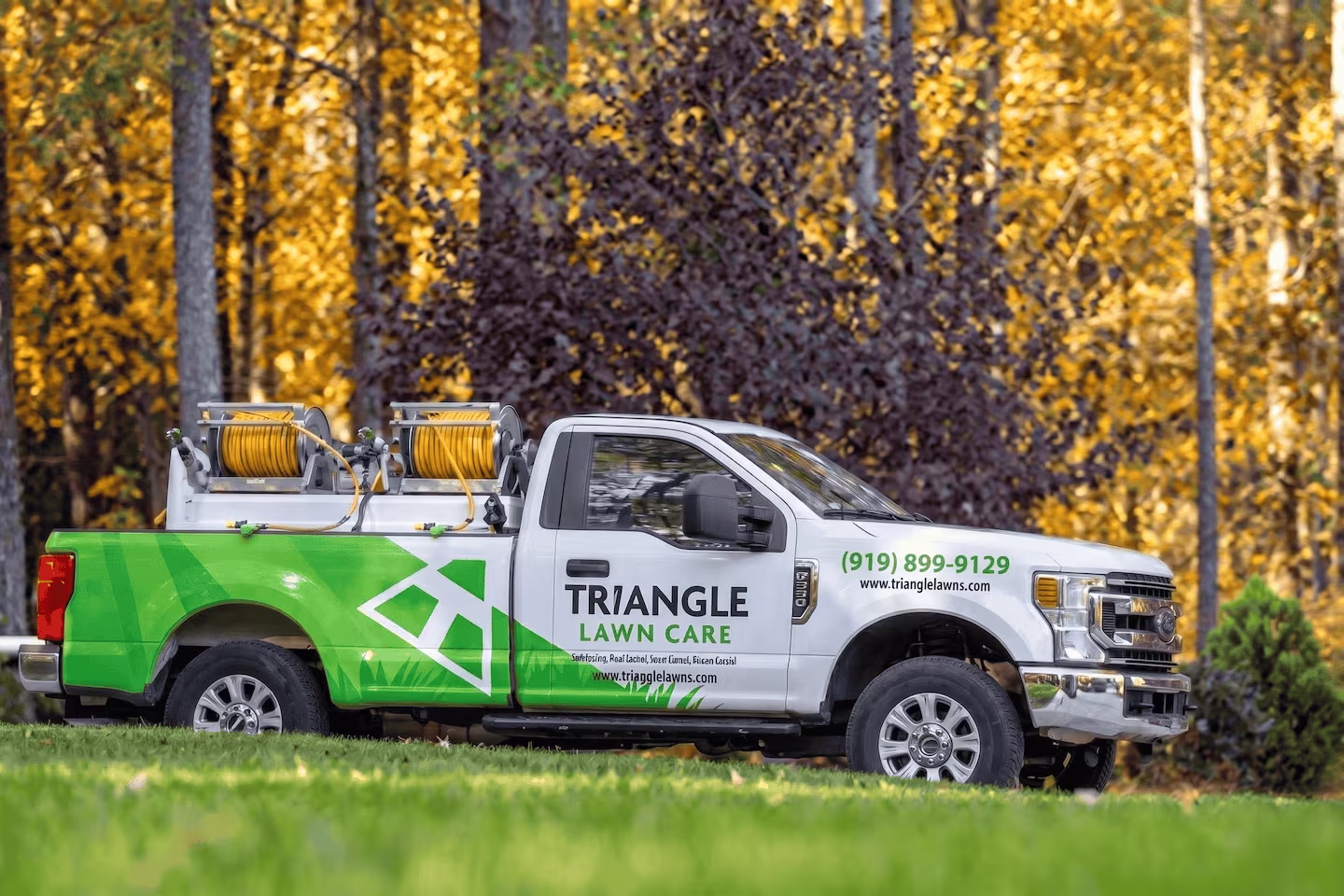
Triangle Home Services is the parent brand behind Triangle Pest Control, Triangle Lawn Care, and Triangle Pest Control. Running several teams through the same neighborhoods without duplicating outreach was one of the problems they named when building their door-to-door program. With real-time tracking and shared route planning they canvassed more than 20,000 homes in just over a month, and software costs stayed flat as the team grew.
Sharing a playbook and sharing a report are two different decisions, and running them together turns a multi-region sales structure into either chaos or bureaucracy.
Merge them one way and every brand invents its own process, so nothing is comparable. Merge them the other way, and you get one report nobody can act on. Franchise sales management gets this wrong more often than any other model, because the brands feel separate enough that separating everything looks obvious.
The dividing line is easier than it looks.
Same across every brand and region:
Set locally:
The rule underneath the split: anything feeding a number you compare across teams has to be identical, and anything touching the customer can differ, because markets differ. A close rate calculated two ways is not a close rate. Our field sales training framework covers teaching the central standard the same way in every market.
The instinct is to solve separate reporting with separate systems. One instance per brand, clean lines, no confusion. It works until somebody asks a question spanning both, and then it takes a week to answer.
The alternative is one data set with roles and permissions deciding who sees what. A brand manager sees their brand. A regional manager sees their region. A director sees it all live, without anyone exporting anything.
This is already how the platform works for field sales agencies, where data is separated by client while retaining agency-wide visibility. The architecture is identical for a multi-brand operator. See custom dashboards and reporting for the reporting layer, and our guide to outsourced field sales for the mixed agency and in-house case.
Resist launching three markets at once. You are not testing whether the product sells there, since you probably already know that. You are testing whether the structure survives being operated by people who did not design it.
Run the second market on the documented playbook alone, with no help from the team that built the first one. Give it six weeks. Whatever breaks is the part that was never actually written down, and it is cheaper to find in one market than in three. That is why Triangle's next market is a repeat rather than a rebuild.
A shared playbook is not the same as a shared report. The teams that expand well hold one standard for how the work gets done, and keep separate lines for how it gets counted.
You are probably not designing from a blank page. You are changing something while reps are still knocking, which is a different problem with a real cost attached.
That cost is paid mostly in the first two weeks, in confusion about who owns what and in the quiet dip that follows any change to how people are measured. Sequencing the changes reduces it, because not everything has to move at once.
It’s okay to shift up these things while in the midst of door-knocking:
Three things should not change in the same fortnight as a structural change:
The reason is simple. Move two variables at once and you will never know which caused the result, and the restructure gets blamed for whatever else went wrong. Change the structure, hold everything else still for six weeks, then read the numbers. If they moved, you know why.
{{faq-1}}
{{faq-2}}
{{faq-3}}
{{faq-4}}
The moment there is more than one team, structure stops being an org chart and becomes a description of ground. Who works where, who decides when that is unclear, and what happens at the edges.
Two decisions carry most of the weight when you work out how to structure a field sales team across markets. Write the boundary rules down before you need them, and keep the playbook decision separate from the reporting decision.
Ecanvasser lets several teams work one map without colliding: territory assigned from a map, role-based permissions so each layer sees what it should, and reporting that rolls up by region. It does not charge per seat, so adding a team or a management layer costs nothing in licenses.
Book a call to see how it handles your structure, or read more about Ecanvasser for enterprise field teams.
Six to eight is the working range for a front-line field manager. Push it lower if your reps are new, if the manager carries a quota, or if your process is undocumented. Push it higher when the pitch, the logging standard, and the weekly rhythm are fixed. Watch coaching hours rather than headcount, because that degrades first.
Put the boundary in the data instead of in a manager's head. Territory should be drawn on a map, assigned centrally, and visible to each rep as the only ground they can work. Then write down four rules in advance: how long an address stays with the first team, what happens when a lead goes cold, who owns a revisit, and how boundary changes reach reps mid-week.
When your front-line managers spend more of the week coordinating than coaching, or when nobody owns the boundaries between areas. The new layer should answer questions no front-line manager can, such as whether two areas differ because of the market or because of the manager. If it coaches the same reps at one remove, you added cost rather than capability.
Ecanvasser’s real-time tracking completely transformed our field operations. Through the dashboard, we can plan efficient routes, customize interactions, and monitor our canvas stops in real time to support our team the second they need help. The "verified drops" feature adds an extra layer of accountability, while the reporting tools make it seamless to track hourly visit rates and optimize performance on the fly.




Scale your operations, empower your reps, and deliver predictable, profitable growth with Ecanvasser.