Short on time?
Pick an AI to summarise this article:
Pick an AI to summarise this article:



A 30-60-90 day sales plan is a three-phase roadmap for a rep's first quarter, and nearly every version you can download was written for the rep rather than for you. It is a document a candidate brings to an interview, and it assumes a month of learning before anyone knocks a door.
Field sales does not run on that timeline. Your rep is working doors on day two, which means the first 90 days are not a learning curve. They are a proving period, and the person who needs the plan is you.
This guide is the manager's version. We cover the three gates that decide whether a rep continues, the numbers behind each one, a template you can copy, and the weekly rhythm that keeps it honest. It picks up from the point where your rep is already field-ready, so if you are still building that first week, start with our guide to onboarding sales reps and come back to this.
Those numbers are the part most guides leave you to invent, so here is a free tracker to work them out for you. It takes your existing reps' last quarter and turns it into the three thresholds this guide is built around.
These plans were built for inside sales, then handed to door-to-door teams with the labels changed. Three things break in the handover.
Field-ready means something specific, and you can reach it fast. Your rep knows their territory, follows the script through the three objections they will hear most, and logs an outcome correctly at the door. A day or two clears that bar, because the platform carries the turf, the route and the script instead of your memory.
So a standard plan spends its first 30 days on learning your rep has already done. That is a month of payroll with nothing to show for it. Use those 30 days to prove something instead: that your rep can work a territory all the way to the end.
Every field-specific plan online tells the new rep to research their top twenty accounts and schedule handover calls with inherited prospects. A residential rep has none of those. Their territory is a set of addresses, most never contacted, and their pipeline starts empty.
The real preparation looks like this:
Territory management handles all four before your rep leaves the office.
A rep-authored plan is a statement of intent. It is useful in an interview and decorative afterwards. What you need is different: thresholds agreed in advance that turn daily activity into a decision at day 30, day 60, and day 90.
Both can exist, and only one decides whether the hire works. A plan with no numbers in it is a hope with a deadline attached.
I have sat in enough day 90 reviews to know how they go wrong. The manager has a strong feeling about the rep and nothing to test it against, so the conversation becomes a negotiation about effort rather than a decision about fit.
Three questions decide a field hire. Can this rep cover the turf, can they convert it, and can they carry it without you? Each gate is a threshold with a real number behind it, and the section after this one covers where those numbers come from.
Coverage rate is the share of assigned addresses actually attempted inside the assigned window. It is not the same as doors knocked, and the difference is the whole point of this gate. A rep can post an impressive knock count while working the easy streets twice and leaving a third of the turf untouched.
Coverage comes first because it predicts everything after it. A rep who never finishes their turf will not generate enough conversations for their conversion rate to mean anything.
Watch two things alongside it. Are outcomes logged at the door, or reconstructed from memory at six o'clock? And does the GPS trail match the territory you assigned?
By now the volume exists, so the ratios start to say something. Contact rate and door-to-close ratio become readable, and you compare your rep against your own team's spread rather than any published benchmark.
Expect contact rate to reach team level before conversion does. Contact rate is largely a function of timing and route, both of which a new rep picks up quickly. Conversion depends on the conversation itself, which takes longer to shape.
That gap is useful. When contact rate has landed and conversion has not, the doors are opening and something in the conversation is losing them. The fix is the pitch rather than the turf. A rep can clear the first gate and fail this one, which is why they are separate gates.
The last gate is about self-management, which separates a rep who survives from a rep who scales. Carrying looks like this in practice:
This is the point where a pro-rated target becomes fair. Resist setting day 90 as a percentage of a fully ramped rep's revenue, though. Consistency across weeks is the more honest measure, and the one that predicts month four. A rep who hits target once and misses twice has not cleared this gate. Field sales training becomes the mechanism once a rep gets here.
Write the numbers down before your rep's first day. A threshold you agree after you have started forming an opinion about someone is not really a threshold.
Territory density, product, price point and season vary so much between field operations that a national average means very little at the door. Pull three numbers from your own last quarter instead:
The range matters more than the median, because your gate belongs near the bottom of it. A new rep sitting below your weakest tenured rep is the signal worth acting on. Field sales KPIs covers the wider menu.
Median tenure in sales and related occupations was 3.3 years in January 2024, against 3.9 across all occupations (U.S. Bureau of Labor Statistics). Your ramp window is a large slice of the relationship.
The standard 25, 50 and 75 percent quota ramp has a mechanical flaw. It pro-rates the output while ignoring that a new rep's input is also below full, so your rep is penalized twice for one thing.
Set the day 30 and day 60 gates on activity and ratio, both of which your rep controls directly. Hold revenue back until day 90, when there is enough volume for it to be fair. One caveat: a rep who ramps into a slow month looks worse than an identical rep who ramps into a good one, so index the gate to what your tenured team did in that window.
Your thresholds and your rep's plan should contain the same figures. Keeping them apart is how day 90 reviews turn adversarial, and sharing them costs you nothing.
In practice that means one shared document rather than two. Targets on the left, actuals filled in beside them at each checkpoint, and both of you looking at the same page. Your rep should never be surprised by a number you have held since before they started. It also changes how the checkpoint conversation opens, because there is nothing to reveal and nothing to defend.
Here is the part you came for. Most templates you will find elsewhere need every row rewritten before they fit a door-to-door team, because they are built around meetings and named accounts. This one comes in two halves: the page your rep holds, and the scorecard you read.
The full tracker is free and ungated, and its first tab turns your reps' last-quarter numbers into your three gate thresholds.
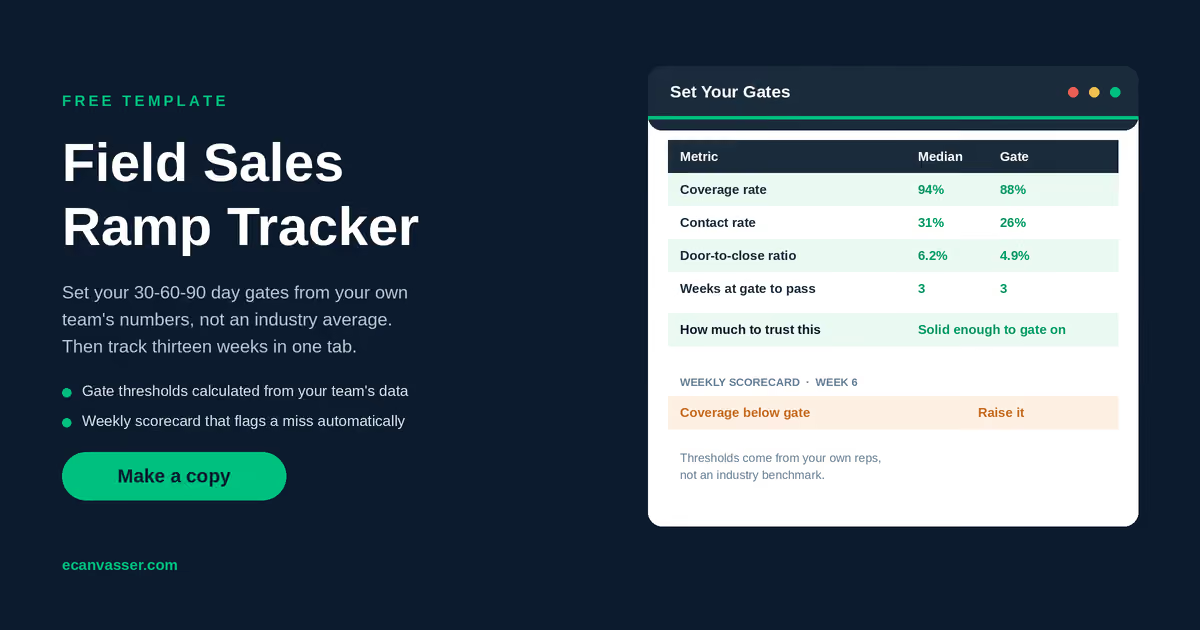
Fill this in with your rep on day one. Four things belong on the page alongside the table, and they are the four most commonly missing:
This is the half almost nobody publishes, and the one that does the work. Six checks, read weekly.
The whole thing should read from a dashboard in under five minutes. If it takes longer, you will quietly stop doing it around week three, and that is the real failure mode.
An experienced door-to-door rep does not need a different plan. They need a compressed one, and knowing what compresses is the whole skill.
What compresses:
What does not:
Halve the first gate window rather than removing it. Two weeks is usually enough to see whether a good rep from somewhere else is a good rep here. It costs almost nothing to find out properly. The temptation with a strong hire is to skip the gate entirely, and that is how a bad territory fit goes unnoticed until month three. Experience earns a shorter proving period. It does not earn an exemption from one, and the reps who have been doing this a decade are usually the first to say so.
Here is how it looks with real numbers attached. A home services company is adding a fourth rep to a suburban territory of roughly 3,100 serviceable addresses. Three tenured reps supply the benchmark. Coverage rates of 94, 91 and 88 percent, contact rates of 31, 29 and 26 percent, and door-to-close ratios of 6.2, 5.4 and 4.9 percent.
The manager sets each gate at the bottom of its range. Coverage 88 percent by day 30, contact rate 26 percent and door-to-close 4.9 percent by day 60, three consecutive clean weeks by day 90. All of it agreed in writing before the rep's first shift.
Day 30 goes well. Coverage lands at 91 percent, logging is clean, and conversion is still noise at that volume. Gate cleared.
Day 60 is the interesting one. Contact rate has climbed to 28 percent, comfortably past the gate. Door-to-close is stuck at 2.8 percent, well under. The turf has produced at team level for two years, so the territory is not the problem, and that combination points squarely at the pitch. The manager books a ride-along for the following Tuesday rather than a performance conversation.
By day 90, the ratio has moved to 4.6 percent. Still under gate, but the trajectory is right and three of the last four weeks cleared coverage and contact. The rep continues, with a revised gate at day 120.
The pattern I see most often is a rep whose numbers look fine in month one and fall apart in month two. It almost always turns out the coverage was never real, because the easy streets carried the first 30 days and there was nothing left underneath them.
A gate at day 30 is useless if nobody looks at the data until day 29. The rhythm below is deliberately short, because a cadence you cannot sustain is worse than none.
Results in the first fortnight are noise. Habits are signal, and they set fast, which is why this fortnight gets more of your attention than any other in the 90 days.
Look at whether outcomes are logged at the door or batched at six o'clock, whether the turf is worked in a sensible order, and whether addresses are being skipped. Bad logging habits embed within about three days, so this review runs daily at first and can drop to weekly by the end of week two. Real-time field tracking means you can do it without ringing your rep mid-shift. Book the first ride-along for week two, once you have a baseline worth watching against.
Both conversations run the same way, in this order:
Opening with the number rather than the verdict changes the temperature of the whole conversation. It only works if you shared the thresholds in advance, which is why the previous section insists on it.
This is the judgement that matters most, and the one managers get wrong under pressure. Compare your rep's ratios against the team spread and the territory's own history.
Three patterns come out:
A UK field marketing agency moved onto Ecanvasser and more than tripled sales performance. Weekly sales went from as low as 80 to 90 up to a consistent 300 or more, over six weeks. Attrition dropped to 23.1 percent against a typical campaign rate of 32 to 34 percent. That window maps almost exactly onto the first two gates.
You rarely hire one at a time, and a plan that only survives being run once is not a system.
Three things change when three or five reps start the same week:
A cohort is actually easier to judge than a solo hire, because the reps become each other's control group. When four reps start on the same turf type in the same month, and one is well behind on coverage, you are not guessing about seasonality. Time-bound lists make the assignment side a few minutes of work.
Triangle Home Services, parent brand behind Triangle Pest Control, Triangle Lawn Care and EnviroCon Pest Control, built a door-to-door operation from scratch. They scaled it past 20,000 homes canvassed in just over a month. They coordinated multiple teams without overlap using real-time tracking and route planning, and their software costs stayed flat as headcount grew.
The question I get asked at this point is always about cost, and it is the right question. If your ramp plan assumes you can hire four reps at once, but your software bills you four more seats to do it, the plan quietly becomes a plan to hire one.
Ecanvasser prices on leads rather than per user, so a cohort costs the same to run as a single hire.
The first 90 days are not a curriculum. They are three decisions, and what makes those decisions possible is having the activity data before the moment you need it. A gate you cannot measure is just a date in your calendar.
Start with the free ramp tracker if you want your gates calculated for you. If you would rather size what your current ramp is costing first, the ROI calculator does that in a couple of minutes. And when you want coverage, contact rate and logging timeliness on a live dashboard instead of a spreadsheet, book a 15-minute consultation.
{{faq-1}}
{{faq-2}}
{{faq-3}}
{{faq-4}}
Ecanvasser does not charge you more for growing. If you want to scale without getting punished for it, learn more about our field sales platform.
It is a three-phase structure for a new rep's first quarter, split at day 30, day 60 and day 90. In field sales the phases are proving stages rather than learning stages, because reps work doors within a day or two of starting. Each carries a threshold set in advance: coverage of the sales territory first, then conversion, then self-management. A business development hire follows the same shape, with accounts in place of doors.
Keep the presentation to one page, and bring a printed sample rather than talking through it. Talk about territory density, route efficiency and coverage rather than meetings booked. Say what you would measure in each phase, and admit you would refine the numbers once you had the team's data. Hiring managers notice when a candidate asks what their tenured reps' ratios are.
No. In the first month a rep does not have enough volume for a revenue figure to be fair, and your director of sales will get a more honest read from activity. Set the day 30 gate on coverage and logging discipline, which your rep controls directly. Bring revenue in at day 90, once there is enough activity behind the number to mean something.

Ecanvasser’s real-time tracking completely transformed our field operations. Through the dashboard, we can plan efficient routes, customize interactions, and monitor our canvas stops in real time to support our team the second they need help. The "verified drops" feature adds an extra layer of accountability, while the reporting tools make it seamless to track hourly visit rates and optimize performance on the fly.




Scale your operations, empower your reps, and deliver predictable, profitable growth with Ecanvasser.