Short on time?
Pick an AI to summarise this article:
Pick an AI to summarise this article:

.svg)

Let’s say a hailstorm rolls through on a Tuesday night. By Friday, there are eight companies working the same subdivision, and three of them have already knocked on the house your rep is standing at.
You know the pitch matters. But what really decides your results is whether your crew is on the right streets, in the right order, and if anyone knows which doors have already been worked.
NOAA's Storm Prediction Center logged 5,432 major US hail events in 2025, up from 5,373 the year before. Meanwhile, UK insurers paid out £244 million for storm damage to homes in 2025, a 32% rise on the year before.
Demand is rarely the constraint in roofing. Hint: it’s coordination.
This guide covers what to say on a roofing porch, including the conversation you have when you are the fourth knocker that week. It also covers the part almost nobody writes about: running the neighborhood as a campaign rather than a pile of unrelated knocks. For teams selling into home improvement, that shift is usually where the money has been hiding.
Roofing does not behave like solar or broadband, and the generic door knocking playbooks miss it by a wide margin.
Three things set it apart:
Texas alone recorded 902 major hail events in 2025, more than double the next highest state, Kansas, at 375.
The reality is that demand clusters, and your crew should cluster with it.
The decisions you make the night before shape more of your week's revenue than anything said at a door. Every other roofing guide opens with the script. Start here instead.
Pull the hail and wind reports for the event. Overlay them on the areas you can actually service. Then rank streets by damage density rather than by how close they sit to the yard.
Roof age matters as much as the storm did. A twenty-year-old roof with moderate exposure beats a five-year-old roof that took a direct hit.
The trap is working outward from wherever the truck is parked. It feels efficient. It is not. Build the ranked list first, then let route planning turn it into a day without dead driving between stops.
Some addresses should never get a knock. Renters cannot authorize a roof. A home re-roofed three years ago is a conversation, not a lead. An HOA community with hard no-soliciting enforcement will cost you a rep for the afternoon.
Here is why that matters more than it sounds. A rep who knocks 60 unqualified doors looks identical on a dashboard to a rep who knocks 60 good ones. Activity numbers on their own will point you at the wrong person.
"We love real-time tracking and reporting so we know that we only knock on the doors of the houses we can service." - Emma Pearce, Head of Marketing, Lightning Fibre
Solicitation permits vary by municipality, and plenty of places require one before your first knock. Some HOAs ban door knocking outright.
Getting shut down mid-shift costs you a day and hands the neighborhood to whoever did check. Keep permit status inside the territory record, not in one manager's head. The person who knows is never the person on the street at four in the afternoon.
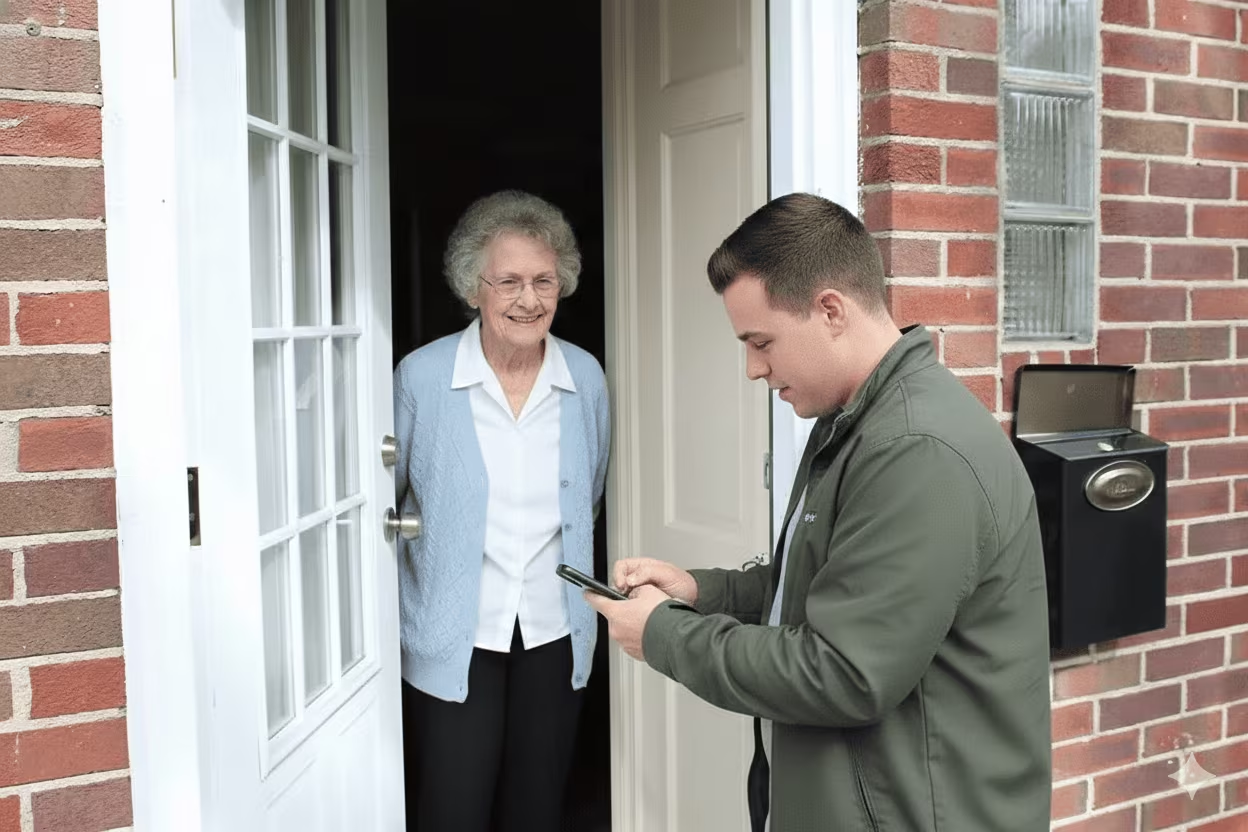
Your opener has one job, and it is not closing. It is starting a conversation. What separates you from the four reps before you is a specific detail about their roof you can point at from the driveway. Every door-to-door pitch example in this guide is built on that.
Name the storm. Name the street or a neighbor. Then name something you can actually see.
"Hi, I'm Sarah with Summit Roofing. We're working on the Callahans' roof over on Sycamore after last Tuesday's hail, and I noticed you've got granule loss along your south-facing slope. Mind if I take a look while I'm here?"
Ask for the look, not the contract. And book the inspection on the spot instead of promising a callback, because a scheduled appointment survives the evening and a promise rarely does.
The strongest thing you can say on a roofing street is that you already did a roof on it.
Reference recent local work without overclaiming, and never name a customer who did not agree to be referenced. The catch is operational. Your reps need to know which addresses your company has actually worked, and on most crews that lives in one estimator's memory.
"Hi, I'm Dan with Ridgeline. We finished a roof two streets over on Oakfield last month, and we're back doing another one on this side. Yours looks similar to the ones we've been replacing round here. Want me to tell you where it's at so you can drive by and check it out?"
Acknowledge the traffic instead of pretending it is not happening.
"I'm guessing I'm not the first person at your door this week. I'm not going to ask you to decide anything today."
Then differentiate on permanence and documentation rather than urgency or price. Storm chasers compete on urgency. You do not have to.
Most reps lose money on the roof, not at the door.
A rep who finds damage on one slope quotes that slope. The homeowner gets a patch, you book a small ticket, and nobody looks at it again for six years.
Three things usually justify a full replacement. Your reps should be able to recognize all three:
Then say the honest version out loud. If a repair really is the right call, sell the repair. Reps who oversell replacements are the reason the storm chaser stereotype exists, and your reputation on that street outlives the ticket.
Plenty of roofing companies knock in markets that rarely see hail, including most of the UK and Ireland, where wind does the damage and no insurance clock is running.
Others knock between events, because a crew that only works storms sits idle most of the year.
Retail replacement is a different sale. Treating it like a storm sale is why most reps quietly give up on it.
Target by age, not by damage. There is no swath to map. What you have instead is build year. A subdivision built in the late nineties is now a street of roofs at the end of their service life. All of them installed within about two years of each other. Filter your lists by build year and you have a territory without a weather event.
Build the pitch on wear the homeowner can verify. Granule buildup in the gutters. Curling at the ridge. Badly patched fascia. Point at something, then offer to tell them how long they have.
"Your roof looks like it is coming up on the end of its life rather than failing. I would rather you knew now than after a leak. Want me to tell you roughly how long you have got?"
Expect a longer cycle. No claim means no deadline, and no deadline means this is almost always a two visit sale. Judge retail territories on revisit yield rather than first knock close rate. A street that looks dead on day one often pays in month two.
The standard objection lists are real but incomplete. Roofing has its own, and pushing hard on any of them is exactly how companies end up in the storm chaser bucket.
Reps handle these better when the language is written down. Our canvassing script guide covers building that without turning your team into robots.
Most of the money you lose after a storm is lost between reps rather than at doors.
Three failures do most of the damage: knocking the same house twice, missing streets entirely, and letting the not-home list die quietly. All three are territory problems.
I see the same pattern on almost every growing roofing team. Managers add reps to fix a revenue problem, and coverage gets worse rather than better, because nobody owns the map. Scaling effort without scaling structure just multiplies the chaos.
Turf handed out in a group chat at 8 am has drifted by lunchtime. Two reps work the same block. The homeowner decides your company is disorganized, or worse, that one of you is not really from your company.
Assign at street level, with boundaries a rep can see on a map. Give each assignment an expiry so it returns to the pool at the end of the shift. Time-bound lists handle that automatically.
Make it visible to everyone. Turf that lives in one manager's head is not a system.
Most of your neighborhood is sitting in the not-home pile right now, and most crews never go back to it in any organized way.
After a storm, the homeowner is filing a claim inside a narrow window. A second pass at a different time of day, inside that window, converts very differently to a cold first knock.
Treat revisits as scheduled work, not something reps do with a spare hour. Nobody ever has a spare hour.
Your headcount triples after a storm and shrinks again by November. Twenty reps with no shared standard produce coverage that looks fine on a headcount report and full of holes on a map.
Standardize what gets captured at the door before they arrive. Keep day one simple. Then verify logged activity against location with real-time field tracking. Seasonal spikes punish per-seat pricing too.
Triangle Home Services built a door-to-door program from nothing, running several teams in the same neighborhoods. Inside just over a month, they canvassed more than 20,000 homes, with software costs staying flat as headcount grew.
Doors knocked, close rate, and knock-to-deal ratio all measure the rep. None tell you whether the street was worth working.
Four numbers a manager actually looks at beat twelve nobody opens.
[blockquote] "The daily, weekly, and monthly reports save me a tremendous amount of time. We get monthly reports back with the number of doors knocked, the number that answered, and the number of sales. That allows me to look at the conversion ratios and know how the team will perform based on previous data." - Neil R, Head of Residential Sales
Weekly is a coaching review at rep level. Per storm is a territory postmortem: which swaths paid, which streets got over-covered, how fast you reached the worst damage.
Run only the weekly review, and you never learn anything about targeting. Custom dashboards make the second review possible, and our field sales KPIs guide covers the wider metric set.
Panda Recycling hit a spell of unusually high demand across the UK and Ireland. Rather than add people, they reorganized territories in real time, cut overlap, and brought response times down. Same problem you face the week after a hailstorm, different industry.
The teams I see keep growing past a couple of crews are the ones that treat territory data as the strategy rather than the admin. Meanwhile, the ones that stall are usually still measuring how busy everyone looks.
Most tips on how to sell roofs door to door assume you already know what you are doing. Here is the honest version.
You will hear no far more often than yes, and that ratio is not a verdict on you. Most of your first season revenue will come from second and third conversations, not first knocks.
Build a fixed daily routine and protect it. A steady 50 doors every day beats one heroic 90-door Thursday followed by three flat ones.
Log every single door, including the bad ones. When your manager reviews performance, the rep with a complete record is the rep who can prove where the time went. That habit is most of what separates people who last from people who quit in October.
{{faq-1}}
{{faq-2}}
{{faq-3}}
{{faq-4}}
Your pitch matters. It is not what separates the crews that make money from the crews that burn a neighborhood.
Coverage discipline is. Knowing which streets to work, in what order, and which doors are already knocked will move your numbers further than another round of script practice. That is a boring answer. It is also the one that survives a bad week and a crew that doubled in size overnight. To see what that looks like against your own headcount and territory, start with our ROI calculator.
If you’re looking for the most scalable, ROI-centric field sales platform, book a free 15-minute demo of Ecanvasser.
Somewhere between 40 and 60 qualified doors is a realistic target for a full shift, though the qualified part carries most of the weight. Sixty knocks on renters and new roofs is a wasted day that looks productive on a report. Track contact rate alongside the raw number so you can tell the difference.
Yes, and the days immediately after a storm are usually the highest value knocking you will do all year. Homeowners have damage they cannot see from the ground and a claim window that is already running. The constraint is rarely demand. It is getting your crew onto the highest damage streets before six competitors do.
Frequently, yes. Many municipalities require a solicitor's or peddler's permit, and requirements change from one town to the next inside the same metro. Some HOA communities prohibit knocking regardless of what the city allows. Check before the crew deploys and store the permit status with the territory, not in someone's inbox.
Ecanvasser’s real-time tracking completely transformed our field operations. Through the dashboard, we can plan efficient routes, customize interactions, and monitor our canvas stops in real time to support our team the second they need help. The "verified drops" feature adds an extra layer of accountability, while the reporting tools make it seamless to track hourly visit rates and optimize performance on the fly.




Scale your operations, empower your reps, and deliver predictable, profitable growth with Ecanvasser.