Short on time?
Pick an AI to summarise this article:
Pick an AI to summarise this article:



A solar pipeline can look healthy and still close slowly. Homeowners often request quotes from several installers, take weeks to compare them, and many never sign. Every one of those leads still cost you money to win.
Whether you sell in the US, the UK, or Canada, incentives come and go, ad prices climb, and homeowners almost always compare quotes before they commit.
The ideas in this guide don't depend on incentives, because incentives can disappear. Instead, they focus on two things every homeowner cares about: lowering their electricity bill, and what their neighbors are doing. These ideas also show you how to get more leads from the homes you've already installed.
When I look at where a solar team's best leads came from, the answer is usually pretty close to home.
They start a few streets from a finished install, or with a friend of a happy customer. Those leads rarely show up on a marketing dashboard, so they rarely get a budget line.
Below are 11 solar marketing ideas, grouped by where the lead starts: your existing customers, your digital channels, in-person events, and the door. The last section shows how to measure which ones are paying for themselves. If you want detailed doorstep tactics and pitches, our guide to door-to-door solar sales covers them separately.
Your marketing can cost more even if your team is doing everything the same way. When an incentive ends, fewer homeowners enter the market, but the number of installers competing for them stays roughly the same. With more companies chasing each buyer, every channel you pay for gets more expensive.
The US is the clearest example this year. The 30% federal Residential Clean Energy Credit, known as Section 25D, no longer applies to new installs. According to the IRS instructions for Form 5695, it can't be claimed for expenditures made after December 31, 2025. For homeowners buying their own system, that credit is gone.
Wood Mackenzie projects US residential solar customer acquisition costs will rise 40% this year as a result. That would take them from a five-year low of $0.60/W in 2025 to $0.84/W.
The same analysis describes how stronger installers are responding. They're planning around the full value of each customer over time, instead of treating the first sale as the end of the relationship. In practice, that means building referral programs, adding products like batteries, and relying on their own sales teams rather than buying expensive leads.
Each of those solar marketing strategies depends on customers you've already won or reps you already employ. They also hold up in the UK and Canada, where installers face the same pressure whenever a grant, loan, or export payment scheme changes. That's why the ideas below start there. For a channel-by-channel look at the costs behind this shift, see our breakdown of what each lead channel really costs.
A finished install gives you four things to work with. There are panels the neighbors can see, a customer who can refer friends, a strong candidate for a battery, and a potential review.
If your follow-up stops at a referral card at handover, most of that value goes unused. The three ideas in this section cover all possible lead sources, with referrals and reviews handled together because they share the same timing.
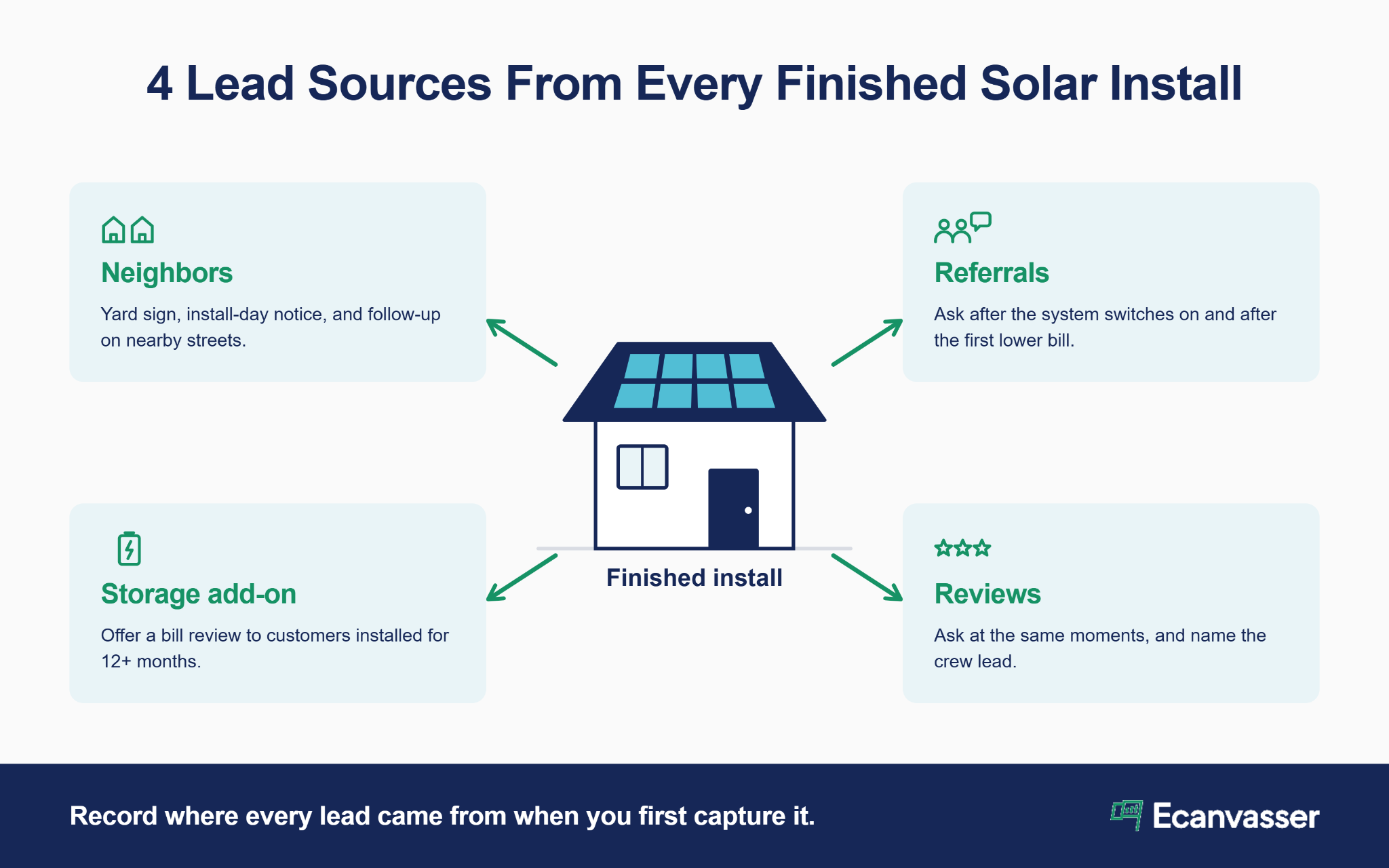
Solar tends to spread street by street, because seeing panels on a neighbor's roof makes the decision feel more real. A homeowner who once wondered whether solar works starts asking whether it would work for their own house.
Research supports this pattern. Lawrence Berkeley National Laboratory found that peer effects drive rooftop solar adoption for both high- and low-income households. Those effects were stronger within income groups than across them.
The income finding is useful for targeting. Your best follow-up prospects are homes similar to the one you just finished. Verified homeowner data and a well-built homeowner lists strategy help you find them.
Give every install the same simple routine:
A field team can draw a territory around each install, so those streets get worked as part of the plan. A good place to begin is the ten installs you completed most recently, since those neighbors have seen your crews most recently.
Most referral advice focuses on how big the reward should be. It says much less about how to tell whether the program is working, which is the part that lets you improve it.
Timing comes first. Ask at the two moments when the system's value is easiest to see. The first is PTO (permission to operate), when the utility approves the system and it switches on. The second is when the first lower bill arrives. Use both moments to ask for a referral and a review, and ask for another review after any service visit.
To improve a solar referral program, you need to know who referred each lead, when they did it, and whether the referred home signed. When a referred lead comes in, record the referrer's name in a dedicated field in your system rather than in free-text notes. Do this whether the lead arrives by web form, phone call, or a rep's tablet at the door. With that field in place, you can calculate the program's cost per install the same way you would for any other channel.
If I had to choose, I'd run a referral program with a modest reward and a tracked source over a generous one nobody can attribute. Without the source, you don't know which customers are worth asking again.
Reviews matter for the same neighbors you're trying to reach. Someone who sees your yard sign will probably look you up before calling, and your reviews shape whether they pick up the phone. Mention the crew lead or rep by name in your request. That makes the review more likely to describe a real person and read as genuine. Keep the request short, with one text, one link, and a sentence on why it matters. For example: "It helps your neighbors find a local installer they can trust."
Reply to every review, including critical ones, because prospects read your responses as well as your rating. A calm, specific reply to a complaint about a delayed install can reassure a prospect more than another five-star review.
Your past customers are also a market for your next product. EnergySage reported that homeowner interest in battery storage reached 76% in the first half of 2026, its highest recorded level. Actual storage attachment lagged at 31%.
Existing customers are the least expensive place to close that gap. They already trust you, and their roof work is done. Changes like time-of-use rates, fixed charges, and net metering rollbacks also give them a new reason to look at storage. After a year, a customer can see what their system produces. They can also see what they still pay for power in the evening, after the panels stop generating.
Try a short campaign for customers whose systems have been running for more than a year. Send a production report or offer a bill review, and use that conversation to bring up batteries.
Your website, ads, and search presence still matter, but the message they carry needs to change. When incentives shrink or change, the homeowner's current electricity bill is the strongest reason to act, and it should anchor your solar lead generation online. For a fuller comparison of channels you pay for each month versus channels you build and own, see our guide to home services lead generation.
Savings are now the main reason people buy. EnergySage (2026) found that 70% of contractors in its 2026 Electrification Contractor Survey said customers purchase solar to save money.
Build city or utility-specific pages and ads around local electricity rates, with a worked bill example and the assumptions shown. Then review every live asset, including ads, landing pages, scripts, and door hangers. In the US, remove any line promising a federal credit on a homeowner-owned system. That claim is no longer accurate. A homeowner who reads one story in your ad and hears another at the kitchen table is unlikely to sign. Repeat the review whenever a state, provincial, or national incentive program changes.
US installers should also be precise about leases and power purchase agreements (PPAs), where a third party owns the system. These can still connect to a federal credit, but the credit belongs to the system owner, not the homeowner. That option has a deadline as well. Under IRS Notice 2025-42, solar systems that began construction after July 4, 2026, must be placed in service by December 31, 2027, to qualify. Your ads should say exactly which product they describe and shouldn't promise a credit at all.
When someone searches "solar installer near me," Google shows a short list of local businesses on a map above the regular results. That list, often called the map pack, decides which installers get the first calls.
Your Google Business Profile drives your place in it, so treat the profile as a portfolio of local work:
Ideas 1 and 2 feed directly into this, since each install can add a new photo and, eventually, a new review. Assign the profile to a specific person, because a profile updated at launch and then left alone falls behind competitors who post every week. Ten minutes after each install, with a photo and the name of the town, is enough to keep it current.
Your sales team hears the same questions every week, and those questions make strong website content. Start with these:
Honest answers on your site make consultations shorter, because homeowners arrive already understanding the basics. They also help poor-fit prospects rule themselves out before a rep drives across town.
Ask your reps which questions come up most, since they hear concerns that never get typed into a search bar. Publish one answer a week, link it from the matching local page, and send it to new leads before their appointment. Keep each answer specific to your area by naming the utility, the rate plan, and the town, and update it when rates change.
Solar is a large, high-trust purchase, and trust builds faster in person. Face to face, a homeowner can ask an awkward question, see how you respond, and judge whether you'll still answer the phone in five years. There are two ways to get in front of homeowners in person, and it helps to plan them together.
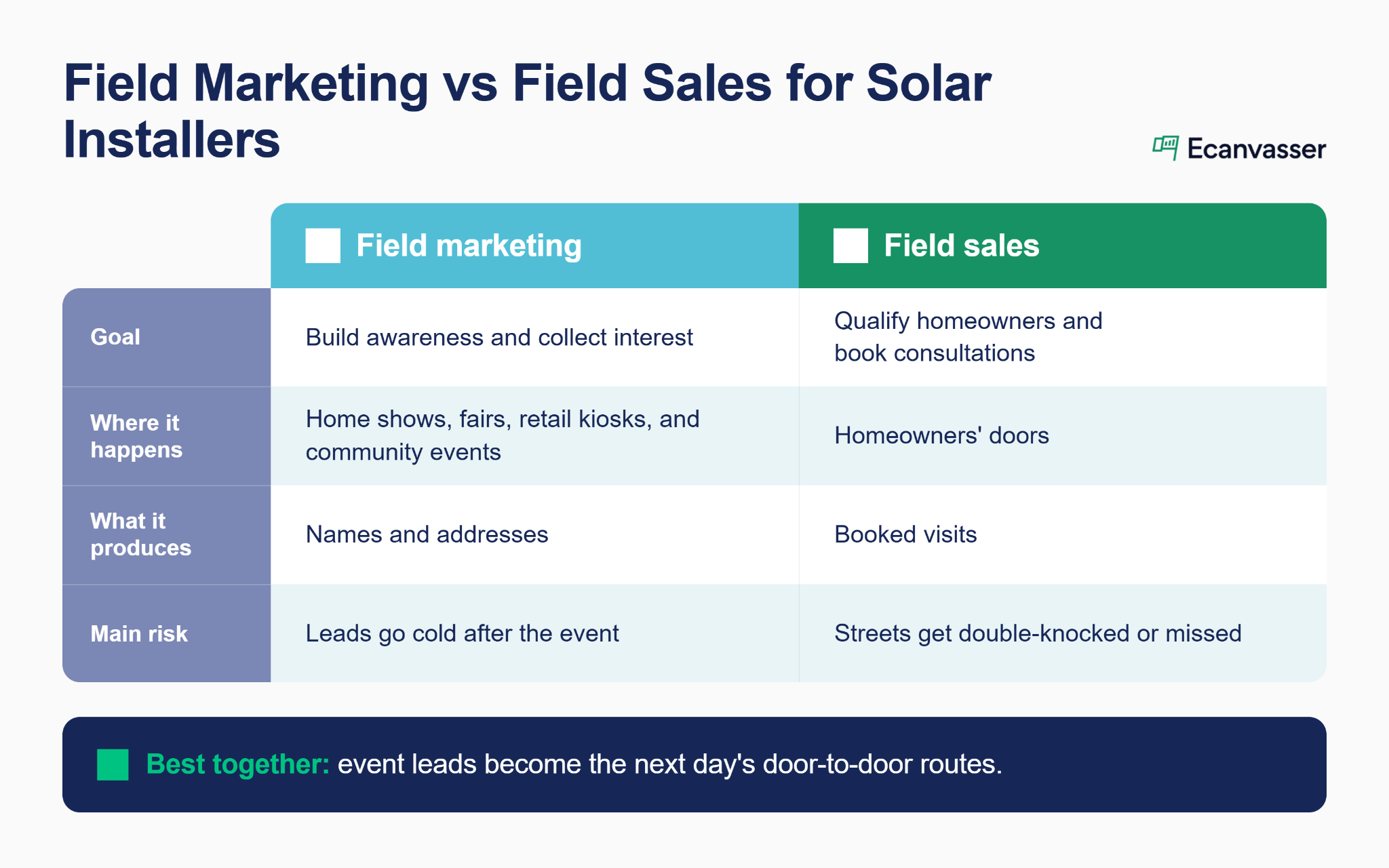
Field marketing builds awareness and collects interest in person, at home shows, county fairs, farmers markets, retail kiosks, community events, and sponsorships. Field sales goes to the homeowner to qualify them and book a consultation, which for solar usually means going door to door. Field marketing produces names and addresses, and field sales follows up on the streets around them.
The two work best when they feed one system. If event leads sit in one list and door-to-door leads in another, you end up with two definitions of a lead. You also lose any reliable way to tell which channel produced an install. That's why the software requirements are the same for both. Any field marketing software you use should capture leads offline, at a booth or at a door. It should save them in consistent fields rather than as handwritten notes.
A busy event can leave you with a long list of names, and two weeks later half of them may have gone cold. Event leads are usually lost in the follow-up, so plan that follow-up before you set up the booth.
Capture each lead on a phone or tablet using the field sales app. Record the event name as the lead source, along with the address, monthly bill range, and best time to visit. Then book the visit from the rep's phone before the homeowner leaves the booth.
Because each lead has an address, you can map an event's leads and group nearby homes together. That lets a single rep follow up on a cluster in one shift. For guidance on how quickly to make that first contact, see our guide on how fast you reach a new lead.
"Before switching to our field sales software, a lot of teams were on pen and paper. That led to inconsistent data and plain human error when it came to remembering and recording information." Jay Lipscomb, Customer Success Manager, Ecanvasser
Panels on a church, school, or busy local business are visible to everyone who passes, every day, for years. Lawrence Berkeley National Laboratory (2023) found that non-residential installations are associated with faster residential adoption nearby. The effect was about 0.4 additional residential adoptions per quarter for each non-residential system, and it continued over time.
Treat each commercial or community job as a local campaign. Ask the owner for permission to add signage and publish a short case study. Offer to co-host an open house or information evening at the building, then target the surrounding residential streets afterward. Neighbors who have been looking at those panels for months will then have a local installer's name to connect with them.
If you don't do commercial work, consider partnering with a commercial installer or a local nonprofit that already has panels.
These contractors often reach your future customers first. A homeowner replacing a roof or upgrading an electrical panel is already thinking about the house and its long-term costs. That makes it a natural moment to raise solar.
Keep the arrangement simple. Agree on a referral fee for each signed install, and give partners co-branded materials to leave with their customers. Set up a shared way to log referred addresses, so both sides can see which referrals converted. Give each partner an easy way to send a lead from the job site, such as a short form or a dedicated phone number.
Make the relationship work in both directions. When you find a roof that's too old for solar, refer that homeowner back to your roofing partner. Start with one partner in each trade, and meet once a quarter to review the referred addresses together. Partnerships that nobody reviews tend to fade by the second season.
A field marketing agency can make sense in a few situations. You might want to test events or door-to-door in a new territory, cover a seasonal peak, or staff retail kiosks your team can't.
The main risk is the data. Agencies usually run their own tools and use their own definitions, which makes their results hard to compare with your in-house channels. Address this in the contract. Require the agency to work in your platform for the length of the test, using your outcome categories and lead-source fields. Agree on the test length and how you'll measure success before it starts, so the final decision rests on numbers rather than impressions. Our guide to field sales agencies covers the broader decision of whether to outsource or build your own team.
Every idea so far creates places worth visiting: streets around your installs, addresses from a home show, and homes near a community rooftop. Someone still needs to follow up in person. The last idea connects them.
A door-to-door team turns ideas 1, 7, and 8 into booked consultations. That's why it works best as part of your solar marketing plan rather than as a separate program. Its cost per install also behaves differently from paid channels. Ad prices rise when competitors bid against you, while a field team's cost per install falls as your reps get better at the work.
Our door-to-door solar sales guide covers street targeting, the doorstep conversation, and how often to revisit. The marketing questions are where to start, how to staff the team, and how to keep costs steady as it grows. Start in one market and prove the model there before you expand. Avoid making the whole channel depend on a single new hire.
"Teams that succeed take ownership. Sometimes I see them fail because they hire someone new to start a team and put all their eggs in that basket." Thomas Hollingsworth, Enterprise Account Executive, Ecanvasser
Triangle Home Services, a home services company rather than a solar installer, shows what a measured launch looks like. The parent brand behind Triangle Pest Control, Triangle Lawn Care, and EnviroCon Pest Control built a door-to-door program from scratch in Raleigh. Within just over a month, they had canvassed more than 20,000 homes and hired a full rep team, with software costs flat as headcount grew. They now plan to take the same playbook to Houston. Read the full story.
Flat costs matter in solar, where headcount rises and falls with the season. See how Ecanvasser supports solar field sales teams with territories drawn around completed installs, roof photos captured at the door, and unlimited reps.
Any of these ideas can generate plenty of activity while costing more per install than it should. To see which ones are working, you need to know where each lead came from.
Record the source the moment you first capture a lead, whether it arrives through a web form or a rep's phone. The source might be a yard sign, a named referrer, a home show, your Google Business Profile, a door-to-door visit, or a trade partner. Then, each quarter, compare your cost per signed install by source. Cost per lead can look good on a channel whose leads rarely sign, so the signed install is the better measure. Cut the sources that cost too much and put more into the ones that work. For the math behind the field channel specifically, see our guide to field sales ROI.
When I sit down with a solar team, my first question is which channel produced their last ten signed installs. If it takes more than a minute to answer, the budget is being set by guesswork.
One residential installer we worked with added a required lead-source field to every place they captured leads. That included reps' phones and the tablet at their home show booth. After a quarter, streets near recent installs were booking more consultations than their purchased lead lists, at a fraction of the cost per install. They moved part of their purchased-lead budget into yard signs, install-day notices, and two additional reps working those streets.
You don't need to launch all eleven ideas at once. Three steps will give you a solid start:
Want to see what a field channel could add to your numbers? Run your own figures through our ROI calculator, or start a free 7 day trial.
{{faq-1}}
{{faq-2}}
{{faq-3}}
{{faq-4}}
Learn more about how Ecanvasser can help transform your solar field sales team.
There's no single best channel, but your existing customers are usually the least expensive place to start. Their neighbors, their referrals, and their interest in batteries all cost less to win than a cold lead. Your paid and digital marketing should focus on what solar does for a household's electricity bill. A field team can then follow up in the neighborhoods where you already have installs.
Ask when customers can see the results for themselves, such as when the system switches on or when their first lower bill arrives. Make the request short and easy to act on. Most importantly, record who referred each new lead, so you can see which customers refer, which referrals sign, and what the program costs per install.
Field marketing creates awareness and gathers interest in person, through events such as home shows, fairs, and retail kiosks. Field sales visits homeowners directly to qualify them and book appointments, usually by going door to door. Solar installers get the most from both when event leads feed directly into door-to-door routes, and both channels record leads in the same system.
Ecanvasser’s real-time tracking completely transformed our field operations. Through the dashboard, we can plan efficient routes, customize interactions, and monitor our canvas stops in real time to support our team the second they need help. The "verified drops" feature adds an extra layer of accountability, while the reporting tools make it seamless to track hourly visit rates and optimize performance on the fly.




Scale your operations, empower your reps, and deliver predictable, profitable growth with Ecanvasser.