Short on time?
Pick an AI to summarise this article:
Pick an AI to summarise this article:

.svg)

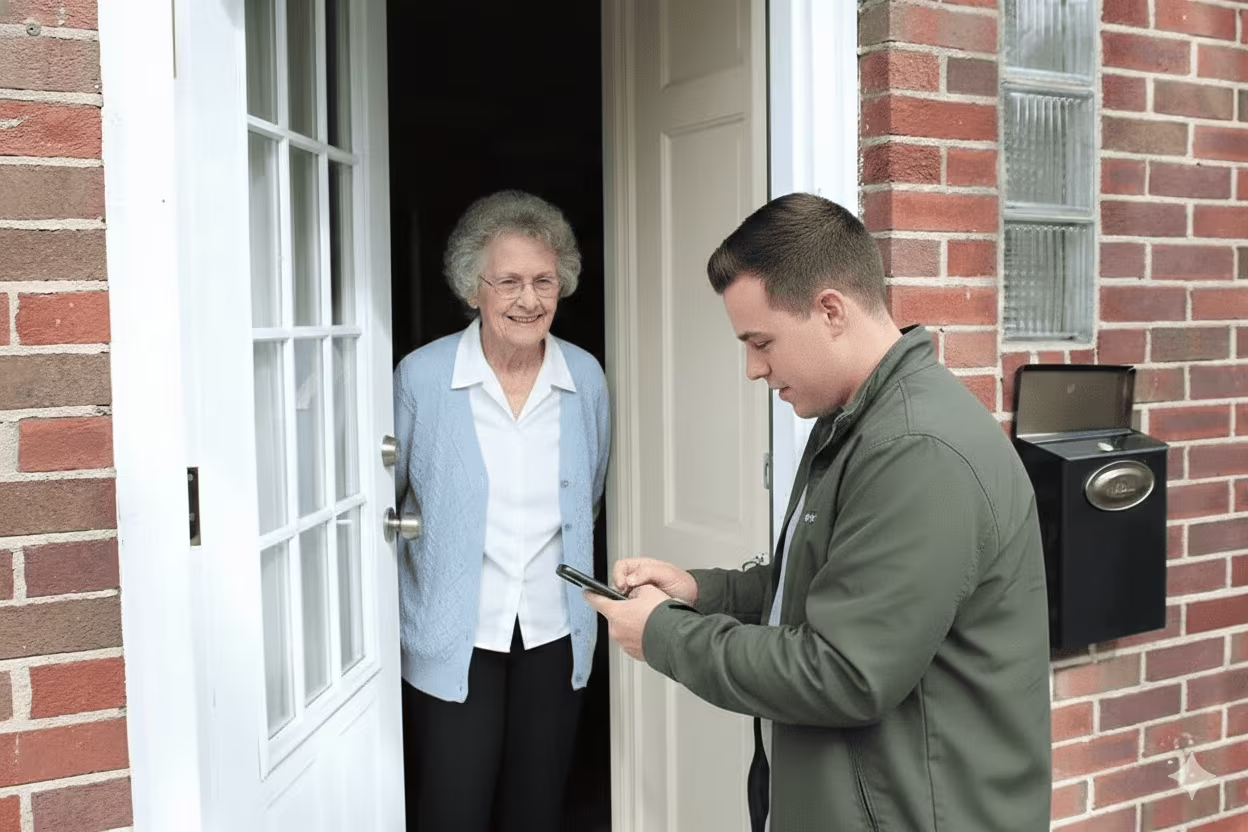
Your rep had a good Saturday. Sixty doors, twelve real conversations, four homeowners who said they were interested and meant it.
Two weeks later, none of them has booked a sit-down. Nobody can tell you which street they were on. The rep has moved three neighborhoods away.
That gap is where solar programs lose their revenue. In other door-to-door verticals, the sale happens at the door or not at all. Solar almost never closes on a doorstep. The homeowner needs a roof assessment, a financing conversation, and usually a second person in the room.
Only 7% of US homeowners have installed solar panels. Another 28% say they have seriously considered it.
The UK picture has the same shape. Among owner-occupiers, 10% already have panels and 52% say they would consider installing them in the next few years.
In both markets the considering group dwarfs the installed one, and hardly any of it converts on a first knock.
This guide is for the person running the program, not the rep working it. Selling solar door to door is an operation, not a set of conversations. We will cover street targeting, the doorstep, the maybe pile, coverage, and the four numbers that show whether a territory pays.
If your reps still open with the federal tax credit, they are promising something that no longer exists.
The Residential Clean Energy Credit under Section 25D no longer applies to expenditures made after 31 December 2025. Public Law 119-21 ended it in July 2025. For a homeowner buying their own system, the 30% credit is gone.
Tell your team plainly. Any homeowner who has read about solar for ten minutes already knows. A rep who glosses over it does not save the deal. They lose it later, at the sit-down, when the real numbers contradict what was said at the door.
Here is what should carry the conversation instead:
The market has tightened too. US residential solar is forecast to contract 21% in 2026 after the credit expiry, returning to growth from 2027.
A contracting market is when a well-run field channel pulls away from a badly run one. The margin for wasted doors disappears.
The biggest lever on your rep's day gets pulled before they leave the car park.
Street selection stacks three layers:
A street can pass all three and still waste a Saturday, because it was knocked six weeks ago.
Hand your reps addresses, not areas. A rep given a map area spends their first hour scouting. A rep given a filtered list spends it selling. Build it on:
Ownership sits first for a reason. A renter cannot buy, and your rep usually discovers that three minutes into a conversation that was never going anywhere. No script fixes it.
Roof consistency does more work than people expect. When a street was built to a handful of designs, your rep carries one rough set of numbers down the whole road. No recalculating at every door.
Recent home sales matter for a different reason. New owners reassess their bills early, so they are already asking the question your rep came to answer.
More solar days are wasted on the wrong street than on the wrong words. A rep knocking eighty doors in a rental-heavy neighborhood will outwork a rep knocking forty owner-occupied doors and still lose.
Lead Prospector handles the filtering, so the list arrives ready instead of being rebuilt by hand each week.
A visible array on a neighbor's roof does more persuasive work than any opener you can write. It answers the trust question before your rep speaks.
The mistake is treating that as a happy accident. Draw a micro-territory around every completed install and assign it while the memory is fresh. This works only when your install data and canvassing data sit on one map.
Two of your reps working the same street costs more than the wasted hour. In solar, the homeowner remembers, because the first conversation was long. Disciplined assignment needs three things:
Territory management is where this lives. Solar adds a wrinkle: assignment has to survive weeks, because your reps will revisit. Whoever knocked first owns the return.
Lightning Fibre, a UK internet provider, hit this in a different vertical. Their reps knocked across areas the service did not yet reach. Mapping serviceable properties and tracking knock recency meant they targeted only qualifying addresses. Read the full story here.
Your rep is not there to sell a system. They are there to earn a scheduled sit-down with everyone who makes the decision. Twenty minutes of talking without a booked time is a bad conversation.
Lead with something local and specific, and never lead with solar. Ask a question that invites a yes, and make it clear you are not asking for a decision today. Here are two openers that work:
There are also two openers your reps should stop using. The first is any version of "you can get 30% back from the government," which is no longer true for a homeowner buying their own system. The second is anything that opens with panel wattage or inverter brands, because it tells the homeowner your rep is more interested in the product than in them.
Keep your scripts in the app rather than on paper. When an incentive changes, you can update every rep on the same day.
Your rep is not going to close on the doorstep, so the conversation has to be judged on what it produces instead. That is a booked appointment and a small set of facts about the household. The facts matter as much as the appointment, because they decide whether the sit is worth holding and whether anyone can do anything useful with the lead if the sit falls through.
The list below is short on purpose. Five answers is what a rep can collect without the conversation turning into an interview, and it is enough to qualify almost any residential solar prospect. Make it the standard for every door, not just the promising ones.
Those answers are worthless in a notebook. Capture them as structured fields at the door. Then you can pull every household that owns their home, pays over a threshold, and said spring. The field sales app takes utility bill photos and roof images, so an estimator can qualify a roof without a second visit.
Your reps will hear dozens of objections, but four of them account for almost every conversation that stalls. The rest are usually versions of these, or they are polite ways of ending a conversation the homeowner had already decided to end. Train against these four and your reps will handle the others by instinct.
Give that last one more space than the rest. It most changes how your reps pitch solar panels this year, and an objection a rep cannot answer accurately kills the follow-up.
Six reps working full weeks will generate one to two hundred open, genuinely interested households inside two months.
Almost none said no. Almost none have bought. This pile is where your revenue is sitting, and it is invisible on any dashboard that counts only doors and sales.
Nobody signs a five-figure contract on a doorstep, and your reps are not failing when they do not get one.
The decision involves two people, a financing conversation, a roof nobody has thought about in years, and a comparison quote. That is a property of the product. Managers who treat the delay as a rep problem coach the wrong thing.
With the federal credit gone, the urgency lever your team leaned on has weakened. Expect timelines to stretch. If the decision runs across weeks, your system has to hold information across weeks.
Confirm the next step while your rep is still standing there. A specific date and time, not "I'll call you."
Interest decays fast. A rep who leaves without a booked time is relying on a callback that competes with everything else that week. A good booking captures more than the slot: who else needs to be present, and how they prefer to be contacted.
The appointment scheduler does this from the rep's phone. The manager-side benefit matters more. When appointments live centrally, you can see what is overdue and reassign the day a rep leaves.
"We love real-time tracking and reporting so we know that we only knock on the doors of the houses we can service and we can see whether we knocked them last week, last month or six months ago. We can then make a schedule to reduce over knocking and get that timing right for potential customers." - Emma Pearce, Head of Marketing, Lightning Fibre
A cadence is a system you set up once, not an intention you renew every Monday. Most teams have the intention. What they lack is anything that survives a busy week, a rep leaving, or a manager going on holiday.
These three rules make it work:
Time-bound lists handle the third rule. Lists appear when the return is due and disappear when the window closes.
Doors knocked is an activity number your rep controls. Coverage is a territory number you control. It asks what proportion of assigned addresses has been worked, and what happened at the rest. That matters more in solar, because a territory gets worked more than once.
Ask your managers what percentage of last month's territory was covered. If they cannot answer, the reason is that a not-home is ambiguous. It is neither a refusal nor a conversation, so unless it is logged distinctly, it vanishes. Real-time field tracking supplies the data underneath.
Start tracking one number this month: assigned addresses with a logged outcome, divided by total assigned addresses, per territory. Not-home has to be its own disposition for that figure to mean anything. A territory at 60% coverage with a strong conversion rate is not good. It is unfinished.
The teams I see scale past a handful of reps treat an unfinished territory as a debt rather than a decision. Moving on early always feels like momentum, and it is almost always why the numbers stop making sense two months later.
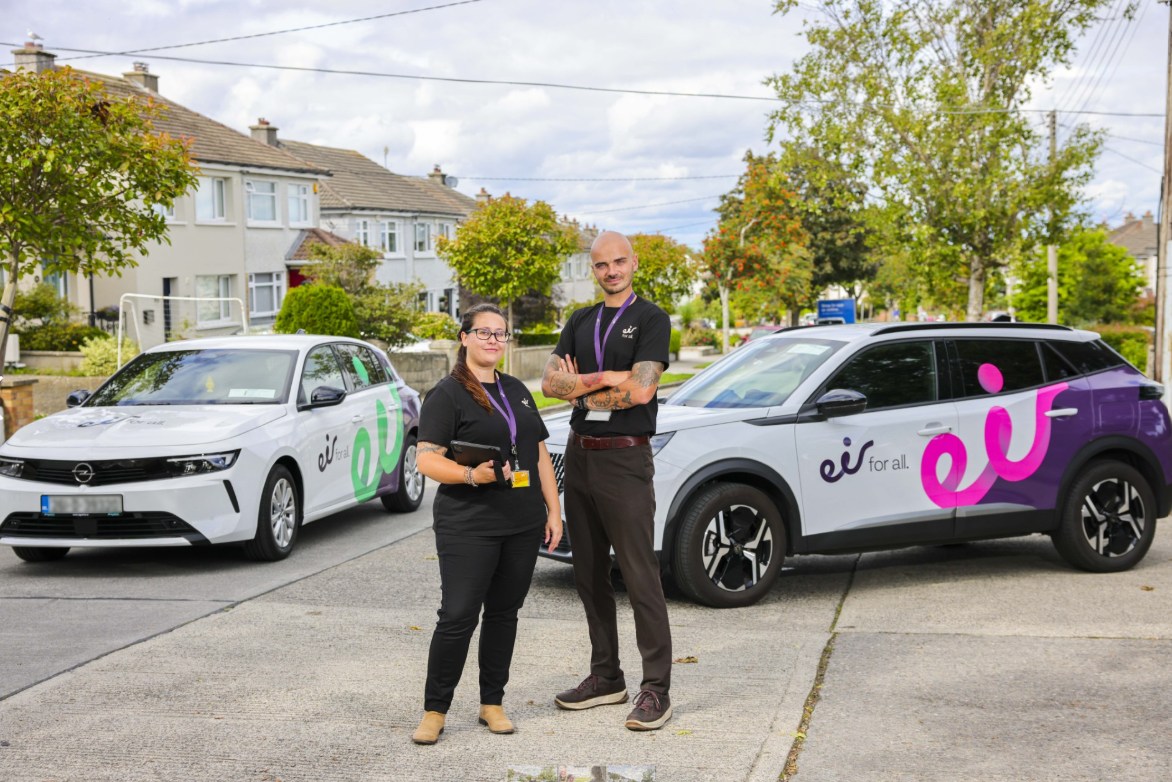
"Ecanvasser gives us very good indicators of high performers versus low performers. It's very easy to see people that are out on time knocking doors, and people that aren't. It keeps everybody honest in the relationship." - Alan O'Reilly, Head of Sales Optimisation, eir
The same household can be knocked by three companies in a month, and by your own team twice. That second visit from the same brand is worse than a first from a stranger. Track when a door was last worked and by whom, then set a minimum interval. One field, two jobs.
You are probably tracking a dozen metrics and acting on none of them.
Four numbers, watched per territory rather than per rep, will tell you almost everything. Read them in order, because each isolates a different failure:
Dashboards and reporting will assemble them once your dispositions are clean.
"There is accountability for sales reps. We can see how they're doing in terms of field tracking, and having that bird's-eye view and insight into the team is really valuable." - Peter S, Team Leader , Hyperoptic
Your contact rate. When it drops, the cause is almost never the rep.
It is timing or targeting. Solar reps want owner-occupied households with daytime jobs, which is the profile least likely to answer at two on a Tuesday. Weekday evenings and weekend late mornings do disproportionate work. When this number is weak, change the schedule before the script.
The most diagnostic of the four, and the most coachable.
A rep having plenty of conversations and booking few sits has a closing-the-step problem. One ride-along will show you what it is. The usual cause: explaining solar at the door instead of booking the sit.
Weakness here points past your field team.
It signals qualification quality or the proposal process, not doorstep skill. If your sits are held with households nobody properly qualified, the fix is at the door, not at the table.
The number your owner cares about and your managers rarely see.
Solar headcount swings hard with season and incentive cycles. The real question is what this number does when your team doubles for a season. Per-seat software pricing pushes it the wrong way as you scale.
Solar has high turnover and seasonal headcount swings, so anything in one person's head leaves when they do. A program that depends on your best rep is a rep.
Day one, a new rep meets all of this inside the app:
A rep who has to ask a colleague how to sell solar here is a rep your system failed. Our guide to onboarding sales reps goes deeper.
Run this before your next seasonal hiring push:
Contractors get cut from a per-seat budget first, which leaves them outside the system. That is how holes appear in coverage data.
Triangle Home Services canvassed over 20,000 homes in a month from a standing start, with software costs flat as the team grew. Read the full story.
"When we merged with another broadband company, it was just so easy to onboard new staff, knowing that there wasn't going to be an extra cost, because we have unlimited licenses. We got them on board straight away, tested it, and got them using the software as quickly as possible." - Scott Kean, Field Sales Manager, Truespeed
You came looking for a better solar sales pitch.
The honest answer is that when you are selling solar door to door, the pitch is the least differentiated thing you control. Every competitor has a decent one. What separates the teams pulling ahead is duller and harder to copy. They decided which streets to work. They captured qualification that survived the doorstep. They built a revisit system that does not rely on anyone remembering.
Start with our ROI calculator to see what coverage and conversion gains are worth against your own headcount. When you want to see it running, book a 15-minute demo.
{{faq-1}}
{{faq-2}}
{{faq-3}}
{{faq-4}}
Ecanvasser doesn’t penalize solar companies as they scale. If you want to grow without constraints, book a free 15-minute consultation.
Yes, though the economics are tighter. Residential solar is forecast to contract 21% this year after the federal credit expired, so wasted doors cost more than in 2025. Teams that target streets on ownership and roof data, book sits at the door, and measure coverage still see the channel pay.
Lead with the electricity bill rather than the incentive. Section 25D no longer applies to homeowner-owned systems installed after 31 December 2025. Any script promising 30% back is inaccurate and costs you the deal at the sit-down. Train reps on what still applies locally: state tax credits, SREC markets, utility rebates, and third-party ownership.
Volume is the wrong target. A rep working a filtered, owner-occupied address list beats a rep knocking twice as many unqualified doors. Measure conversations rather than knocks, and coverage rather than daily door count. Build any shift target from your own contact rate.
You need one, and your reps should be able to leave it. A script is a checklist that stops reps forgetting the five qualification answers, not a monologue. Keep it in the app rather than on paper, so you can update it the day a state incentive changes. The best reps treat it as a floor, not a ceiling.
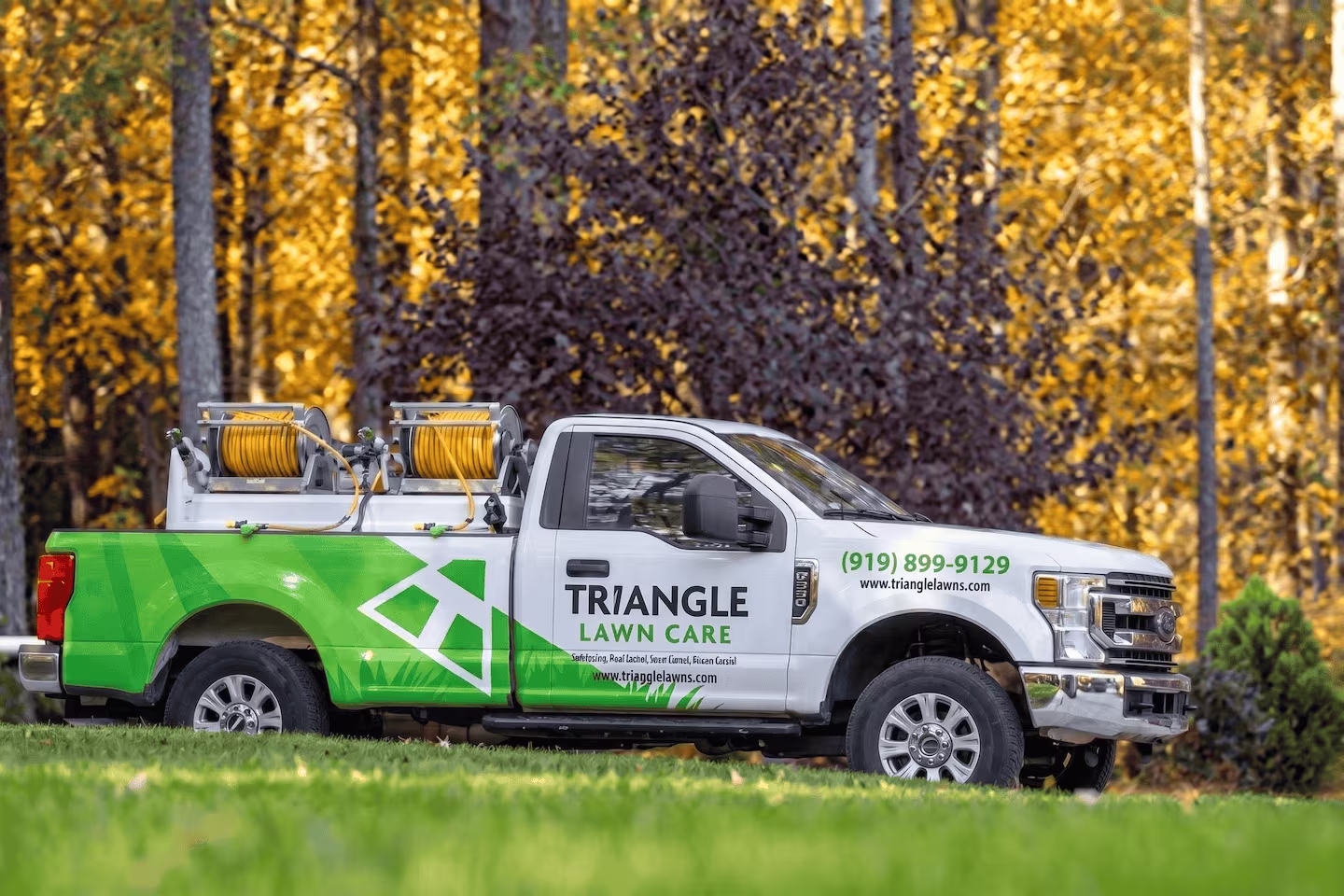
Ecanvasser’s real-time tracking completely transformed our field operations. Through the dashboard, we can plan efficient routes, customize interactions, and monitor our canvas stops in real time to support our team the second they need help. The "verified drops" feature adds an extra layer of accountability, while the reporting tools make it seamless to track hourly visit rates and optimize performance on the fly.




Scale your operations, empower your reps, and deliver predictable, profitable growth with Ecanvasser.