Short on time?
Pick an AI to summarise this article:
Pick an AI to summarise this article:



Is door-to-door canvassing even worth the budget anymore?
Digital acquisition looks cheaper on a spreadsheet. But every provider in your market is running the same paid search and retargeting playbook against the same shrinking pool of clicks.
Meanwhile, fiber buildout is still expanding, and most eligible homes haven't switched yet. A conversation at the door still closes deals your ads never will.
That doesn't mean any type of canvassing works. Telecom requires a tailored approach. Treating it like a generic playbook is how teams end up with disappointing take rates and a leadership team asking hard questions.
In this guide, I offer tips on how to structure a telecom canvass so it targets the right doors. I also cover the objections you'll hear most often, and how to pitch someone who already has service from another provider.
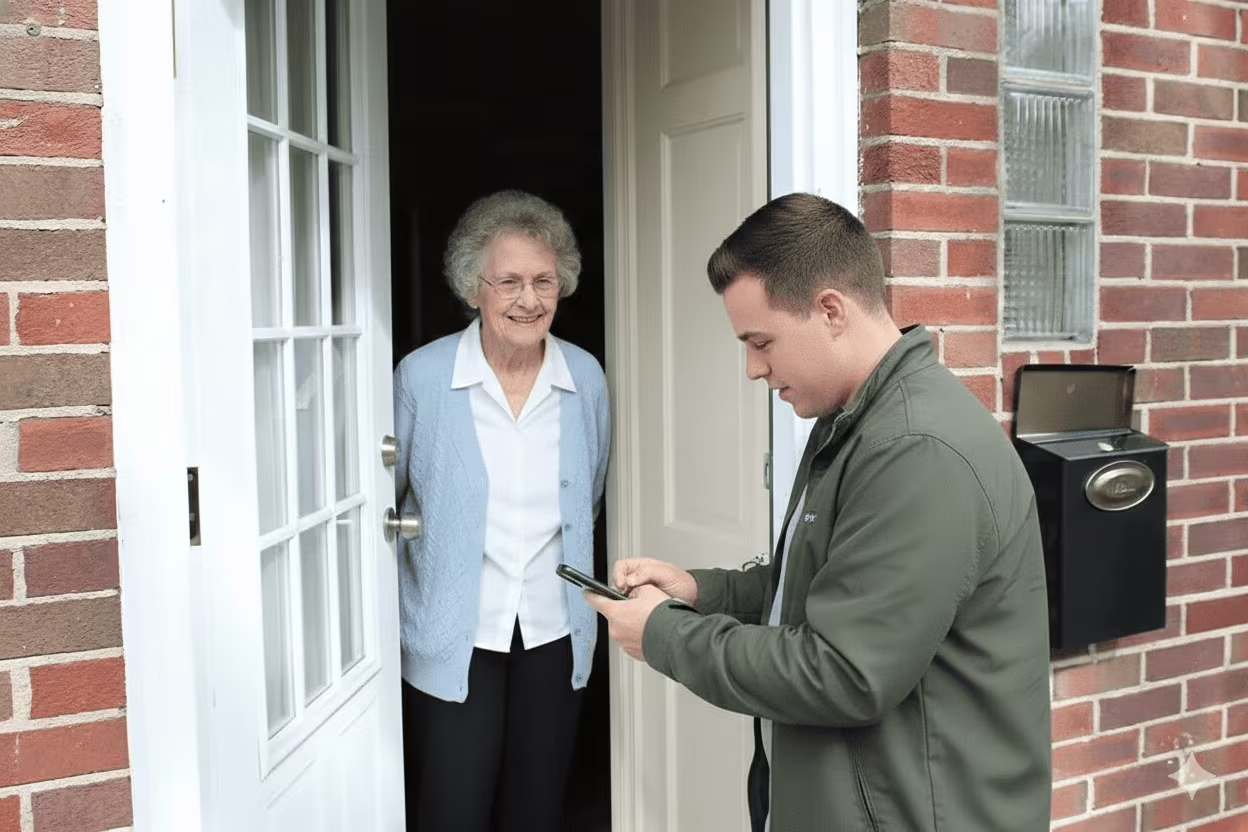
The honest answer starts with acknowledging why the doubt exists in the first place. You're typically asking someone to give up a service they already have, and that's a harder sell than it sounds on paper.
But fiber providers are still building into new neighborhoods every month. The addressable market for switching hasn't been tapped out the way a lot of internal budget conversations assume.
Solar, security, and roofing all introduce something the homeowner didn't have before. A rep shows up, names a problem, and proposes a solution to a gap that was already there.
Fiber doesn't work that way. The homeowner has internet. It probably functions fine, and they haven't thought about switching because there was never a reason to. Your job at the door isn't to introduce a need. It's to interrupt inertia with something concrete enough to make switching feel worth the effort.
That distinction should shape every objection response and every pitch line in this article. Generic D2D advice built for discovery sales will consistently underperform when the prospect already owns the product category.
Most homeowners a rep meets at the door aren't unhappy enough with their current service to have gone looking for something better on their own.
That's exactly why the door conversation matters more than any ad ever could. A few patterns show up again and again once you start these conversations directly:
None of these homeowners went looking for a reason to switch. They just hadn't had the conversation yet. That's the opening a well-run canvass is built to find.
A well-run canvass with a mediocre pitch still beats a great pitch aimed at the wrong doors. Before you touch a script, the operational foundation has to be right, because telecom canvassing depends on hitting serviceable addresses that haven't already been contacted. Get that wrong and no pitch fixes it.
Fiber availability is binary in a way most D2D categories aren't. A rep standing at a door where the service doesn't reach has nothing to offer, full stop. That means your canvass has to start with a verified serviceable-address list, not a general neighborhood boundary drawn on a whim.
Territory mapping turns a buildout map into an assignable territory your reps can actually work. Skip this step and you'll burn hours of selling time on doors that were never winnable.
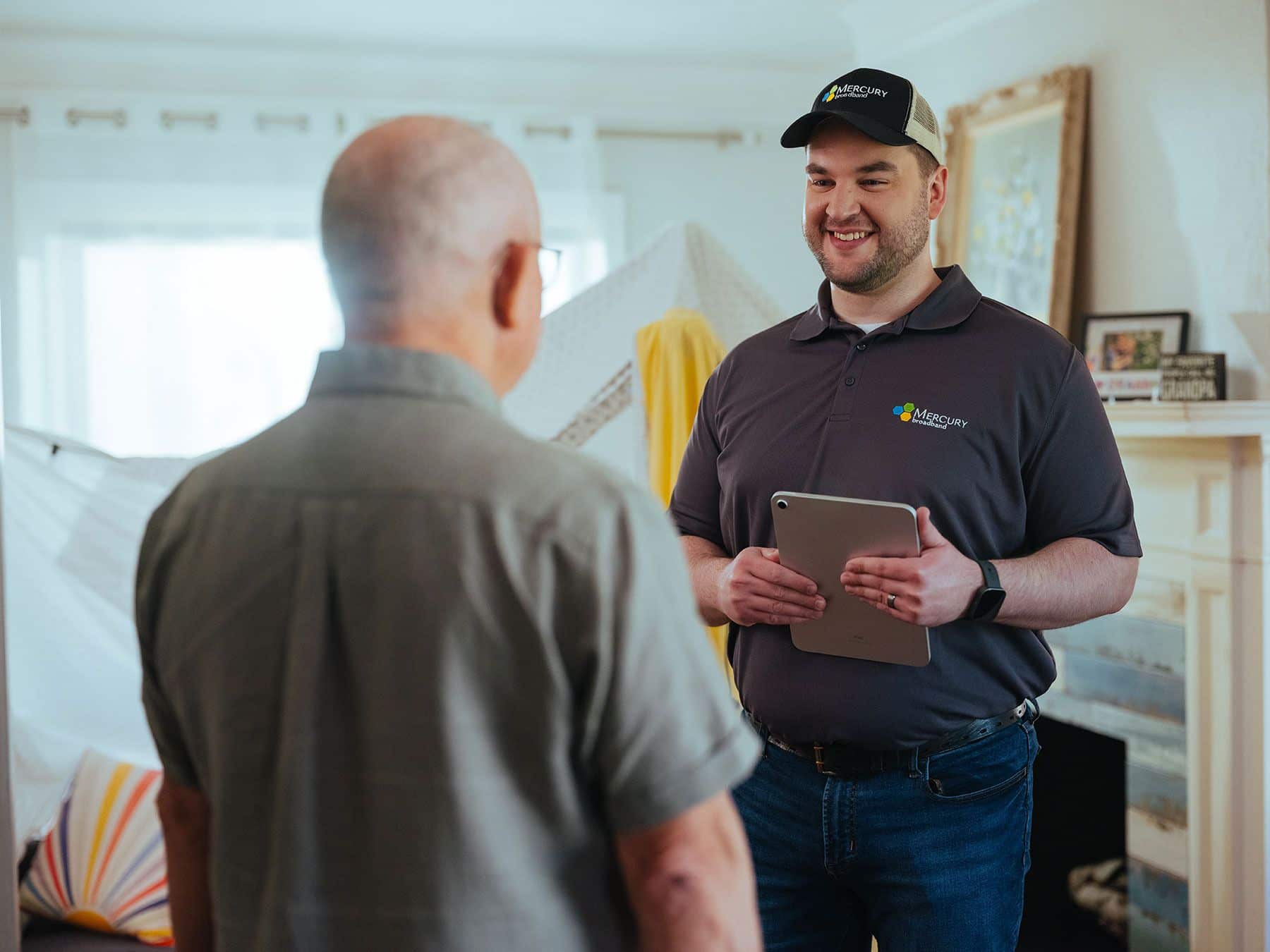
Mercury Fiber is a fiber and fixed wireless provider serving rural and underserved communities across the Midwest. It ran into this exact problem when it started building out its door to door channel. Its previous tooling wasn't built around a location-based data model.
That made it nearly impossible to plan territories accurately or see which doors had already been worked. It also made it hard to keep operating reliably in the low-connectivity areas its teams cover. Moving to a location-based canvassing structure changed what its managers could actually see and act on:
Plan a return visit to a buildout neighborhood two to three weeks after the first pass. By then, awareness has had time to spread, and undecided homeowners have often talked to a neighbor who already switched.
Track that second pass separately from the first so you can see which approach is actually converting.
None of this works without an accurate record of who was contacted and what they said the first time. That's why the tracking piece above isn't optional, it's the thing that makes a second pass worth running at all.
Most objections you'll hear at a telecom door aren't really about the product. They're about the effort of switching. Treating them as a real rejection instead of a reflex is where a lot of reps lose the conversation early.
Acknowledge that effort honestly instead of arguing past it. Keep the tone conversational rather than scripted. A homeowner can tell the difference between a rep who's listening and one who's waiting for their turn to talk.
When I coach a rep through objection handling on a telecom canvass, the first thing I fix is the instinct to argue with "I already have internet." Almost everyone at the door will say some version of it, so arguing gets a rep nowhere. The rep's job is to ask one good follow-up question, not to win the first exchange.
As the table above shows, this is a reflex, not a rejection, which means the fix is tactical rather than persuasive.
Something as simple as asking who their current provider is and what they're paying does more work than any opening line you could write. It gives you a real number to compare against instead of a guess.
Address concerns about early termination fees or contract lock-in honestly, including confirming whether the homeowner is actually still under contract before assuming they are.
Homeowners routinely overestimate how locked in they are, so a simple clarifying question often removes the objection before you've had to counter it at all. Come prepared to address:
The teams that get the most out of a telecom canvass aren't the ones with the slickest script. They're the ones who've drilled the three or four objections that come up at almost every door. That way the rep never has to think on their feet under pressure.
Pitch structure comes last, after the operational and objection-handling foundation is in place. A strong pitch delivered at the wrong door, or without a plan for the first objection, still underperforms.
A good telecom pitch is short and specific. Never attempt a rehearsed monologue!
A vague opener gives the homeowner nothing to react to, and it triggers an automatic no before you've said anything worth hearing.
A pitch that names their likely current speed and price gives them something concrete to evaluate. It works even better once you contrast it with what's now available at their address.
Ask a clarifying question early. It turns the interaction into a conversation instead of a monologue. It also signals you're there to give them information, not to run through a memorized script.
Neighborhood-level social proof, a nearby household that recently switched, works as a credibility signal. Fabricating urgency backfires the moment a homeowner senses it isn't real.
A rep can only reference genuine recent activity in the area if the team has accurate, shared records of where they've already been. That's the same structure covered earlier in this article. Pitch and operations aren't separate concerns here. They reinforce each other, and neither works well without the other. A rep with a great opener still stalls out on a street the team already burned through last month with no record of what happened.
Every opener below follows the same rule as the examples above: name something specific instead of leading with a generic pitch.
Adjust the details to match the street, the offer, and what your data actually shows before a rep uses any of these.
{{faq-1}}
{{faq-2}}
{{faq-3}}
{{faq-4}}
Structure comes first. A telecom canvass that targets the right addresses and tracks who's already been contacted will outperform a sharper pitch aimed at the wrong doors. That's true every time.
Once that foundation is in place, the pitch and objection handling in this guide give your reps a way to have a real conversation. That's a very different experience for a homeowner than a script that ignores what they're actually saying.
The next step is testing this against your own buildout map rather than a generic territory.
See how Ecanvasser supports telecom field sales teams. When you’re ready, book a 15 minute call to see if we’re a fit.
Yes. Fiber buildout is still expanding into new neighborhoods, and most eligible homes haven't switched providers yet. A face-to-face conversation still closes a switching decision faster than digital channels can. That's especially true when the homeowner has never directly compared their current provider to the new option.
Track every visit against a serviceable-address list, and use time-bound assignments so reps can see which doors have already been worked and when. Without that record, teams end up re-knocking the same streets while other eligible homes never get a first visit at all.
Lead with a specific comparison instead of a generic opener. Naming the homeowner's likely current speed and price, then contrasting it with what's newly available, gives them something concrete to react to. A vague pitch about your service in general will rarely earn you more than a few seconds at the door.
Ecanvasser’s real-time tracking completely transformed our field operations. Through the dashboard, we can plan efficient routes, customize interactions, and monitor our canvas stops in real time to support our team the second they need help. The "verified drops" feature adds an extra layer of accountability, while the reporting tools make it seamless to track hourly visit rates and optimize performance on the fly.




Scale your operations, empower your reps, and deliver predictable, profitable growth with Ecanvasser.