Short on time?
Pick an AI to summarise this article:
Pick an AI to summarise this article:



You’re probably paying at least three different prices for leads right now, and it’s always hard to tell which is cheapest.
One channel invoices you per lead.
Another bills per click.
A third costs you a salary and does not produce an invoice at all.
Ask which is delivering better value and the honest answer is that you do not know, because the sticker price and the real price are different numbers.
The spread is wider than your invoices suggest. Local Services Ads averaged $53 per lead across home services in February 2026, while blended Google Ads ran to $104.
The truth is, there is no single cost per lead for home services. There are often five or six, and they all behave differently. In this article, we cover all of your bases, including a channel you might not be making use of.
Every benchmark you have read has the same flaw. It rarely tells you whether it is counting a form fill, a phone call, a booked appointment or a signed job. Those are four different things at four different prices.
Here is the definition used throughout this article. A lead is a homeowner who has expressed interest, before anyone has been booked. What follows is home services lead generation channels compared on the one variable that decides everything else, which is who sets the price.
The figures above come from $6.72M in real Local Services Ads spend, across 888 contractors and 126,650 leads.
The gap between Local Services Ads and paid search is not a quality gap. It is a pricing mechanism. Google sets your Local Services Ads price based on your trade and your area. With standard paid search, you bid against everyone else who wants the same homeowner.
Buying a marketplace lead does not buy you a conversation. It buys you a position in a race.
The same homeowner request is sold to several contractors at once, reported as three to eight simultaneously, and sometimes considerably more in high-value trades.
That changes the arithmetic in a way the invoice never shows you. Your real price is the sticker price multiplied by however many people you are racing. Nobody tells you that number at the point of purchase.
Your cost per lead went up last year. You did not get worse at your job.
Every price in that table except the last one is set by an auction. In an auction, the price reflects how many competitors are bidding. It does not reflect how good you are, how fast you answer, or how well you do the work.
So a new contractor opens across town, starts bidding on your keywords, and your cost per lead rises. You did nothing. The number moved anyway.
This is why "just market better" keeps failing on you. You sharpen your landing pages, tighten your follow-up, and end up level. The floor moved at the same time.
The operators who get furthest with this stop asking what a good cost per lead is and start asking who sets it. Once you can name who decides the price on every line of your budget, the whole conversation changes shape.
You have probably been told to stop measuring cost per lead and measure cost per booked job instead. That advice is right, and it is incomplete. Cost per lead is still the number you are quoted, the number you budget against, and the number on the invoice. You cannot negotiate with a metric you refuse to track.
Two contractors pay exactly $55 a lead. One books 48% of them. The other books 30%.
The first is paying around $115 per booked appointment. The second is paying $183. Same invoice, wildly different business.
Run it across the table above and your ranking reorders. Local Services Ads booked at 43.9% in February 2026, producing a cost per paying customer of $233. Blended Google Ads came in at $472, despite carrying the higher average ticket.
Your real home services customer acquisition cost is rarely where you assume it is. The channel you were about to cut is often the one carrying you.
Some of what you buy was never going to convert, and you pay full price to find that out.
Three kinds show up on every invoice:
The cost of a wasted lead is the price plus the time. Tightening your service area and your targeting removes both. This is what territory mapping is for on the field side, and it is the same discipline as a properly bounded service area in paid search.
"We love real-time tracking and reporting so we know that we only knock on the doors of the houses we can service and we can see whether we knocked them last week, last month or six months ago. We can then make a schedule to reduce over knocking and get that timing right for potential customers" - Emma Pearce, Head of Marketing, Lightning Fibre.
Keep both numbers and use them for different jobs.
Cost per lead is a buying metric. It tells you what a channel charges and lets you compare quotes before you spend anything. Cost per booked job is a judging metric. It tells you what actually happened after the money left.
Our guide to home services lead generation walks through all six channels and where each one hits a ceiling. This article stays on the money.
Every figure so far has been a price you were quoted. This one is a price you build.
That is the buying leads vs generating your own leads question, and it turns on structure rather than preference. Media spend is a variable cost at a rate somebody else sets. A field team is a fixed cost divided by however many conversations it produces.
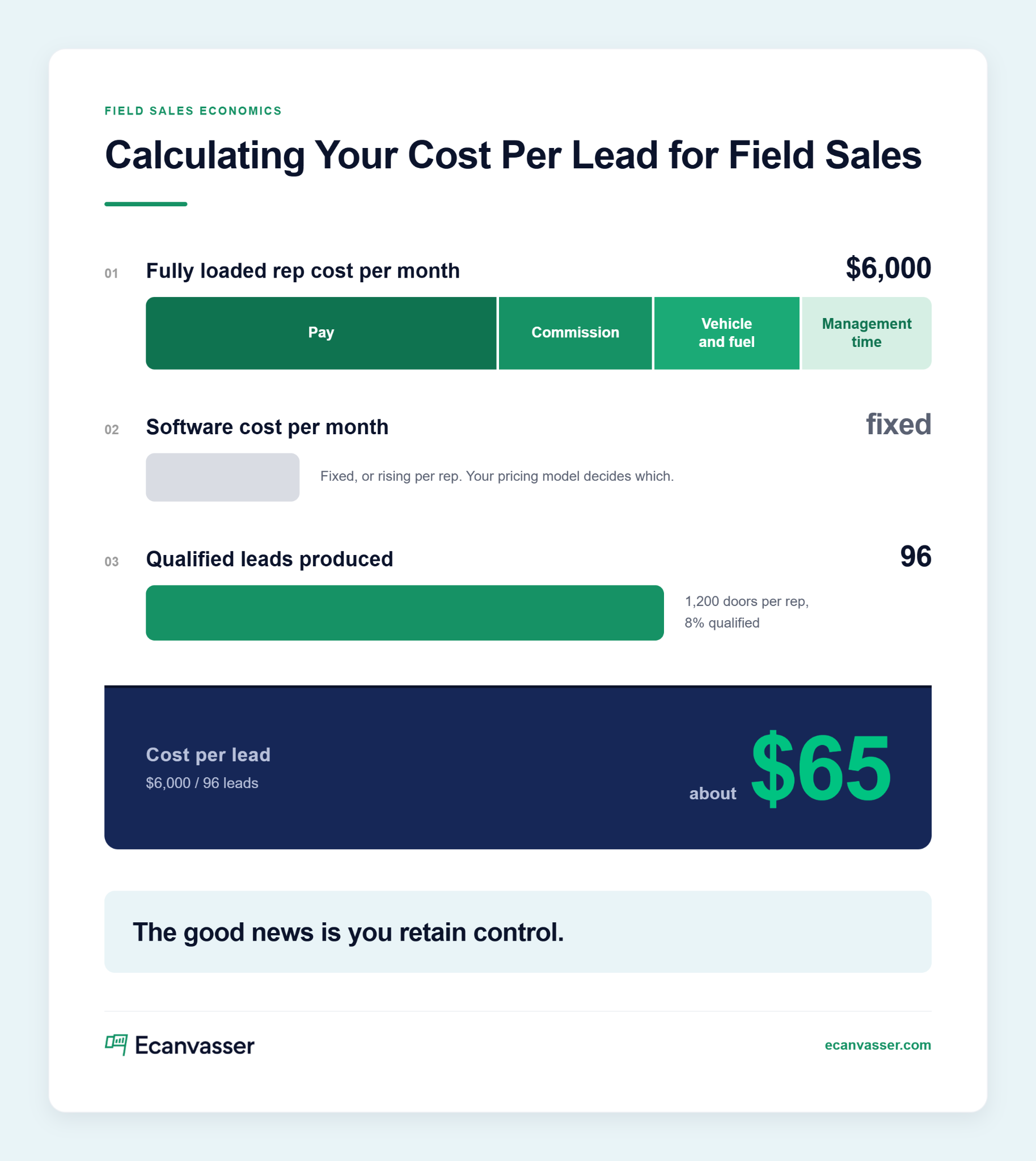
It only takes three lines, and you can run them on a napkin:
Here’s a worked example. Say 1,200 doors per rep per month and a $6,000 fully loaded monthly rep cost. If roughly 8% of those doors produce a qualified lead, you land at about $65. Ecanvasser publishes 10 doors per hour and a 5% door-to-contract conversion rate as industry averages, which is where the door volume comes from.
Replace all three inputs with yours before you compare anything. Our ROI calculator will run the arithmetic against your own figures.
Price this badly and you will kill a program that was working.
Everything below belongs in the numerator:
A program priced without these looks cheaper than it is. Priced with them, it frequently still wins.
Here is where a field channel stops behaving like the rest of your budget.
Ecanvasser models the same ten reps, on the same wage bill, covering 20% more ground:
Nothing about the team changed. The wage bill did not move. The output did, and because the cost was fixed, the entire gain landed on the per-unit number.
In an auction, your improvement gets competed away. Your better landing page lifts your quality score, the market adjusts, and you return to roughly where you started.
A field channel does not do that. There is no auction to lose. Better routes, tighter territories and cleaner targeting land directly on your cost per lead, and they stay there.
Triangle Home Services put several crews into the same neighbourhoods at once and covered more than 20,000 homes in just over a month. Managers watched hourly visit rates against target and rebuilt routes mid-shift when a patch underperformed. Headcount climbed throughout. The software line stayed where it was. Every door added after the first one pushed their cost per lead down rather than up. Read how they did it.
Every field team I have watched get this right improved the number by making the shift better, not by finding a cheaper lead. The gain is yours to keep.
Software is a real component of field cost per lead, and its pricing model decides whether that number can keep falling.
Per-seat pricing turns a fixed cost into a variable one. That quietly reintroduces the dynamic you just escaped.
Work it through. Under a per-user model, your software cost per rep stays constant no matter how many you hire. So your software cost per lead only improves if each rep produces more.
On a 100,000 record territory, a per-user model prices at $10,620 a year for 15 reps and $17,700 for 25. That is $708 per rep at both sizes. Ecanvasser holds at $5,990 across both, which works out at $383 per rep at 15 and $230 at 25.
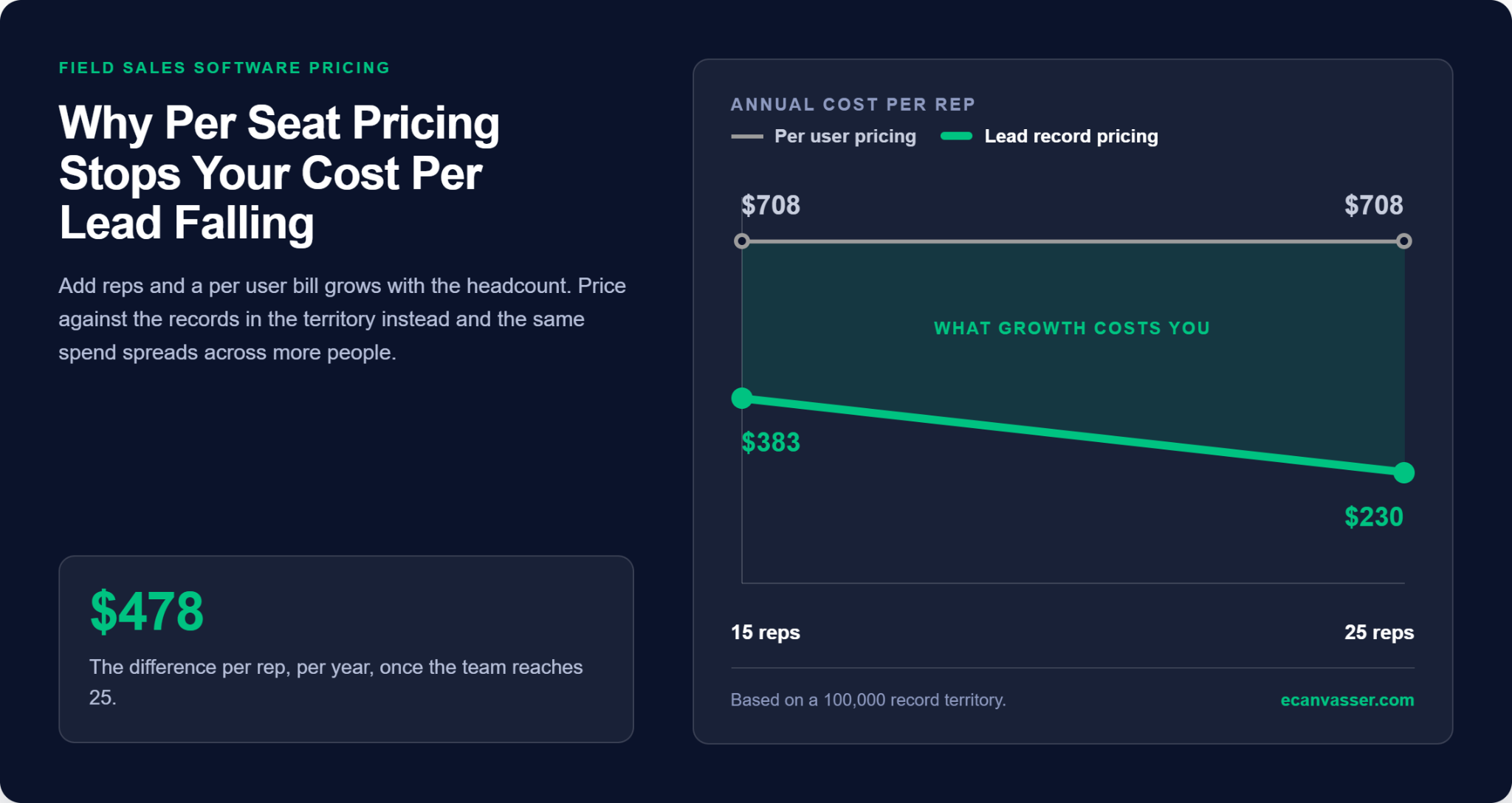
Under lead-record pricing the cost is fixed against territory size. Add a rep and your software cost per rep falls. Your software cost per lead falls twice over. Our pricing is public, so you can check the shape of it yourself. You can also use our pricing comparison calculator to see the differences based on our team and territory size.
Four questions, and all four are about cost per lead rather than features:
That first question does more work than the other three combined. Lead Prospector handles the targeting side, but the pricing model is what decides whether growth costs you.
"When we merged with another broadband company, it was just so easy to onboard new staff, knowing that there wasn't going to be an extra cost, because we have unlimited licenses. We got them on board straight away, tested it, and got them using the software as quickly as possible." Scott Kean, Field Sales Manager, Truespeed
Most advice on how to lower cost per lead for a home services business starts and ends with finding a cheaper source. It rarely works, because a cheaper lead is cheaper for a reason. It is shared more widely, or qualified less, and you recover the saving downstream at a worse rate.
The alternatives to buying home services leads at a lower price all work on the denominator instead.
Serviceability is a cost control, not an operational detail.
Every knock on an address you cannot serve is a fully priced lead that could never have converted. Same logic applies to your ad accounts through service-area targeting. Check both against where your trucks actually go, not where you would like them to go.
More activity in a badly covered territory raises your cost per lead.
Reps re-walk ground somebody already covered, miss streets nobody touched, and produce fewer conversations from the same shift. Structured territory assignment lowers the number before anyone knocks an extra door. The four ratios that show you this are covered in our field sales KPI guide.
Your home services marketing budget has a seasonal problem that annual averages hide. Cost per lead is not stable across the year:
So your slowest months are also your most expensive ones, which is exactly backwards. Pull two years of booked work, find the eight weeks where the schedule thinned, and you have found where a field channel earns its keep.
{{faq-1}}
{{faq-2}}
{{faq-3}}
{{faq-4}}
Pull up what you paid per lead on each channel for the last three years and look at the direction of travel. On every purchased line, it points up. It will keep pointing up because the price responds to how many competitors are bidding, not to anything you do about it.
A field channel gives you the other direction. It starts expensive. It takes a quarter before the figure means anything. It asks for work that switching on an ad campaign does not ask for. What you get back is a number that responds to your own routes, your own targeting, and your own reps.
Run your own figures through the ROI calculator, or take out a free 7 day trial and we’ll help you through it.
There is no single figure, and any benchmark quoting one is hiding the important part. Local Services Ads averaged $53 in February 2026 while non-branded paid search ran to $149. A good cost per lead is one your book rate and average ticket can carry profitably. Work backwards from your margin rather than comparing against a national average.
Because the price was never yours to set. Paid search and marketplace leads are priced by auction, so the number reflects how many competitors are bidding in your area. A new contractor opening across town raises your cost without you touching a single setting. Improving your execution does not protect you from this.
Buying is cheaper to start and more expensive to scale. A purchased lead costs you nothing upfront but arrives at a price that rises with competition. A field team costs real money before it produces anything, then gets cheaper per lead as your reps improve. Judge it at 90 days, not 30.

Ecanvasser’s real-time tracking completely transformed our field operations. Through the dashboard, we can plan efficient routes, customize interactions, and monitor our canvas stops in real time to support our team the second they need help. The "verified drops" feature adds an extra layer of accountability, while the reporting tools make it seamless to track hourly visit rates and optimize performance on the fly.




Scale your operations, empower your reps, and deliver predictable, profitable growth with Ecanvasser.
.svg)