Short on time?
Pick an AI to summarise this article:
Pick an AI to summarise this article:



Paying door-to-door reps is simple enough—until a customer cancels.
A rep signs a deal, you pay the commission, and a week later the customer changes their mind. Do you take the money back? All of it? From this paycheck or the next one? Whatever you decide in that moment becomes your real commission plan, written down or not.
That moment is built into door-to-door sales. Customers have a legal right to cancel a sale made at their home. And many of the people you pay, like appointment setters, never close a deal themselves. If your door-to-door sales commission plan was borrowed from an office-based sales template, it wasn't built for either.
This guide is for the owner or sales leader designing the plan. You'll get five pay structures with worked math and a chargeback policy you can put in writing. You'll also get a fair way to split credit between setters and closers, plus the points where the plan breaks as your team grows.
The first commission plan I ask to see in any door-to-door business is the one written for the week a customer cancels. If that week isn't on paper, your best reps will find out what it looks like the hard way.
A pay plan that works for an office sales team can fall apart at the door. There are two reasons. Your customer can cancel after you've already paid the rep. And some of the people you pay never sign a customer themselves. Office sales teams rarely deal with either.
Getting this wrong shows up in retention first. One UK field marketing agency moved its commission-heavy campaigns onto structured territory rotation and daily disposition reporting. Weekly sales climbed from as low as 80 to 90 to a steady 300+ within six weeks. Attrition fell to 23.1%, against a typical campaign rate of 32 to 34%. Predictable work produced predictable pay, and reps stayed.
Doorstep sales come with a legal cooling-off period in both the US and the UK, and that's where your chargebacks come from.
In the US, the FTC Cooling-Off Rule (16 CFR Part 429) sets the terms. You must tell buyers they can cancel a door-to-door sale within three business days. It covers in-home sales of $25 or more.
In the UK, the Consumer Contracts Regulations 2013 set a 14-day cancellation period for off-premises contracts. That period extends by up to 12 months if the trader never gave the customer the required cancellation information (legislation.gov.uk, text current to April 2026).
So the design rule writes itself. Your clawback window must run at least as long as the legal window. And a rep who skips the cancellation paperwork can leave you exposed on a UK deal for a year.
Setters knock, qualify, and book. Closers sign. Pay both on commission only, and one of them may be a legal problem.
In the US, commission-only pay usually leans on the FLSA outside sales exemption. It applies when an employee's primary duty is making sales away from your place of business, including door to door at the customer's home. The Department of Labor's Fact Sheet #17F is explicit on one point. Promotion work "incidental to sales made, or to be made, by someone else is not exempt outside sales work."
Read that against your setter's job. A setter booking appointments for a closer may be owed minimum wage and overtime, whatever the offer letter says.
In the UK, commission counts toward National Minimum Wage. You still have to top up any pay period where commission falls short.
This is general information, not legal advice. State rules, California's in particular, can be stricter, so check yours before you finalize the plan.
Before you pick a structure, it helps to know roughly what reps in your industry expect to earn. These are working estimates, not survey data, so treat them as a sanity check rather than a benchmark.
Your own rates will move with product price, market and how many leads you supply. Use these as a starting point, then run the math on your margins.
Most door-to-door teams pay reps using one of five structures, or a mix of two. Each one below comes with a worked example. The numbers are illustrative, so swap in your own rates from the section above before you model anything. Run each one against a strong month and a weak month, since the weak month is the one reps remember. Whichever you choose, write it into your field sales job description, so a candidate sees the pay terms before the first interview.
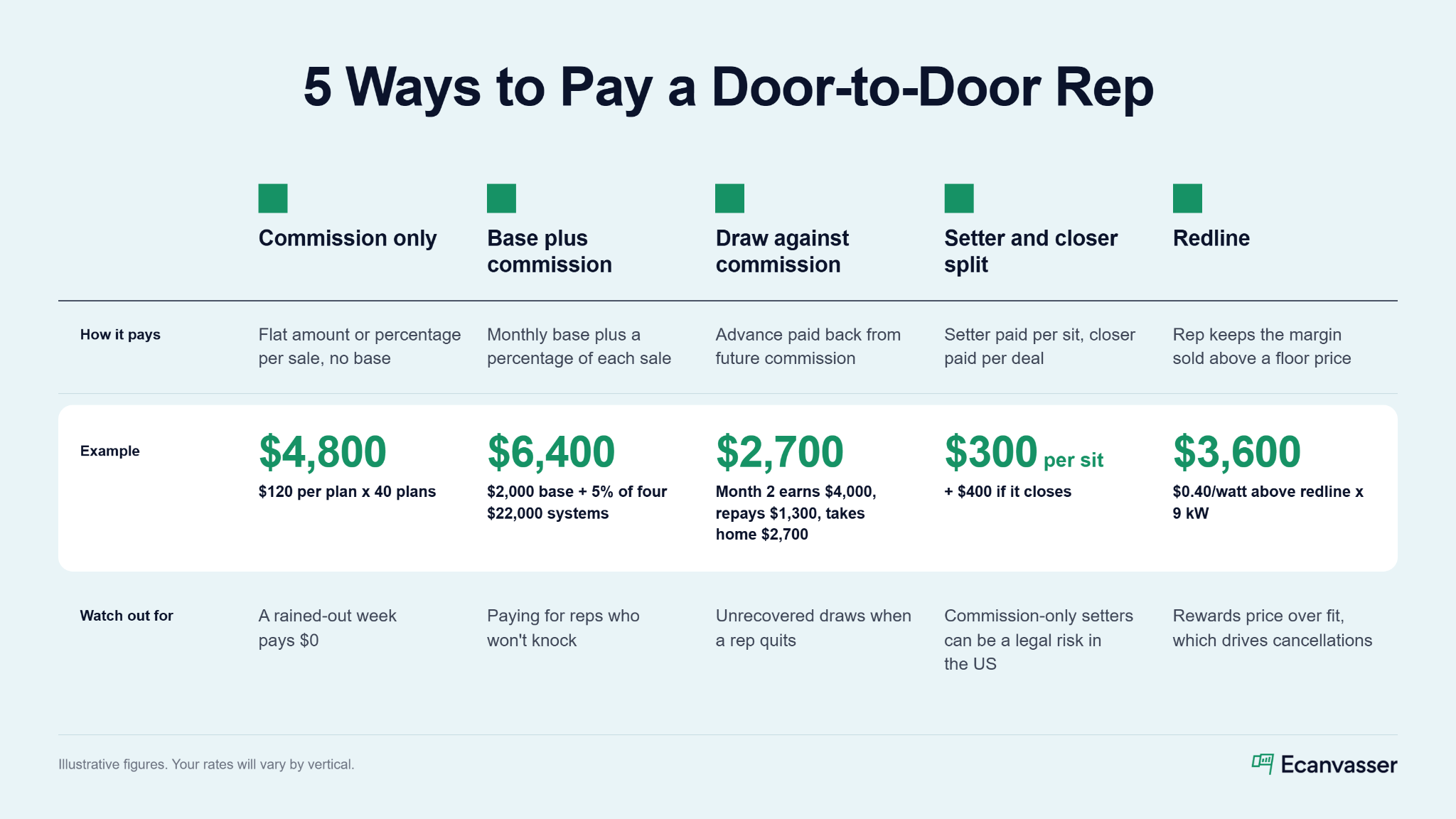
No base. The rep earns a flat amount or a percentage per sale, and the rate runs higher to cover the risk they carry.
Example: a pest control rep earns $120 per signed annual plan. Forty plans in a month pays $4,800. A rained-out week pays $0, and the rep still has to fill the tank.
It's also the model candidates know from commission-only sales jobs, so expect them to compare your offer against those listings.
This is the cheapest plan to run at low volume. It's also the plan most exposed to the setter and minimum-wage issues above, because it assumes everyone you pay is a closer.
A base is contested in door-to-door sales in a way it isn't in B2B. One camp says a base attracts people who won't knock. The other says it buys training time and cuts first-month churn.
Example: $2,000 a month in base, plus 5% of a $22,000 solar system. Four installs in a month gives $2,000 + $4,400 = $6,400.
Where does the base earn its cost? Long install cycles, new markets and regulated products, where a rep can do everything right and still wait weeks for a paycheck. It earns far less on short, high-volume sales like pest control.
A draw is an advance against future commission. Recoverable draws get paid back from later earnings. Non-recoverable draws don't.
Example: a $2,500 recoverable monthly draw. In month one the rep earns $1,200, receives $2,500, and carries a $1,300 deficit. In month two they earn $4,000. The $1,300 is recovered and the rep takes home $2,700.
Now answer the question you'd rather skip. What happens to an unrecovered draw when the rep quits? Put that answer in writing on day one. Draws exist to cover a new rep's first weeks, and that's exactly when people leave. Forgive it or recover it, but decide before it happens.
This is the structure you won't find in a B2B template, and the one that starts the most arguments.
Example: the setter earns $300 flat for every appointment that actually sits, plus a $400 kicker if it closes. The closer takes the rest of the per-deal commission.
That flat fee for the sit matters. As covered in the section on non-closing roles, a US setter paid only on closed deals is the riskiest version of this plan.
If a setter and a closer can't agree on who earned a deal, the problem isn't the split. It's that nobody recorded who knocked the door first.
Tiered plans raise the rate once a rep crosses a threshold. Illustrative example: 5% up to $40,000 in monthly sales, then 7% above it. A $60,000 month pays $2,000 + $1,400 = $3,400.
Redline plans are common in solar and roofing, and they're missing from generic commission guides. You set a floor price. The rep keeps some or all of the margin they sell above it.
Example: a redline of $2.80 per watt on a 9 kW system sold at $3.20 per watt. The rep earns $0.40 × 9,000 = $3,600.
Be honest with yourself about the risk. Redline rewards price over fit. A rep who stretches the price on a homeowner who can't really afford it is writing tomorrow's cancellation.
When does a rep actually get paid? That single decision shapes behavior at the door more than the rate does.
Pay on the appointment, and you reward volume. Expect more sits and weaker ones, because a booked calendar is what earns the money. Pay on the signature, and you reward closing, but the plan ignores what happens during the cooling-off period. Pay on the install, and you reward clean sales. The catch is cash flow, since the rep may wait weeks for a job to be scheduled and completed. A new rep with rent due won't wait that long.
None of these is wrong on its own. Each one simply tells the rep what you care about most. Choose the trigger that matches the behavior you want at the door, then protect yourself from its weak spot.
The pattern worth copying is a split trigger. Part of the commission pays on signature, and the balance pays on install or once the clawback window closes.
Example: a deal worth $3,000 in commission pays $1,500 at signature and $1,500 after install. The rep has money in hand this week, and you only carry half the exposure if the customer walks.
Solar field teams show why this matters. Their install timelines run long enough that a pure install trigger can starve a new rep before their first deal completes.
A chargeback feels like a rep failing. On a doorstep, it's a forecastable cost of the channel, because the law gives every customer time to reconsider.
So write this part of the plan before anyone is hired. Budget for cancellations the way you budget for fuel or lead costs, then decide who carries them. It needs four answers in plain language. What triggers a clawback? How long does the window run? How much gets recovered? And how is it recovered?
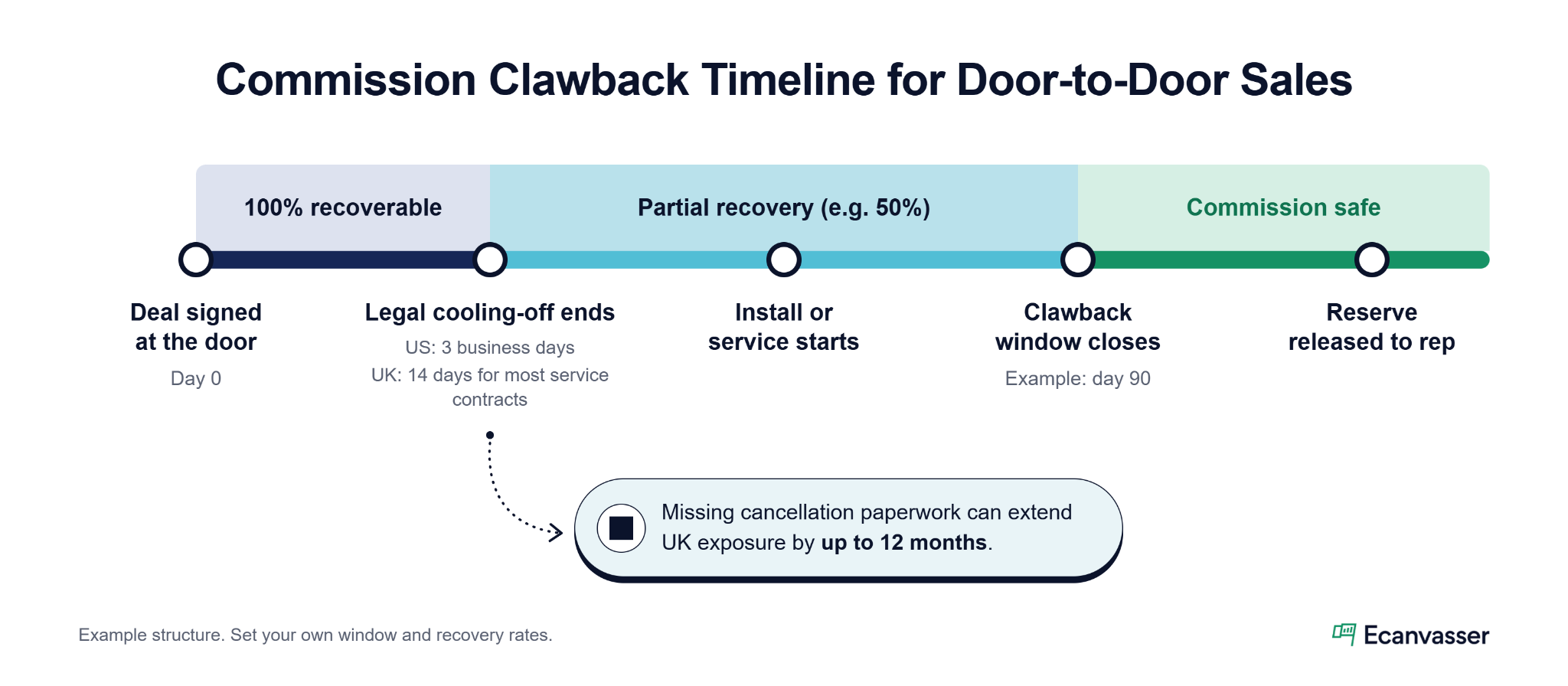
Start with the minimum. That's the cooling-off period that applies to you: three business days in the US, and 14 days in the UK for most doorstep service contracts.
Then extend the window to cover the real failure points. The legal window is only the first. Finance declines, failed site surveys and canceled installs can land weeks later.
Example: 100% recovery inside the legal window, 50% recovery up to day 90, and nothing after that. That's a structure to adapt, not a benchmark.
Remember the UK extension from earlier. Missing cancellation paperwork can stretch your exposure on a deal by up to 12 months. Treat that as a training and compliance issue as well as a pay issue, because the fix happens at the door. Make the cancellation notice part of every rep's close, and check it in ride-alongs.
A reserve, sometimes called a holdback, withholds a fixed share of each commission. You release it once the clawback window closes, and any clawback comes out of the reserve first.
Example: hold 15% of a $1,000 commission. The rep is paid $850 now, and $150 sits in reserve until day 90. If the deal holds, the $150 is released.
Why does this beat payroll deductions? The rep never sees a negative paycheck, and you never have to recover money from someone who has already left. A negative paycheck is one of the fastest ways to lose reps.
A 25-rep pest control operation we worked with learned this the hard way. It paid full commission at signature and pulled cancellations from the next paycheck. In one heavy cancellation week, three reps took home almost nothing and two of them quit. The manager spent Friday afternoon working out which deals had actually fallen through. A 20% reserve and a 60-day window, written into every offer letter, ended the disputes. The rules were set before the deals were.
The process matters as much as the policy. Apply the same rule to every rep, send a written notice for every clawback, and keep a record the rep can check. One exception for a top performer undoes the rule for everyone who hears about it.
Every clawback conversation goes better when both of you look at the same facts. That means the verified door log, the date the deal was logged, and the date it fell through. Reps accept a clawback they can see. They fight one they have to take on trust. Ecanvasser records that field activity. It doesn't calculate the payout, so the numbers still run through your commission sheet or payroll tool.
After cancellations, credit is where pay disputes start. On a recruiting-heavy team, one person can be a seller, setter and team lead in the same year. Your rules need to hold up across all three, and they need to be written before the first disagreement.
A self-generated lead usually earns a higher rate, because the rep carried the cost of finding the customer. A company-provided lead earns less, because you paid for it through marketing or a lead purchase.
Example: 10% on a self-gen deal and 6% on a company lead. On a $10,000 sale, that's $1,000 versus $600, and the $400 difference funds your lead budget. Knowing what a purchased lead costs tells you whether that gap is the right size.
The rule only works if the source of every lead gets recorded at the door. Two reps will both remember finding the same homeowner, and both will be sincere. GPS-verified door logs settle it, because the first logged knock has a time and a place. For the handoff itself, see how setters qualify leads before passing them to a closer.
Decide one more rule in advance. What happens when a company lead turns into a referral the rep finds on the same street? Pick an answer and write it down, because it will come up in your first busy month.
An override pays a team lead, sales manager or recruiter a small share of their team's production. It's central to door-to-door growth, because leaders are paid to build teams rather than just sell.
Example: a 2% override on a six-rep team that produces $180,000 in a month earns the lead $3,600.
Watch for two failure modes. Stacked overrides at several levels can quietly eat your margin. And a lead paid purely on production has every reason to recruit fast and little reason to keep anyone.
Two guardrails help. Cap override depth at two levels. Then tie part of the override to 90-day rep retention, so the lead earns more for building reps who stay. Review the override cost as a share of revenue every quarter, not just when margins slip.
Your pay plan doesn't decline gradually. It breaks at predictable sizes. For the management side of growth, read what breaks at 30 reps. This section covers only the pay plan.
At this size, commission runs on memory and goodwill. You make exceptions one conversation at a time, and each one feels fair when you make it. Nobody complains, because everyone can still walk into your office.
The trouble starts when two reps compare paychecks and find different rules. Neither one is wrong, because you told each of them something different.
The fix is cheap now and expensive later. Write the plan down, including the clawback terms and the reserve, before rep eleven joins. Keep it short enough that a new hire reads all of it.
Somewhere around 30 reps, a team lead layer appears. So do several lead sources and at least one blended structure. The one-off exceptions from the early days now contradict each other, and reps compare notes.
Your field sales commission structure needs to live in one written plan, with an effective date and a change log. You also need a weekly reconciliation that checks payouts against logged activity and the KPIs that matter. This is usually where a commission spreadsheet stops coping. Formulas break when someone inserts a row, and nobody is sure which version is current.
Give one person ownership of the plan. Team leads can raise exceptions, but only the owner can approve them, and every approval goes in the change log.
By 50 reps, you're running several override levels, seasonal hiring, and a steady flow of joiners and leavers. Any cost that scales per head compounds with every hire, from overrides to per-seat software.
Triangle Home Services built a brand-new door-to-door program and scaled it past 20,000 homes in just over a month. Software costs stayed flat as headcount grew. Truespeed saw the same effect when it absorbed a whole team through a merger.
"When we merged with another broadband company, it was just so easy to onboard new staff, knowing that there wasn't going to be an extra cost, because we have unlimited licenses. We got them on board straight away, tested it, and got them using the software as quickly as possible." Scott Kean, Field Sales Manager, Truespeed
Pay disputes are usually data disputes wearing a different shirt. Settle the data, and most of the arguments go away.
Run the plan on a simple rhythm. Keep one written plan and one weekly cut-off. Reconcile payouts against logged activity, and give every rep a statement they can read without asking you what it means.
Be clear about what your tools do. Ecanvasser isn't commission or payroll software. Some door-to-door platforms bundle a commission calculator, and if your plan is complex, you may want a dedicated comp tool alongside your field platform. What Ecanvasser supplies is the record your plan runs on. That means verified knocks, per-rep activity reports, lead attribution, and a live scoreboard for tiers and contests.
"Ecanvasser gives us very good indicators of high performers versus low performers. It's very easy to see people that are out on time knocking doors, and people that aren't. It keeps everybody honest in the relationship." Alan O'Reilly, Head of Sales Optimisation, eir
I'd rather pay a rep a little less per deal and pay them on time, every time, than promise a big number that arrives late and gets clawed back without explanation.
{{faq-1}}
{{faq-2}}
{{faq-3}}
{{faq-4}}
Ecanvasser is priced so that adding a rep never adds a seat. See pricing or start a free trial to see how your activity data can back up your pay plan.
An average sales commission figure hides more than it tells you, because the rate depends on the structure and the vertical. As rough estimates, solar closers earn about $0.20 to $0.60 per watt, and roofing reps about 8% to 12% of contract value. Pest control pays around $75 to $200 per plan, and fiber around $50 to $250 per activation. Benchmark against your own margin and cancellation rate before copying anyone's rate.
Sometimes. In the US, reps who make sales at the customer's home can fall under the FLSA outside sales exemption, which allows commission-only pay. Setters who only book appointments for someone else may not qualify, and could be owed minimum wage and overtime. In the UK, commission counts toward National Minimum Wage, and you must top up any shortfall. Check with an employment lawyer before you finalize the plan.
At minimum, as long as the legal cooling-off window: three business days in the US, and 14 days for most UK doorstep service contracts. Then add time for the failure points that come later, like finance declines and canceled installs. Ninety days with partial recovery after the legal window is a common starting point to adapt. Put the window in the offer letter, not just the handbook.
Ecanvasser’s real-time tracking completely transformed our field operations. Through the dashboard, we can plan efficient routes, customize interactions, and monitor our canvas stops in real time to support our team the second they need help. The "verified drops" feature adds an extra layer of accountability, while the reporting tools make it seamless to track hourly visit rates and optimize performance on the fly.




Scale your operations, empower your reps, and deliver predictable, profitable growth with Ecanvasser.