Short on time?
Pick an AI to summarise this article:
Pick an AI to summarise this article:



You are not short of home services marketing advice. You are short of a channel you control.
Do you recognize this problem? Let’s say a homeowner fills in a form at nine in the morning. By 9:04 you have called them. But so have three of your competitors, because all four of you bought the same lead. Whoever answers first wins the job. The price of that lead goes up next quarter anyway.
So, you go looking for something better. Every guide you find tells you to stop renting demand and start owning your channels. Then it lists eleven channels, and every one of them is demand somebody else owns and meters out to you.
This article gives it to you straight.
I’ll walk through the channels you are already running, what each is genuinely good at, and where each one hits a ceiling. Then I make the case for the channel almost nobody in this industry writes about.
Your cost per booked job has climbed for three years running. You have not gotten worse at your job.
The reason is structural. Almost every channel in the standard mix is an auction or a marketplace. In an auction, the price is set by how many competitors are bidding, not by how good you are or how much value you create.
When a new contractor opens up across town and starts bidding on the same keywords, your cost goes up. You did nothing different, but the number changed anyway.
This is why the advice to simply market better keeps failing. You can improve your execution, tighten your follow-up, sharpen your landing pages, and still lose ground. The floor underneath you is moving. Lead generation for home service businesses now behaves like a commodity market, and you are a price taker in it.
There is a second effect worth naming. Because everybody buys from the same handful of sources, everybody ends up talking to the same homeowners. The differentiation you built into your service never gets a chance to matter. The conversation starts as a price comparison between four names on a list. You are not competing on the work you do. You are competing on who picks up the phone first, and on how little you are willing to charge.
The operators leaving that model are easy to count. Angi reported 131,000 average monthly active pros over the twelve months to Q3 2025. That is down 17% year over year, and newly acquired pros fell 37% over the same period.
That number does not mean the marketplace model is finished. Plenty of contractors still use it well. It does mean a lot of businesses like yours have run the maths and decided the trade is no longer worth it.
The operators I talk to almost always open with a volume problem, and three questions in, volume was never the issue. They are buying the same lead their two closest competitors just bought, and the only lever left is answering the phone faster.
Before you add anything, take stock of what you have. The marketing strategies most home services companies already run were added one at a time, usually because somebody sold them, and rarely reviewed since. This is an inventory rather than a ranking. You are not picking one channel here. You are working out what each one is actually doing for you.
The table below maps all six against the variable that matters most, which is who decides how much you get.
This is the most valuable asset you already half own. Your profile costs nothing, the leads are exclusive to you, and someone searching for emergency furnace repair has already decided to hire somebody today. Local marketing for home services starts here, before you pay for anything.
Optimized means something specific:
The ceiling is real, though. You cannot make more people search. In a slow month, a perfect profile still returns a slow month.
These two get lumped together and behave very differently. Local Services Ads charge you per lead, not per click. They also carry the Google Guaranteed badge, which does real work on a homeowner who has never heard of you. Standard paid search gives you keyword control and instant reach, but you pay for every click, including the ones that were never going to call.
One change worth knowing: Google began moving Local Services Ads into Performance Max pay-per-lead campaigns in August 2026. Budgets shift from weekly to daily, and Google is retiring the standalone dashboard. Export your historical data before it goes.
Reviews are not a demand channel, and you should stop measuring them like one. What they do is multiply every other channel you run. The same search traffic converts at a completely different rate against a profile with 90 recent reviews than against one with twelve from 2023.
Volume and recency both matter. Ten glowing reviews from two years ago read as a business that used to be busy. Ask after every job, every time, and the numbers take care of themselves.
Referrals close better than anything else you will ever run, and they cost you the least. You already know this. What gets missed is why they stay so lumpy.
Referrals are downstream of job volume. They arrive in proportion to work you have already completed, which means they are strongest in your busiest months and thinnest in the slow ones. That's the opposite of what you need.
A formal program helps. Scale the reward to the job:
Pay on completion rather than on the lead, so you don't fund referrals that never convert. But understand what you're buying. A program accelerates an existing pattern. It does not create one.
Direct mail still works for a specific job, and it deserves better than the eye-roll it usually gets. You choose the geography. You reach households that never search for anything. Give each drop a distinct phone number and you can measure it properly.
The maths only holds on high-ticket work, because response rates are low enough that a $200 repair will not carry the print and postage. You also have no idea whether the piece was read or went straight in the bin.
Hold onto that combination. Outbound, geography-first, and blind to what happened after delivery. It becomes relevant shortly.
Shared leads are sold to several contractors at once. That is the model working as designed, and it explains the close rate you are seeing. Your response speed matters more here than in any other channel, because you are in a race rather than a conversation.
The record on lead quality claims is worth knowing. The Federal Trade Commission ordered HomeAdvisor, which also operates as Angi Leads, to pay up to $7.2 million in 2023. The order barred the company from making unsubstantiated claims about how often its leads turn into paying jobs.
None of that makes marketplaces useless. They fill a genuinely awkward gap. Say your schedule has holes in February, or you are testing a service area you have never worked. Buying leads is a reasonable way to find out quickly. The failure is treating a gap-filler as a foundation.
You just audited six channels. Look at the volume column again. In five of the six, somebody else decides how much you get this week, and your only move is to bid harder or wait.
There is a sixth option, and it is the one your own field team runs.
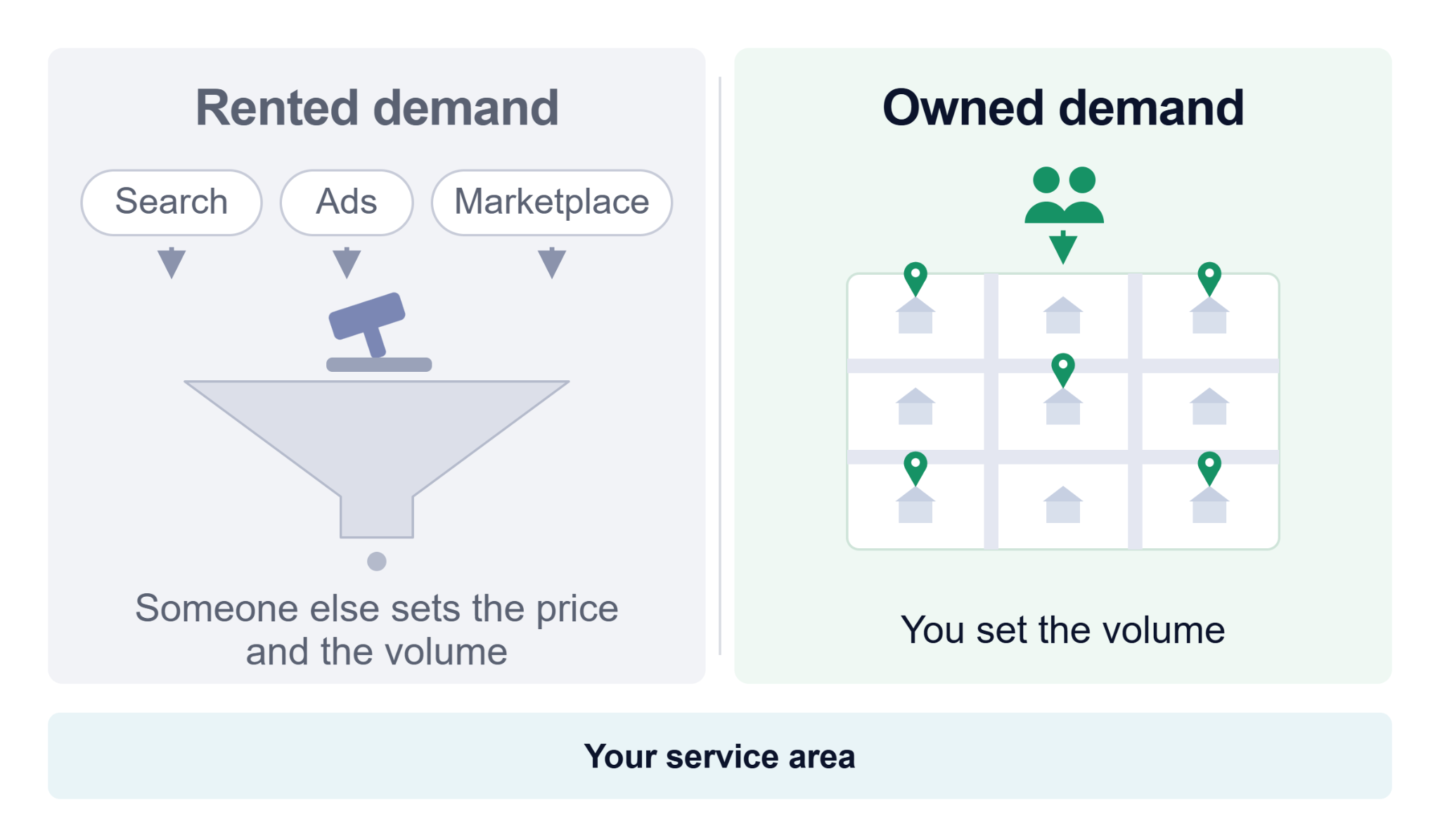
Reps work a defined territory inside the service area you already cover. They have conversations at doors, log every outcome, and the data from those conversations compounds into a map of where your revenue actually lives. Canvassing, applied properly to a home services operation, is a lead generation channel with a database attached.
Two things it is not. It is not a commission-only crew of strangers cold-knocking a suburb you have never worked in. And it is not the one-off canvass your installers do around a completed job, useful as that is. Ecanvasser's home services field sales platform exists because the difference between those two things is a system.
Every channel in the table converts money into an unknown quantity of leads at a price you do not control. A field channel converts labor into a known number of conversations. You know roughly how many doors a rep covers in a shift. Multiply by reps, multiply by days, and you have a forecast rather than a hope.
Be clear about the trade you are making. Conversion at the door runs lower than an inbound search lead because the homeowner wasn't looking for you when you arrived. You give up intent. You buy back control.
That control matters more as the rented supply gets less stable. Angi's network channel leads fell 81% year over year in Q3 2025, from 2.6 million to 495,000. The cause was the company's own move to a homeowner-choice model in January 2025.
"Ecanvasser gave us the power to scale our D2D outbound campaign to over 20,000 homes in just over a month, providing the perfect balance of real-time field tracking, powerful reporting, and budget-friendly scalability." - Alice Bridge, Web Developer, Triangle Home Services
Nothing here argues for switching off your paid search. Keep it. Field marketing for home services works best as an addition to the mix, not a replacement for any part of it.
The two feed each other in a way that is easy to miss. Search captures homeowners already looking. A field team creates conversations with homeowners who were not looking yet, and some of them go and search for you a week later. Your reps also come back with something no dashboard gives you: first-hand knowledge of which streets are worth your ad spend.
Skilled teams don't treat the field channel as a replacement for anything. They add it because it is the only line in the budget where more effort reliably produces more conversations.
If you want the execution detail rather than the channel decision, our guide to door-to-door lead generation covers what happens at the door.
This is wrong for some businesses, and it is worth saying so plainly. Do not do this if:
If you recognized yourself in that list, fix the constraint first. A field channel added on top of a capacity problem just produces leads you cannot serve.
Nobody writing about this industry will tell you what a cheque looks like. Here is one. Treat every figure as directional, because compensation and market conditions move a lot between Raleigh and Sacramento.
Start inside the service area you already cover. Not a new market, not the town you have been meaning to expand into. You want the variable under test to be the channel, not the geography.
Hire two reps rather than one. A single rep gives you no benchmark. When the numbers come back weak, you cannot tell a bad territory from a bad hire. If you hire two, you get a comparison.
On pay, the structural choice matters more than the percentage. Base plus commission attracts a different person and keeps them longer than commission-only. Commission-only lowers your fixed cost and raises your turnover.
The tooling breaks into four parts, and pricing each separately stops you from being sold a bundle you do not need:
Ask one question before you sign anything: does the price go up when I add a rep? Per-seat pricing penalizes exactly the growth you are trying to produce. Ecanvasser prices by lead records rather than headcount, and handles route planning up to 200 stops where a lot of tools stop at 25. Lead Prospector removes the CSV upload step entirely. You can see how this works for a home services field team, and the pricing is public.
Hold your team to a timeline, and hold yourself to judging it at the right moment:
Judge the channel at 90 days, not at 30. Month one measures a learning curve.
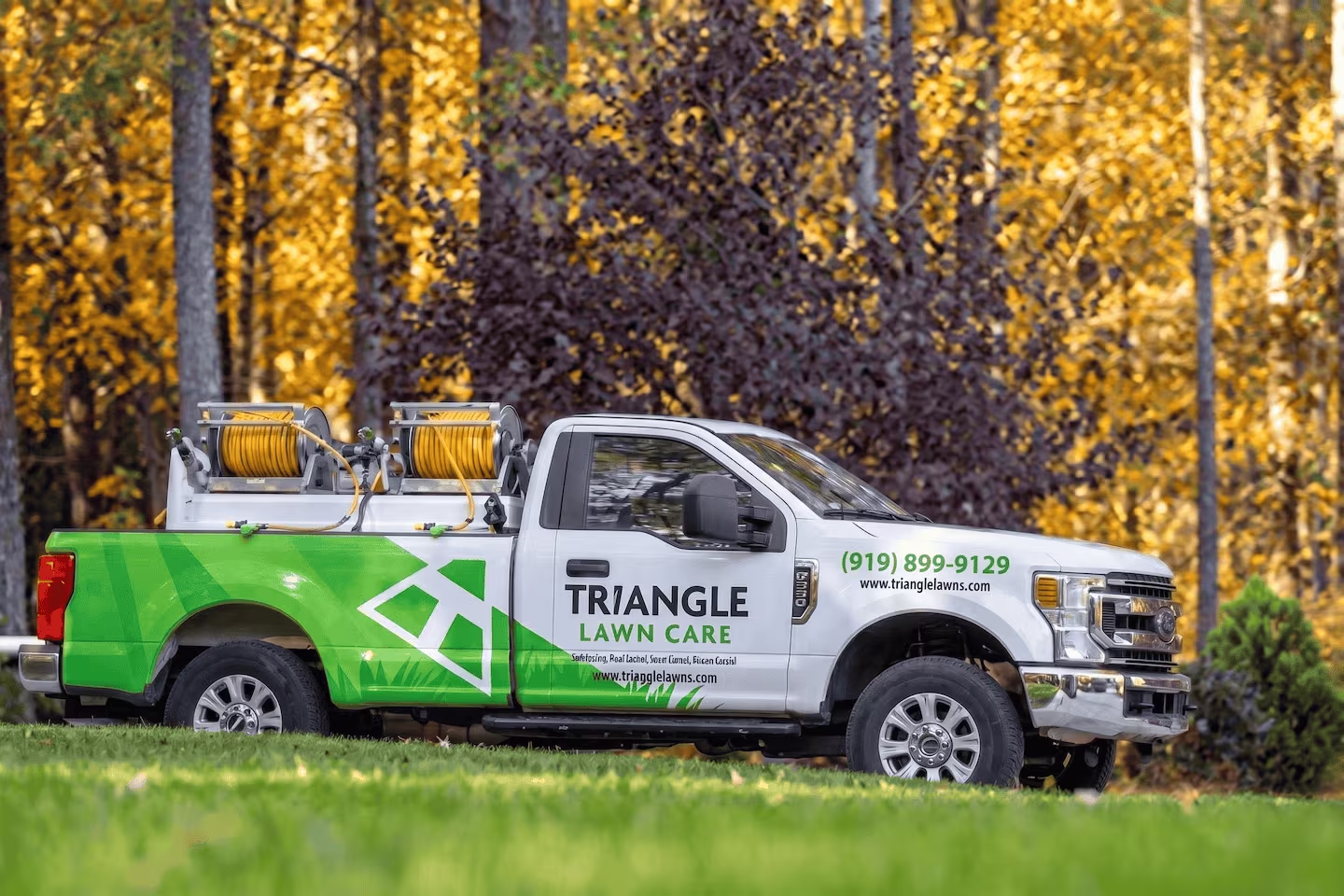
Triangle Home Services, the parent brand behind Triangle Pest Control, Triangle Lawn Care and EnviroCon, had no door-to-door operation at all before they started. They had looked at other platforms and found them, in their own words, outrageously priced for what they needed at that stage. Just over a month after launch, the team had canvassed more than 20,000 homes across Raleigh and deployed a full field crew. Software costs stayed flat throughout. They are now running the same playbook into Houston. The full customer story has all the detail.
You already know how to evaluate paid search. The trap is measuring a field channel with the same yardstick, deciding it looks expensive, and killing it in month two.
Cost per lead is the metric that makes bought leads look cheap, and everything else look wasteful. Drop it. How you generate leads for your home services business matters far less than what each one costs you to close.
Run the comparison properly for every channel you have:
A $30 shared lead that closes one time in ten costs you $300 a job. A $90 exclusive lead that closes one in three costs you $270. The cheap channel was the expensive one. Customer acquisition cost is the number that runs your business, and our ROI calculator will do the arithmetic against your own figures. Keep the per-lead figure for buying decisions though. It is what you are quoted before any money moves, and our breakdown of cost per lead by channel runs the numbers for all six.
Four numbers tell you everything, and the ratios between them are the diagnostic:
A low answer rate is a timing or targeting problem, not a rep problem. Send them out at different hours before you send them to training. A healthy answer rate with a weak booking rate points somewhere else entirely, usually at the pitch or at who you are knocking.
None of this exists unless reps log outcomes at the door rather than reconstructing the day from memory in the van at six o'clock. That is a tooling decision as much as a discipline one. Custom dashboards turn the logs into ratios.
"The daily, weekly, and monthly reports save me a tremendous amount of time. We get monthly reports back with the number of doors knocked, the number that answered, and the number of sales. That allows me to look at the conversion ratios and know how the team will perform based on previous data." Neil R, Head of Residential Sales
Here is the honest limitation. A homeowner talks to your rep on Tuesday, thinks about it, and calls the office on Friday. Your phone system credits that job to whatever channel it can see, which will not be the doorstep.
You will not solve this cleanly, so stop trying. Tag the territory and the date instead. Then compare inbound volume from knocked streets against unknocked streets over the same weeks. It is directional rather than exact, and directional is enough to make the decision in front of you.
Most home services marketing ideas assume the demand is already out there and your job is to capture more of it. That works for eight months a year.
Think about your channels as a portfolio with different behaviors. Search and reviews capture demand that exists. Referral compounds off work you have already delivered. Marketplaces plug a hole at short notice. Adding door-to-door to your existing marketing mix gives you the one line you can turn up deliberately.
Seasonality is where this stops being theoretical. Your quiet months are quiet because fewer homeowners are searching, which is exactly when every auction-priced channel gives you the least. Your reps do not care that search volume dropped. The doors are still there, and so are the people behind them.
There is a practical version of this you can plan around. Look at your last two years of booked work and find the eight weeks where the schedule thinned out. Those weeks are where a field channel earns its cost. You can point reps at a neighborhood and generate conversations that were never going to arrive through a search bar. The rest of the year, the field team backfills and builds territory data you will use in the next slow patch.
That is the whole argument for the field channel. Not that it converts better. That it is still there in February.
{{faq-1}}
{{faq-2}}
{{faq-3}}
{{faq-4}}
You have two options, and they are not equivalent.
You can keep bidding for demand that somebody else owns, at a price they adjust. The auction adds a competitor every time a new company opens up across town. That is a viable business. Plenty of good operators run it.
Or you can build the one channel where you set the volume. It costs more upfront than turning on an ad campaign. It takes 90 days to tell you anything useful. And at the end of those 90 days, you own something that does not get repriced without your permission.
If you want to see what that looks like in action, take out a free 7 day trial.
Referrals, measured per booked job. They arrive pre-trusted, they close at a much higher rate than paid channels, and the only cost is whatever reward you offer. The catch is volume. You cannot ask for more referrals than the work you have already completed can generate, which makes them unreliable exactly when your schedule has gaps.
They are worth it for a specific job. Filling holes in a slow month, or testing a service area you have never worked in, are both reasonable uses. As a foundation, they struggle. Shared leads go to several contractors at once and close at a fraction of the rate exclusive leads do. Judge them on cost per booked job.
Two. One rep gives you a number with nothing to compare it against. When results come back weak, you cannot separate a bad territory from a bad hire. Two reps working adjacent turf give you a benchmark from the first week. Adding more than two before you have 90 days of data just makes a bigger experiment, not a better one.
Ecanvasser’s real-time tracking completely transformed our field operations. Through the dashboard, we can plan efficient routes, customize interactions, and monitor our canvas stops in real time to support our team the second they need help. The "verified drops" feature adds an extra layer of accountability, while the reporting tools make it seamless to track hourly visit rates and optimize performance on the fly.




Scale your operations, empower your reps, and deliver predictable, profitable growth with Ecanvasser.
.svg)