Short on time?
Pick an AI to summarise this article:
Pick an AI to summarise this article:



Your platform closed its third acquisition in eighteen months, and the integration plan on your desk runs to forty pages. Finance has a workstream. HR has a workstream. IT has a timeline for consolidating three instances of the same accounting software. Nowhere in any of it does anyone say who knocks which street on Monday.
Private equity money moved into home services a decade ago and has not slowed since. Take Apex Service Partners, the largest residential HVAC, plumbing and electrical business in the US. It now runs 75 local brands across 46 states, with more than 13,000 employees, and took a minority investment from Apollo in May 2026.
Home services M&A has shifted with it. PitchBook forecasts platform buyouts at a quarter or more of total US private equity deal activity in 2026. That leaves most deals as add-ons, bolted onto a platform that already exists.
So the hard part is rarely the deal. It is the Monday after. Here is what that looks like in the field: redrawing territory, choosing what to standardize, getting acquired reps productive, and building a report your sponsor can trust.
Learn more about how Ecanvasser can help private equity firms or keep reading for our best guidance.
Search post-merger integration best practices, and you will find finance, HR, IT and culture. Four workstreams, a program office, a hundred-day plan. Useful material, and none of it about the map.
That gap matters more in field sales than anywhere else, for a simple reason. A back-office integration problem surfaces as a variance in a quarterly review, where somebody investigates it and fixes it before anyone outside the building notices. A field integration problem surfaces as a homeowner on the phone, on day four, wondering why your company has been to their house twice.
The integration plans I see are thorough about systems and almost silent about the map. That gap holds until the first Monday, when two reps from what used to be competing companies knock the same door an hour apart.
Still working out how several teams share one map? The models for structuring several teams on one map cover the shapes and the span of control for each. This piece picks up where that one stops, with teams that arrived by acquisition rather than by hiring. You will also inherit a channel mix from each brand, and choosing between those channels is its own decision.
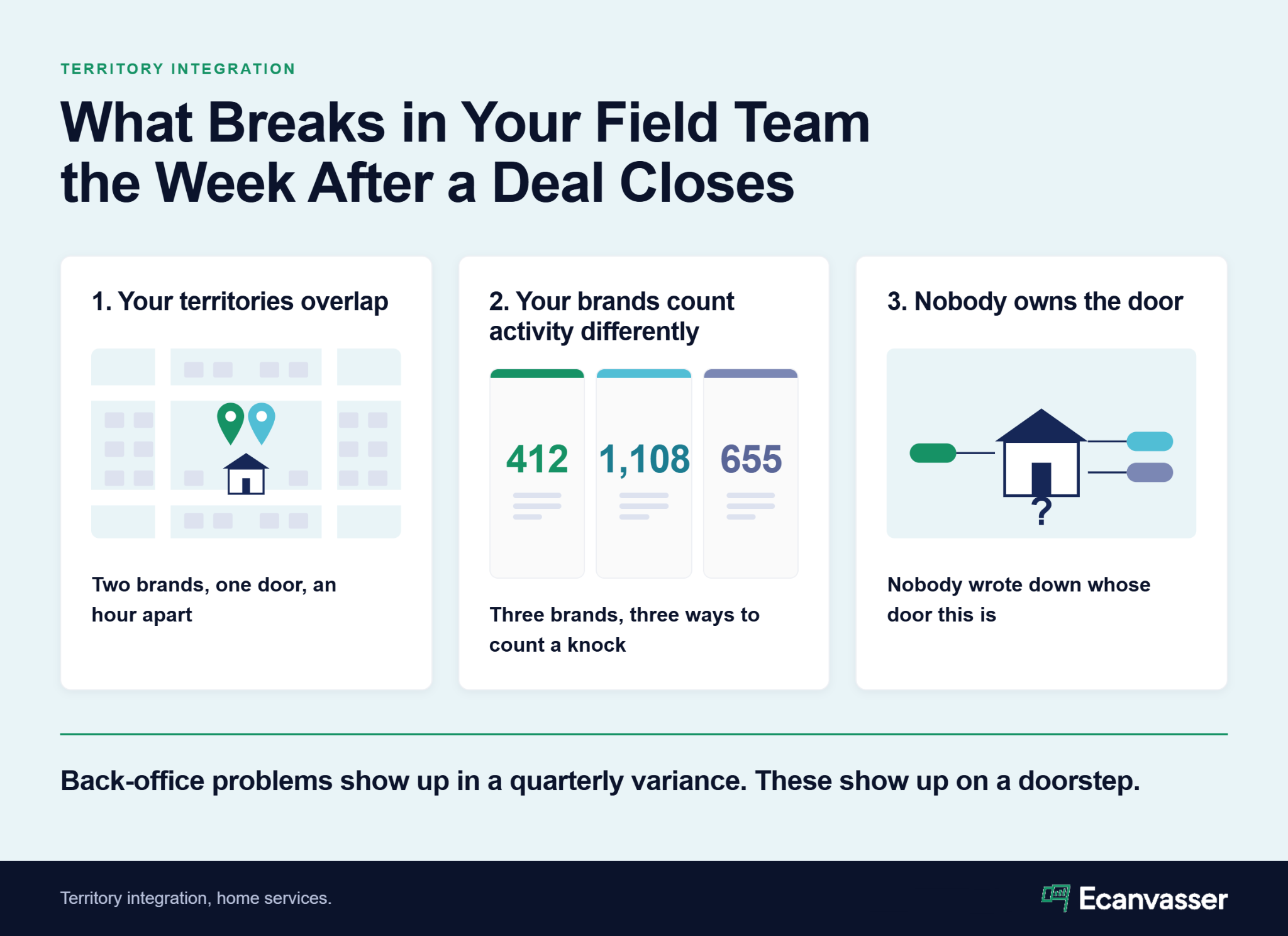
Three things break in the first week. Your territories overlap, your brands count activity differently, and nobody owns the doors that two brands can both claim. All three are map problems, and none of them appears on a standard integration plan.
Two acquired companies in neighboring markets almost always overlap at the edges, and often through the middle. Before the deal, both sets of reps worked those streets legitimately and neither knew about the other. Afterward, you are one company knocking twice. Two brands, one door, an hour apart.
The wasted drive time is real enough. The higher cost is the homeowner who now thinks your brand is disorganized, and two reps in your car park arguing about whose sale it was.
Each acquired brand logs the same day's work in its own way, so any figure you roll up averages things that were never the same measurement.
The usual culprits are:
None of it shows up until someone asks for a coverage rate across all three brands and gets a number that looks perfectly reasonable. This is a measurement problem long before it is a systems problem. That is why the reporting section later is mostly about definitions.
In a home services roll-up, two of your brands can legitimately service the same address, either for different trades or for the same trade in a shared postcode. Ask who calls on that homeowner and the deal documents have no answer. Somebody has to write that rule down before anyone knocks, and most of what follows is about making it enforceable.
Territory management after an acquisition is a rebuild, not a merge. Merging three existing maps preserves every assumption that made them overlap. You inherit boundary logic drawn by three companies while they were competing. Start from the addresses instead. Territory integrity covers the discipline in general, and everything below is that discipline under acquisition conditions.
Follow these three steps in order:
Step two is the one that gets skipped, and it causes the most embarrassing week-one incidents. Picture a homeowner who already pays you monthly, opening the door to a rep from your own group who has no idea. That costs nothing to prevent.
It's important to set some ground rules if you want your team to be successful. Here are four ways of managing this.
The wrong rule chosen deliberately will beat the right rule left implicit. An unwritten rule gets resolved at the door, by whichever rep arrives first, and you find out about it from the customer. Time-bound list assignment turns whichever rule you pick into something the system enforces rather than something managers have to remember.
Rebranding after an acquisition is usually framed as a marketing call. Platforms tend to keep the local names, because local reputation is a good part of what they bought. That decision has an operational consequence nobody raises in the deal review. Your brands stay separate to the customer, while the map underneath them has to become single.
Both things can be true at once. Brand becomes an attribute of the territory rather than a reason to keep three maps. A rep sees their turf and their brand. You see the whole footprint in one view. Territory management is what makes the second half of that possible.
"Once we configured Ecanvasser for our peculiar use case, we have been benefiting from a reliable, intuitive, easily adopted, out-of-the-box SaaS solution. We are now seeing continuous improvements and new features without any further investment." - Gavin Langlands, Business Analysis and Change Management, Ringtons
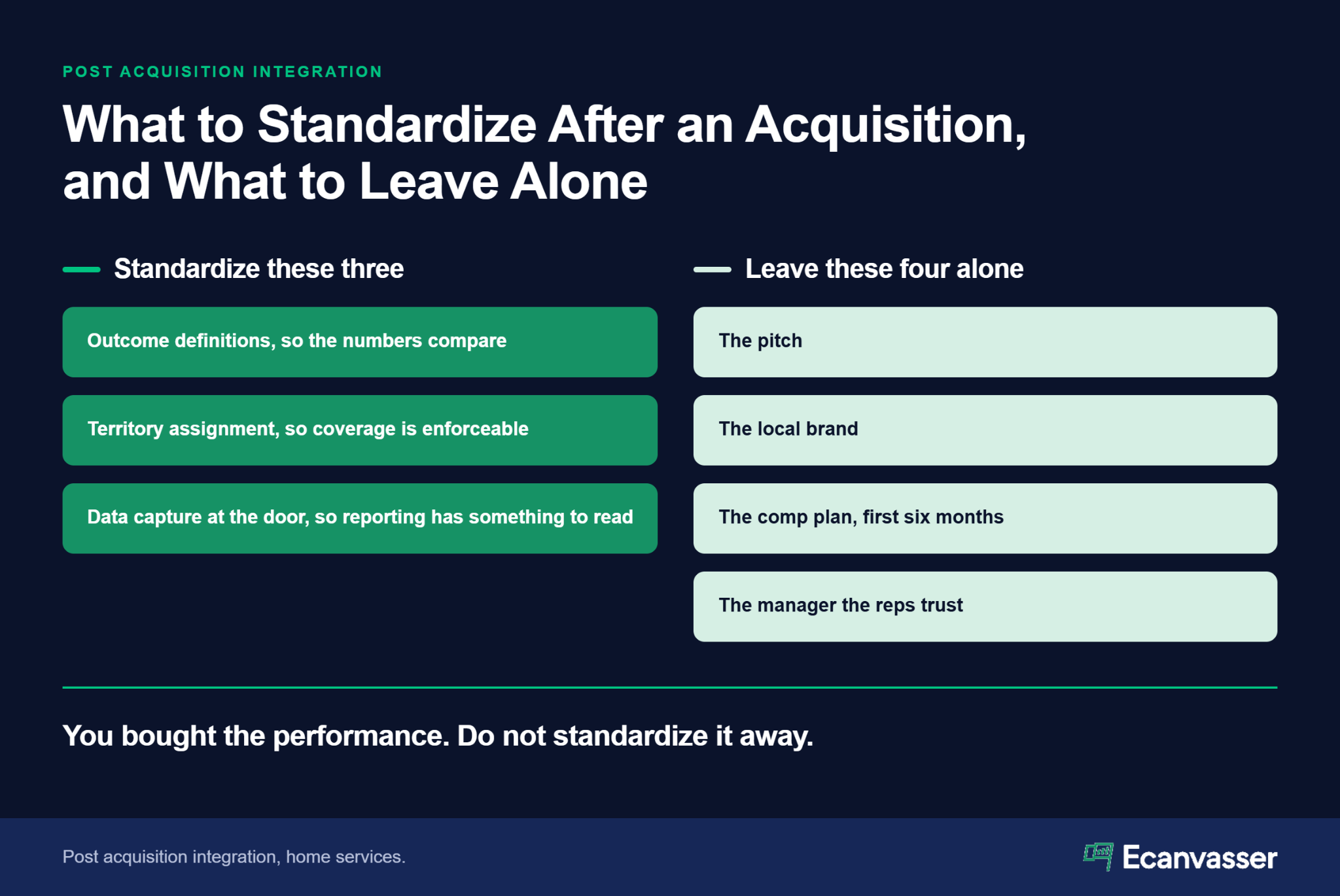
Your post-acquisition integration checklist will tell you to standardize. It will not tell you where to stop, and that is the whole difficulty. Standardize everything, and you destroy the performance you paid a multiple for. Standardize nothing, and you own three companies rather than one platform.
The split is more predictable than it looks, and you can settle it in an afternoon.
Standardize these three in the first month:
All three are preconditions for measuring anything. Everything else can wait until you can measure, and most of it should.
Leave these four alone:
Move any of these early, and you pay for it in attrition, at exactly the moment you can least afford to lose people.
Integrating sales teams after a merger fails at the same point every time, and the point is the reps. A finance team will tolerate six weeks of parallel systems because their work still gets done. A field rep whose turf is unclear for a fortnight starts taking calls from your competitors.
Field onboarding after an acquisition is mostly a territory problem wearing a training costume. Onboarding field reps covers the general version well.
An acquired rep already knows the trade, the pitch, and usually the streets better than you do. Three things are missing on day one:
Have those ready and your rep works a normal day, sells something, and goes home thinking the acquisition was fine. Leave them missing, and your rep spends a week in meetings, which is where doubt starts.
"When we merged with another broadband company, it was just so easy to onboard new staff, knowing that there wasn't going to be an extra cost, because we have unlimited licenses. We got them on board straight away, tested it, and got them using the software as quickly as possible." - Scott Kean, Field Sales Manager at Truespeed
Per-user pricing turns every add-on into a software line item that grows with headcount. Absorbing forty reps costs forty more seats before a single one of them has sold anything. The number is small against the deal value and large against the integration budget you were actually given. That is how it ends up shaping decisions it should never touch.
Ecanvasser is priced on leads rather than per user, so bringing an acquired team onto the platform does not require a new negotiation first. Licenses are unlimited, which also means the territory history stays with you when a rep leaves rather than walking out with them. The claim here is about cost predictability while your headcount is moving, not about being cheaper in every scenario.
Multi-location field sales management only works when every location counts the same way. Your sponsor will ask for one consolidated report long before that is true. Build the dashboard first, and you get a confident number that is wrong, which is worse than no number at all.
A consolidated report only means something if every brand fed it the same kind of data. Four things have to match:
Once those hold, one reporting layer across every brand becomes a configuration job rather than a project. One concession usually brings acquired managers on board, and it is worth offering early. Each brand keeps its own targets, as long as everyone shares the definitions underneath them.
Five numbers belong in the board pack, by brand and in aggregate.
Read that way, each one reports on integration progress rather than sales performance. That is what makes the set useful to somebody who has never knocked a door.
The first consolidated report a platform produces is usually the least reliable one it will ever produce, because it averages three brands that were counting different things. It is worth saying that out loud before anyone builds a target on it.
Everything above is worth doing once, and only because it makes the next one faster. Platforms that win at home services acquisitions integrate the third deal faster than the first. That compounding is the synergy the model actually depends on.
Triangle Home Services built a door-to-door operation from nothing in Raleigh and proved it worked. That result told them whether to expand into new company branches. What made the second market a decision rather than a debate was a playbook already written down. They hired and deployed a full field rep team with software costs staying flat throughout that growth. Houston was planned on exactly that basis. Prove the model in one market, then replicate it without the cost growing out of control.
That is the same arithmetic your sponsor runs, one level up. It works for home services field sales the way it works for a portfolio.
{{faq-1}}
{{faq-2}}
{{faq-3}}
{{faq-4}}
The deal thesis lives or dies on whether your field operation can absorb the next acquisition without resetting itself each time. What makes that possible is unglamorous. One map, shared definitions, turf assigned before a rep's first shift, and a reporting layer that reads the same data from every brand.
Want to size what your field operation is leaving on the table first? The ROI calculator does it in a couple of minutes. Ecanvasser does not charge you more as your headcount grows, which matters when growth arrives by acquisition.
Book a 15-minute consultation to see how platform teams run several brands on one map, or read more about running field sales across a multi-brand platform.
Usually yes, at least through the first year. Local reputation is often a meaningful part of what you paid for. Retiring it mid-integration risks the customer base and the reps who built it. Keeping the name does not require a separate territory map underneath it. Treat brand as an attribute of the territory instead.
Rebuild the map from a combined list of serviceable addresses rather than merging the two existing maps. Then write down one ownership rule for shared doors, by trade, by postcode, by existing relationship or by capacity, and enforce it through territory assignment. The rule matters less than having one before anybody knocks.
Days, not months, provided three things are ready before their first shift. Turf assigned in the new system, visibility of what was knocked before the deal, and a working way to log outcomes. Reps already know the trade and the streets. What slows them down is waiting for territory, not learning software.

Ecanvasser’s real-time tracking completely transformed our field operations. Through the dashboard, we can plan efficient routes, customize interactions, and monitor our canvas stops in real time to support our team the second they need help. The "verified drops" feature adds an extra layer of accountability, while the reporting tools make it seamless to track hourly visit rates and optimize performance on the fly.




Scale your operations, empower your reps, and deliver predictable, profitable growth with Ecanvasser.