Short on time?
Pick an AI to summarise this article:
Pick an AI to summarise this article:



Knowing how to motivate a sales team in the field starts with fixing what wears reps down each day. Bad turf, constant rejection, and long hours alone are the worst offenders. Give reps fair territory, a daily win they can see, and regular contact with you, and any rewards you add later will actually stick.
When a rep slows down 80 doors into a shift with no sale, it's easy to blame their attitude. Their drive usually isn't the real problem. They're working tired turf with no way to see their effort adding up.
Look up sales team motivation advice, and you'll find it's built for an office, with TV leaderboards and team lunches. None of it reaches a rep standing on a doorstep in the rain.
This guide covers what drains field reps and how to fix each drain, starting with the conditions you control.
I used to think a slow week meant my reps needed a better speech. More often, it meant we'd sent them down streets that had already been knocked twice.
Let's dive in.
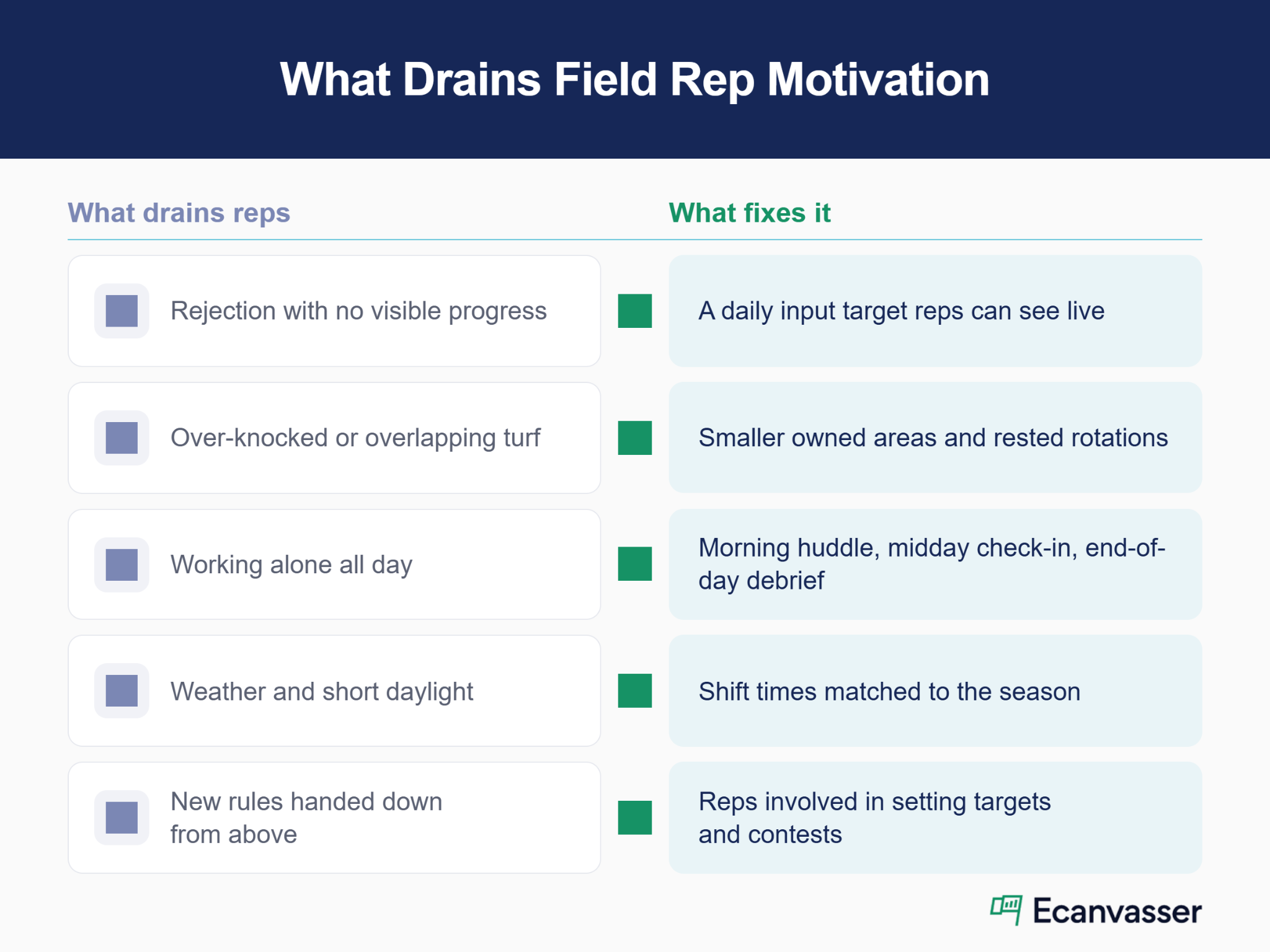
Your reps have a harder workday than anyone on an inside sales floor. They hear more "no" per hour, they work alone, and the weather sets their mood before the first knock. If you're losing people outright, our guide on why field reps quit covers turnover. This one is about the daily energy of the reps who stay.
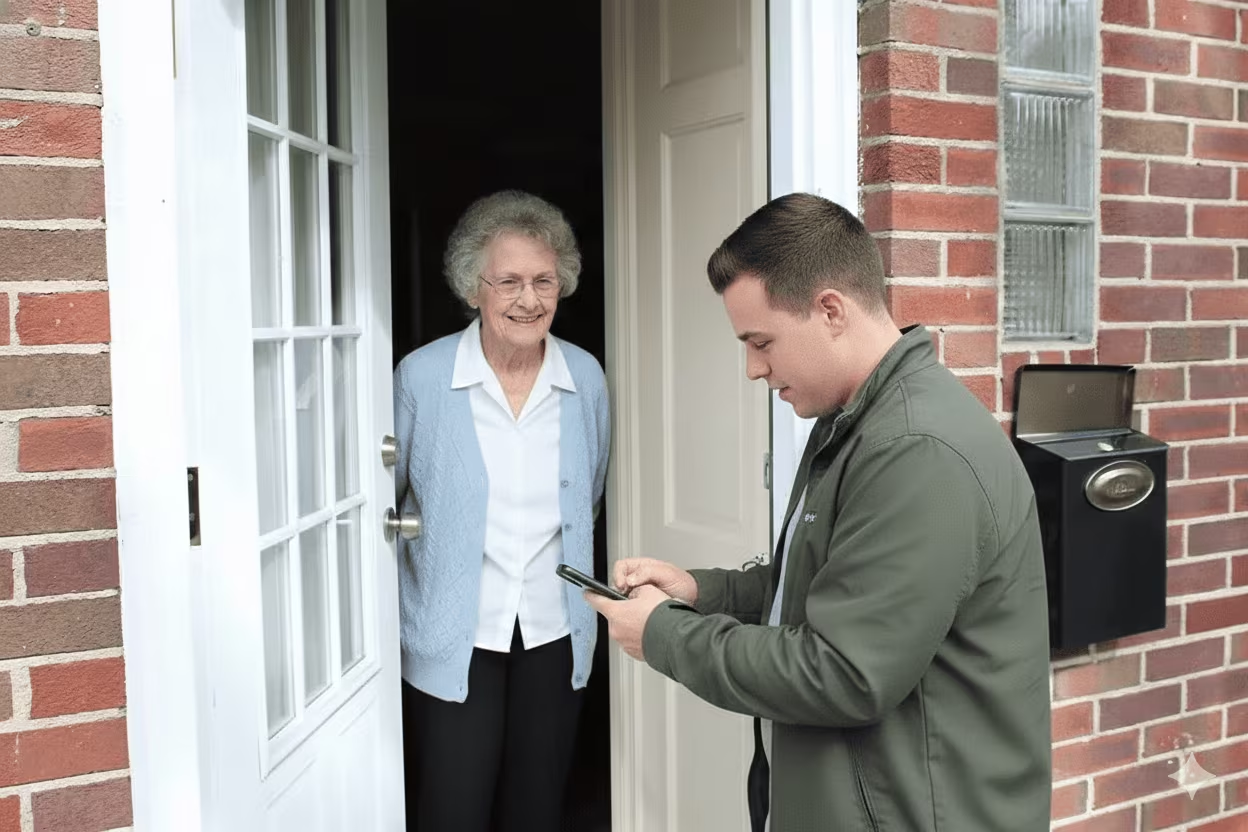
An inside rep might hear "no" a dozen times an hour. A door-to-door rep can hear it 100 times in a shift, face to face.
Rejection alone rarely breaks a good rep. Rejection with nothing to show for it does. When closed sales are the only number that counts, a day with no sale feels wasted, even if the rep did everything right. The fix is a daily win, covered below.
Then there's the heat, the cold and the rain. A neighborhood where nobody knows your name. No colleague nearby after a rude homeowner.
Isolation does more damage than it looks. Gallup found fully remote employees report daily loneliness at 25%, against 16% for fully on-site employees.
Your reps aren't remote workers, but they spend the day apart from their team in much the same way. The same research found people with a best friend at work are 21% less likely to be lonely. That's why daily check-ins matter so much in the field.
A rep can't stay positive working doors that can't convert. Before you rewrite the pep talk, look at how you plan territories.
Bad turf drains sales team motivation faster than any missed bonus. Watch for streets knocked twice in a month, reps overlapping in one area, and neighborhoods where nobody's home when you work.
A few changes can make turf fair again:
One UK field marketing agency used territory mapping and daily allocation to keep agents on structured rotations, rather than burning through doors. Over six weeks, sales rose from as low as 80 to 90 a week to a consistent 300 or more.
Owning an area is only half of it. The size of that area matters too.
"If a user just has a lot of lists and assignments, it might look like a good thing. But often they find that they need to give less territory in order to control it and the activity better." Jay Lipscomb, Customer Success Manager, Ecanvasser
What did your rep win today? If the honest answer is "nothing, unless they closed," you've built a job that feels like losing most days.
Give every rep a daily number they control, whether or not they make a sale:
Set a simple standard, like a daily doors target, and let each rep watch their own count climb on their phone. A Friday spreadsheet arrives too late to lift anyone's Tuesday. Ecanvasser's sales leaderboards and dashboards show reps and managers the same live numbers, so effort adds up in front of them during the shift.
The reps who last longest can tell you exactly what they got done today, even on a day with no sales. Give them that number and a bad day stops feeling like a wasted one.
None of this works unless reps log every interaction, and new teams rarely see why they should.
"Sometimes they think they do not need to log every interaction, and need to be shown the value of it." Thomas Hollingsworth, Enterprise Account Executive, Ecanvasser
Your reps don't share a break room, so camaraderie won't happen by accident. You have to schedule it.
A simple daily rhythm looks like this:
Pair new reps with experienced ones, and keep ride-alongs on the calendar. Push notifications let you recognize a win the moment it happens.
Why does your rhythm carry so much weight? Gallup's meta-analysis found that the quality of management explains 70% of the variance in team engagement.
Between check-ins, live visibility lets you help in real time. Triangle Home Services used Ecanvasser's real-time field tracking dashboard to see each canvasser's location and logged interactions, so managers could step in with instant support.
One pest control team saw activity collapse every July afternoon. Their manager moved the start later, added a shaded huddle, and posted each rep's live door count at 6 p.m. Within three weeks, doors knocked after 5 p.m. had roughly doubled.
Announce a new motivation program from the top, and you'll get compliance on day one and drift by week three. Reps back what they help build.
Bring one or two respected reps into the room when you set targets, turf rules or contest formats. Explain the reason behind every number you ask for. Even small choices count, like letting the team vote between two contest formats.
CSM Jay Lipscomb sees the same pattern when teams adopt new tools, and it applies to any new process you introduce:
"A lot has to do with the larger team buy-in, and if the team has someone or people who want to see the value and feel there is a need. If it's just a new tool that management says they have to use, it will fall through the cracks." Jay Lipscomb, Customer Success Manager, Ecanvasser
Prizes and contests feel like the obvious answer. Put them after the basics, not before.
Pay comes first. A commission plan your reps can't predict demotivates faster than any prize motivates, so get your commission structure right before adding extras.
Gamification works as an amplifier. Leaderboards and contests lift a team with fair turf and clear targets, but they can't rescue reps stuck on burned streets. Your reps will notice quickly if a prize is covering for a turf problem. Our guide to sales gamification covers how to design contests that reward the right behavior.
The numbers dip, and your instinct says rally the troops. Check the operation first. Three causes are worth ruling out before you treat a slump as a morale problem:
When the numbers drop, I check the map before I check the reps. In my experience, a slump usually starts with the territory, not the attitude.
Then reset short-term targets on inputs your reps control, like doors and conversations. Tell the team plainly when the dip isn't their fault. Move fresh turf to the reps who need a win most. For setting and reviewing targets over the longer term, see our guide to sales performance management.
You don't need a new program to start. Pick these up in the next five days:
Ecanvasser puts territory control, live field tracking and leaderboards in one app, so all three changes run from the same place. Start a free trial.
{{faq-1}}
{{faq-2}}
{{faq-3}}
Explore how our field sales software can transform results for your team.
Give them a win that doesn't depend on a sale. Show them their doors and conversations for the day, and recognize the effort in the end-of-day debrief. Motivating door-to-door sales reps after a rough day comes down to proving their effort counted and giving them better turf tomorrow.
Start with what money can't fix. Give reps fair, clearly owned territory, a daily number they can see climbing, and regular contact with you and their teammates. Recognize wins in public, and involve your best reps in setting targets. Reps who feel their days are winnable need less pushing.
Watch the activity data before the sales data. Start times drift later. Doors per hour fall off in the afternoon. Fewer interactions get logged per door. Each one shows up days or weeks before sales drop. When you spot the pattern, check the rep's turf first, then talk to them.
Ecanvasser’s real-time tracking completely transformed our field operations. Through the dashboard, we can plan efficient routes, customize interactions, and monitor our canvas stops in real time to support our team the second they need help. The "verified drops" feature adds an extra layer of accountability, while the reporting tools make it seamless to track hourly visit rates and optimize performance on the fly.




Scale your operations, empower your reps, and deliver predictable, profitable growth with Ecanvasser.