Short on time?
Pick an AI to summarise this article:
Pick an AI to summarise this article:



Your best new rep just handed in their notice. Four months in, they’re finally closing and worth the Saturday ride-alongs you gave up for them. Then they hand back the tablet, and you realize their callback list lived in their head.
That moment is familiar to anyone running a field team. Field sales loses people faster than almost any other sales role. Some sales rep turnover is healthy, because the doors filter out people who were never going to do the job. The rest has causes you can find and fix, and most of them sit inside your own operation.
So this guide does two jobs. First, it helps you keep more of the reps worth keeping, with field-specific reasons they quit and what to change in their first 90 days. Second, it makes sure that when someone does leave, the departure costs you a person, not a territory.
How much did your last departure cost you? If your answer is a recruiting invoice, you're counting the smallest line on the bill. Turnover hides behind two habits: measuring it as one number, and costing it as one expense. Pull those apart, and both the problem and the price get much easier to see.
When you say "turnover," you're probably bundling three different things. D2D HIRE, a door-to-door recruiting firm, splits it into fall-off, filtering and turnover. That means people who accept and never start, rookies the doors screen out early, and proven reps who leave after they've made it.
Lump all three together as sales rep churn, and you can't tell which one you have.
When a leader tells me turnover is killing the team, my first question is when people leave. A rep who walks in week one and a rep who walks in month six need completely different fixes.
The rest of this guide focuses on the proven reps, plus the avoidable part of early filtering.
You'll find two kinds of benchmark, and neither is an annual rate for field reps.
The first comes from desk-based teams. Alexander Group puts average annual cross-industry B2B sales rep turnover at 13.9%, with best-practice teams aiming for about 8%.
It’s useful as a contrast, not a target. Your reps work alone, outdoors, on commission.
The second comes from door-to-door itself. D2D HIRE tracks retention per rep who reaches the field. It treats roughly 60% at week one, 40% at day 30 and 20% at day 90 as healthy, based on its own mostly cold recruits.
Want the average sales rep turnover rate that matters? Trust your own stage-by-stage numbers first.
Here's how to price one departure yourself. Fill in the right-hand column with your own figures.
The ramp gap is usually the biggest line. Take an illustrative rep who sells 10 deals a month once ramped. If the replacement sells 3 a month through a six-week ramp, you've lost about 10 deals before counting anything else.
For a floor under all of this, look at Work Institute's 2025 Retention Report. It conservatively puts the cost of turnover at 33% of base pay, across all employees.
Field reps take pipeline with them, so treat that figure as the minimum.
Run your own numbers. The ROI calculator does the arithmetic for your team.
An inside rep who hears no forty times still has a desk, a team and a manager nearby. Your field rep hears it at forty doors, alone, then does paperwork at the end of the shift. Every cause below is something you control.
Rejection alone rarely drives a rep out. Rejection with no sign of improvement does.
Think about what your rep can actually see. If the only number they get is a monthly commission statement, a slow week looks like failure. A rep whose contact rate climbed this week can survive five days without a close. A rep who only sees closes can't.
So give every rep a live view of their own leading numbers: doors knocked, contacts, conversations, and appointments set. Progress they can see on a bad Tuesday is what gets them out the door on Wednesday.
Ecanvasser's new mobile app opens on a Home Activity screen that shows each rep their own numbers, live, from the moment they log in.
Your field rep can go a whole shift without seeing you. To them, silence reads as indifference.
The fix is small. A five-minute check-in at the start or end of every shift tells a rep someone is paying attention. Real-time visibility does more than catch problems, too. It lets you spot a good hour and say so while it still matters.
Use visibility as recognition, and reps stop reading it as surveillance. A quick message saying you saw their best street of the week costs you ten seconds. To a rep working alone, it's proof the effort is being noticed.
Picture your rep's day. A printed list in the morning. A separate app for directions. Notes scribbled at the door, then typed up at the kitchen table after dinner.
If that rep is on commission, every one of those minutes is unpaid, and they know it. Admin burden is a real reason field reps quit. Cutting it is a retention decision, as much as a software one.
That's the thinking behind Ecanvasser Mobile App 8.0. It brings one-tap logging at the door, routes planned before the rep leaves the car park, and offline sync for patchy signal. The interaction is saved before the rep reaches the next house.
Weighing up tools? Here's what a good field sales app should do.
The headline rate is rarely what breaks a rep. Three patterns do: commission-only with no draw during ramp, chargebacks that land weeks after a sale, and splits nobody can explain.
A rep who can't work out next month's check is already browsing job boards. Show them the math on day one, including what happens when a deal cancels. Predictability through the first 60 days does more than a bigger number.
If you're rebuilding the plan, start by designing a commission plan reps trust.
Who gets the worst turf on your team? Probably your newest rep. Veterans keep the proven patches, while rookies get knocked-out streets or empty greenfield.
Alexander Group saw this with one client. New hires got greenfield territories and bigger quotas, and most couldn't succeed. Turnover approached 25% until territories and quotas were rebalanced.
Give a new rep turf with a fair shot at early wins, and check knock history before you assign it.
"We love real-time tracking and reporting so we know that we only knock on the doors of the houses we can service and we can see whether we knocked them last week, last month or six months ago." Emma Pearce, Head of Marketing, Lightning Fibre
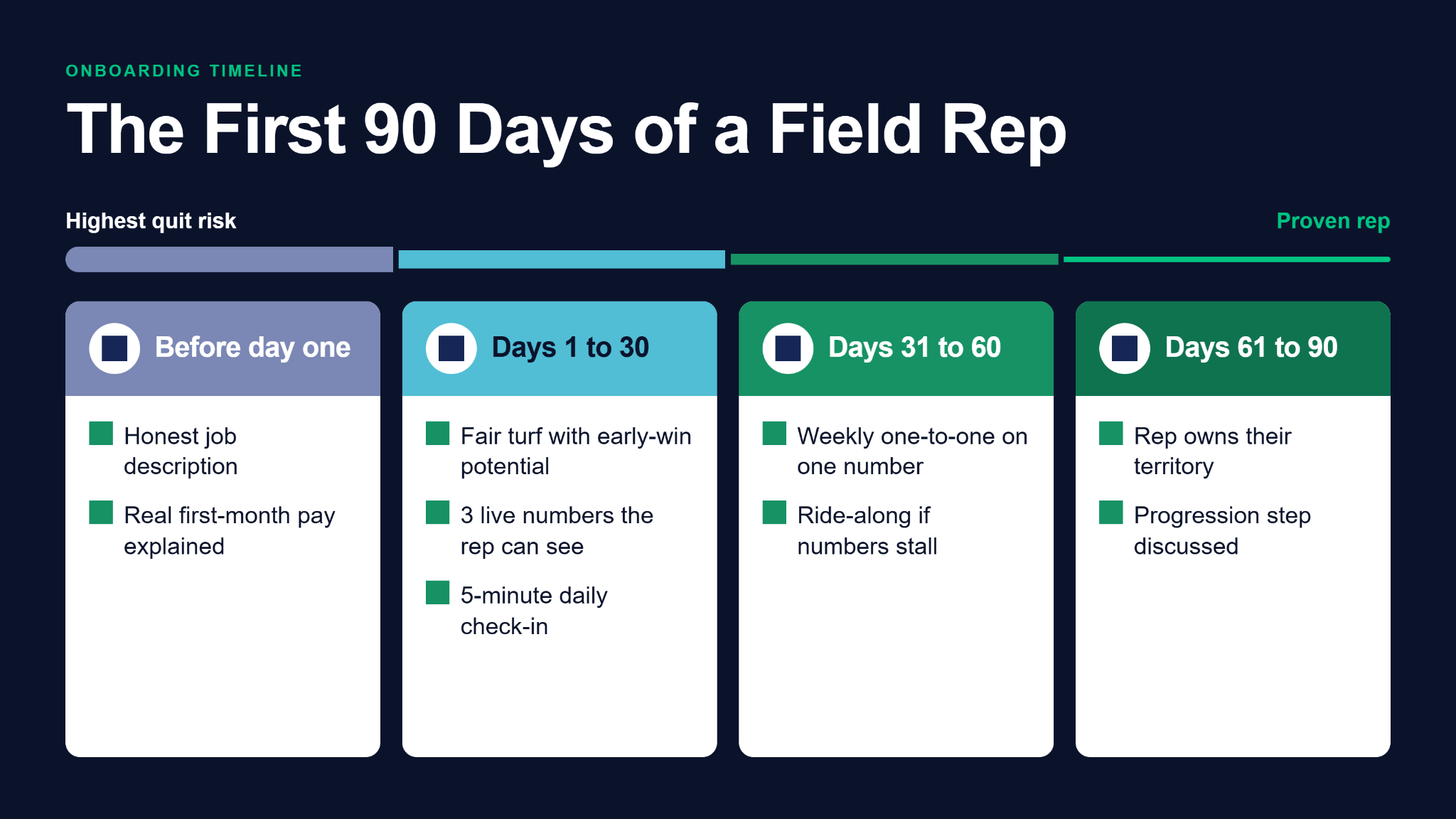
Work Institute's 2025 Retention Report finds that as much as 40% of all employee turnover happens within the first year. Field sales squeezes that window into weeks. So field sales rep retention is won or lost on a timeline, and here's the plan by time.
Plenty of week-two quits were decided at the offer stage. The candidate accepted a highlight-reel version of the job: the top earner's month, not a rookie's.
Describe the honest first month instead. Cover how much rejection to expect, what week-two pay looks like, and how long the ramp really takes.
Start with a job description that tells the truth about the role, then interview for resilience, not polish. The candidates who still say yes, knowing all that, are the ones you want. The ones who wouldn't have lasted leave before you've paid to train them.
Keep the first month simple. Three things matter more than anything else:
Use time-bound lists so a new rep only sees the turf they should be working, when they should be working it. That's one less way for a rookie to get lost.
For the full day-by-day sequence, see our field onboarding guide.
This is where proven reps start to slip away. The rep seems fine, so the check-ins stop, and nobody notices the numbers flattening.
Run a weekly one-to-one built on one live number. Use ride-alongs for reps whose numbers have stalled, and scoreboards to make progress visible. For a ready-made structure, use a 30-60-90 day plan.
"Rather than overwhelming teams with reports, I encourage a few key metrics: doors knocked, contact rate, and conversion or outcome tracking. It helps identify top performers and areas for improvement, and it enables daily optimization instead of end-of-week reviews. Small visibility can lead to big behavior change." Aoife Murphy, Customer Success Manager, Ecanvasser
The reps I've watched leave in month two rarely had a skills problem. They had gone three weeks without anyone telling them what they were doing well.
Here's the question I'd ask any field sales leader. If your best rep resigned tomorrow, what would you still know about their territory on Monday?
Be honest: is the answer "not much"? That rep was the only record of which doors were knocked, who asked for a callback and whose contract ends in spring. Some turnover is unavoidable. A turnover-proof team is one where departures don't erase the map.
Where does your team's field knowledge actually live? On a lot of teams, it's in notebooks, personal phones, WhatsApp threads, and memory.
eir, Ireland's leading telecom provider, runs field sales as its second-largest sales channel. Before moving to Ecanvasser, critical details like customer contract end dates lived in reps' notebooks, and they were often lost. Follow-ups are now tracked centrally and timed to those dates, so the knowledge stays when a rep moves on.
The rule is simple. Anything a rep learns at the door gets captured at the door, in a system the whole team shares.
Turnover carries a software cost you may not have priced. On per-seat field sales tools, every departure means a license to reassign or cancel. Every hire means another one to buy.
Under that pressure, corners get cut. Logins get shared. Leavers stay active for weeks, and access lingers where it shouldn't.
Ecanvasser prices by database records instead, with unlimited users. You can add a new rep the day they're hired, and a departing rep's history stays in the account.
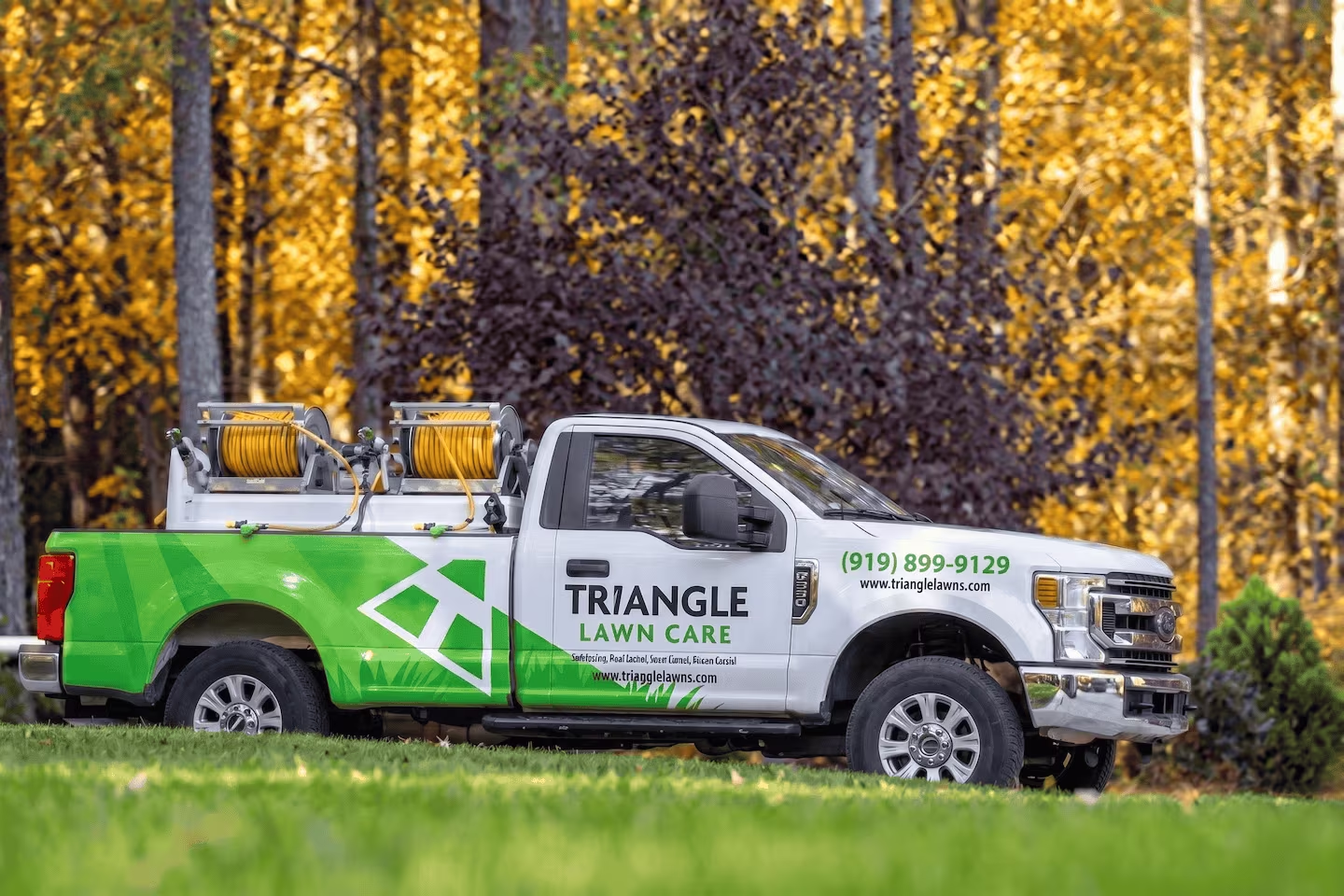
Triangle Home Services saw this when it launched a new door-to-door program. It hired and deployed a full field rep team, and its software costs stayed flat throughout. Competitors it evaluated were, in its words, "outrageously priced" for its needs.
When headcount keeps moving, a bill that stays still is one less cost of churn.
When history stays in the account, your replacement inherits a working map. That means every knocked door with its outcome and date, open callbacks and appointments, and notes on who said "come back in spring."
Reassign the departing rep's lists to the new rep on day one, instead of recutting turf. The alternative is a cold start. Your new hire re-knocks doors that said no last month, annoys the homeowner who asked for spring, and misses the callbacks already booked. That's how you keep territory insights, even in high turnover.
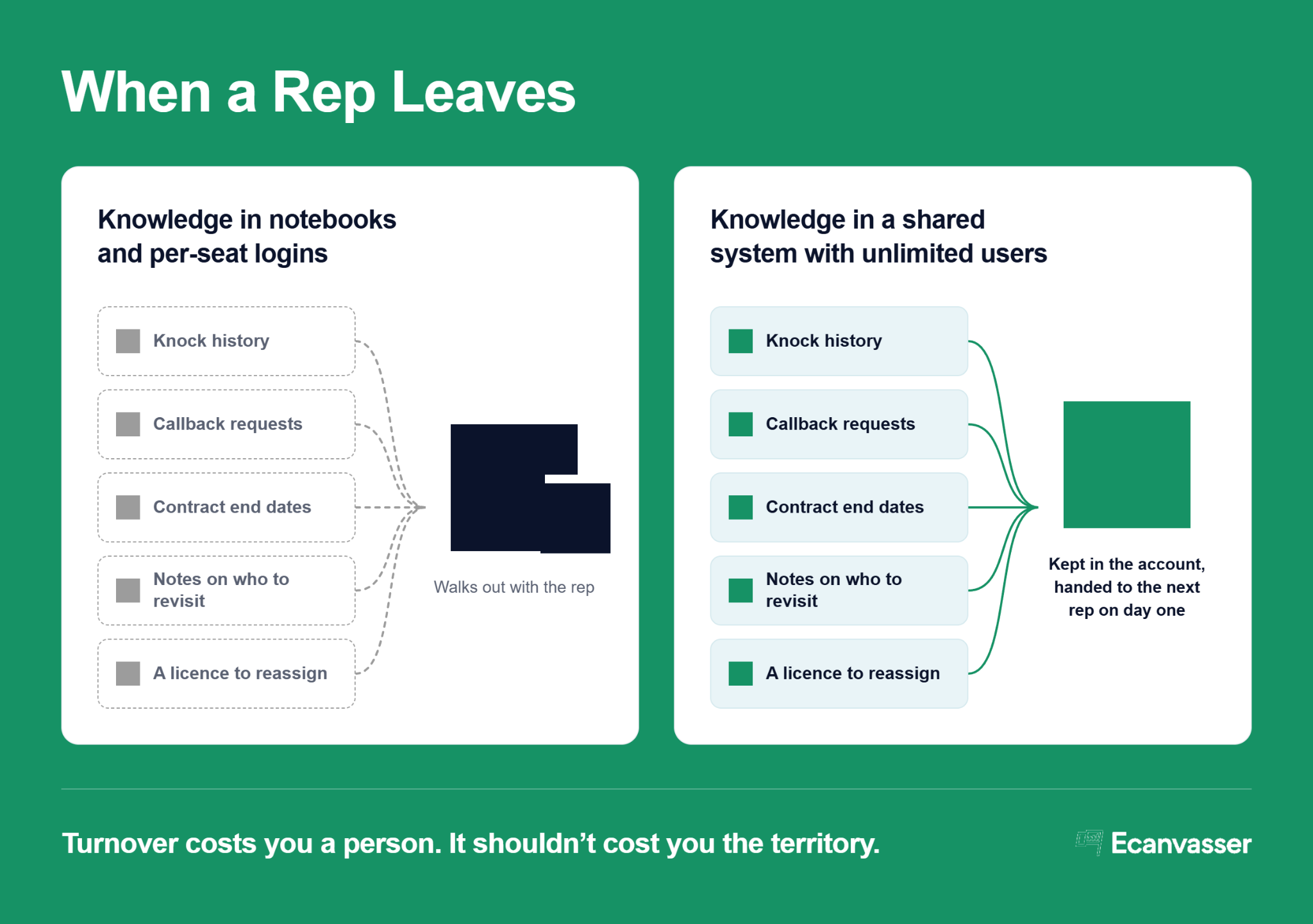
No field team gets turnover to zero, so don't try. Knowing how to reduce sales rep turnover is half the job. The other half is a team whose results hold when individuals leave.
If two star reps carry your numbers, every resignation becomes a crisis. Your team is only as strong as its most restless member.
A team that runs on shared territory rules, one logging standard and visible numbers can absorb a departure. The next rep plugs into the same system. How you structure the team matters as much as who's on it.
"Struggling teams rely heavily on individual reps being 'good'. Scaling teams build repeatable processes that lift the whole team. The difference: one is inconsistent and hard to grow, the other is predictable and scalable." Aoife Murphy, Customer Success Manager, Ecanvasser
Track four numbers for every hiring cohort:
The first stage that falls out of line tells you where to fix. D2D HIRE's planning picture for cold recruiting shows why. Of every 10 accepted offers, about 7 reach the field and about 3 are still selling past day 30. About 1 becomes a long-term keeper.
Count proven reps who leave separately. They're the expensive group.
Structure moves attrition as well as coverage. A UK field marketing agency running fiber and charity campaigns used Ecanvasser's territory mapping and daily allocation to put agents on structured rotations. That stopped teams burning through doors too early. Real-time tracking kept everyone accountable, and daily disposition reporting showed trends fast enough to act on them mid-campaign.
Over six weeks, weekly sales rose from as low as 80-90 to a consistent 300+. Attrition dropped to 23.1%, against a typical campaign rate of 32-34%.
{{faq-1}}
{{faq-1}}
{{faq-1}}
{{faq-1}}
Field sales will always lose people, but most of what drives your losses is yours to change. Show reps their progress. Check in daily. Cut the admin, make pay predictable, and give new reps turf with a real chance of early wins. Then coach from live numbers through day 90, when proven reps start to drift.
After that, do the part that protects you when prevention fails. Put every door, callback and contract date into a shared system. A resignation should cost you a person, never the territory. That's how you reduce sales rep turnover, and survive the turnover you can't prevent.
Want to see what that looks like on your team? Start a 7-day free trial.
It depends on the kind of team. Desk-based B2B benchmarks sit far below anything you'll see in door-to-door, where heavy early attrition is built into the model. Compare your own sales rep turnover rate stage by stage: reached the field, day 30 and day 90. Then fix the first stage that falls out of line.
More than the recruiting bill. Add manager time, the ramp gap while the replacement gets up to speed, lost callbacks and appointments, and the drag on peers covering the turf. The ramp gap is usually the largest line. Use the table above, or the ROI calculator, to price it with your own numbers.
Early quits usually come from a gap between the job described and the job lived. Relentless rejection with no visible progress, long shifts alone, unpaid admin, unpredictable pay and weak turf all widen that gap. Honest expectations before day one, plus live personal numbers from the first shift, close most of it.
Ecanvasser’s real-time tracking completely transformed our field operations. Through the dashboard, we can plan efficient routes, customize interactions, and monitor our canvas stops in real time to support our team the second they need help. The "verified drops" feature adds an extra layer of accountability, while the reporting tools make it seamless to track hourly visit rates and optimize performance on the fly.




Scale your operations, empower your reps, and deliver predictable, profitable growth with Ecanvasser.