Short on time?
Pick an AI to summarise this article:
Pick an AI to summarise this article:



Sales gamification works for field teams when two things are true. The scoreboard ranks verified activity that reps control, and contests give more than your top performers a chance to win. Get both right, and a leaderboard lifts effort across the whole team. Get them wrong, and the same few reps win every week while everyone else stops looking.
Field sales raises the stakes. Your reps don't share a sales floor, so nobody sees a colleague close a deal. The board also only knows what reps tap into their phones at the door. If you rank the wrong thing, the game starts rewarding the wrong behavior.
The first leaderboard I ever ran rewarded doors knocked, and within two weeks my top rep was also my worst closer. I'd built a game for logging, instead of for selling.
Gamification works best as one part of a wider sales performance management system. This guide covers what to put on the scoreboard, how to keep it honest, and which contests lift the reps in the middle of your table.
Your reps are competitive. It's part of why they took a job knocking doors. Sales gamification puts that instinct to work. It applies game mechanics like leaderboards, contests, targets and recognition to everyday sales activity, so effort and progress become visible and worth competing for. Done well, it gives a rep working alone a reason to push for one more conversation.
In the field, the mechanics stay the same, but the conditions change:
Those conditions are why field teams arguably need gamification more than inside teams. They're also why an inside-sales playbook, copied straight across, tends to fall flat.
If your reps have stopped checking the leaderboard, look at the board before you look at the reps. It's probably measuring the wrong thing, or measuring the right thing badly.
Rank only closed sales or revenue, and your best two or three reps will win every period. Everyone else learns, quickly, that they can't. In door-to-door, that podium owes as much to tenure, route familiarity and inherited turf as it does to talent. A board that only rewards the podium motivates three people out of thirty. The rest stop checking it, then stop trusting it. The fix is to rotate what you rank and run contests that someone in the middle can actually win.
Give one rep a dense estate of owner-occupied homes. Give another a spread of rural roads. Put them on one results board, and you know who wins. That tells you nothing about skill.
A raw-results leaderboard ends up ranking your territory planning instead of your people. Normalize before you compare:
Good territory management makes this easier, and so does treating territory integrity as a sales ops job.
Attach a prize to a metric, and effort moves toward it. In the field, self-reported activity is the easiest number to inflate. A "not home" takes two seconds to log, knock or no knock.
This pattern shows up well beyond field sales. In a 2024 field experiment, 410 employees across 42 supermarkets got relative performance information on their sales. When the information got more detailed, results fell on low-yield tasks (Kohler, Mahlendorf, Seiter and Vogelsang, Journal of Accounting Research, 2024). Fewer than a third of employees looked at it at all.
Your board has to measure the right thing, and it has to be hard to fool.
Which number goes on the board? It matters more than any prize. Keep the rule simple: rank what reps control, verify what you rank, and show everyone where the middle is.
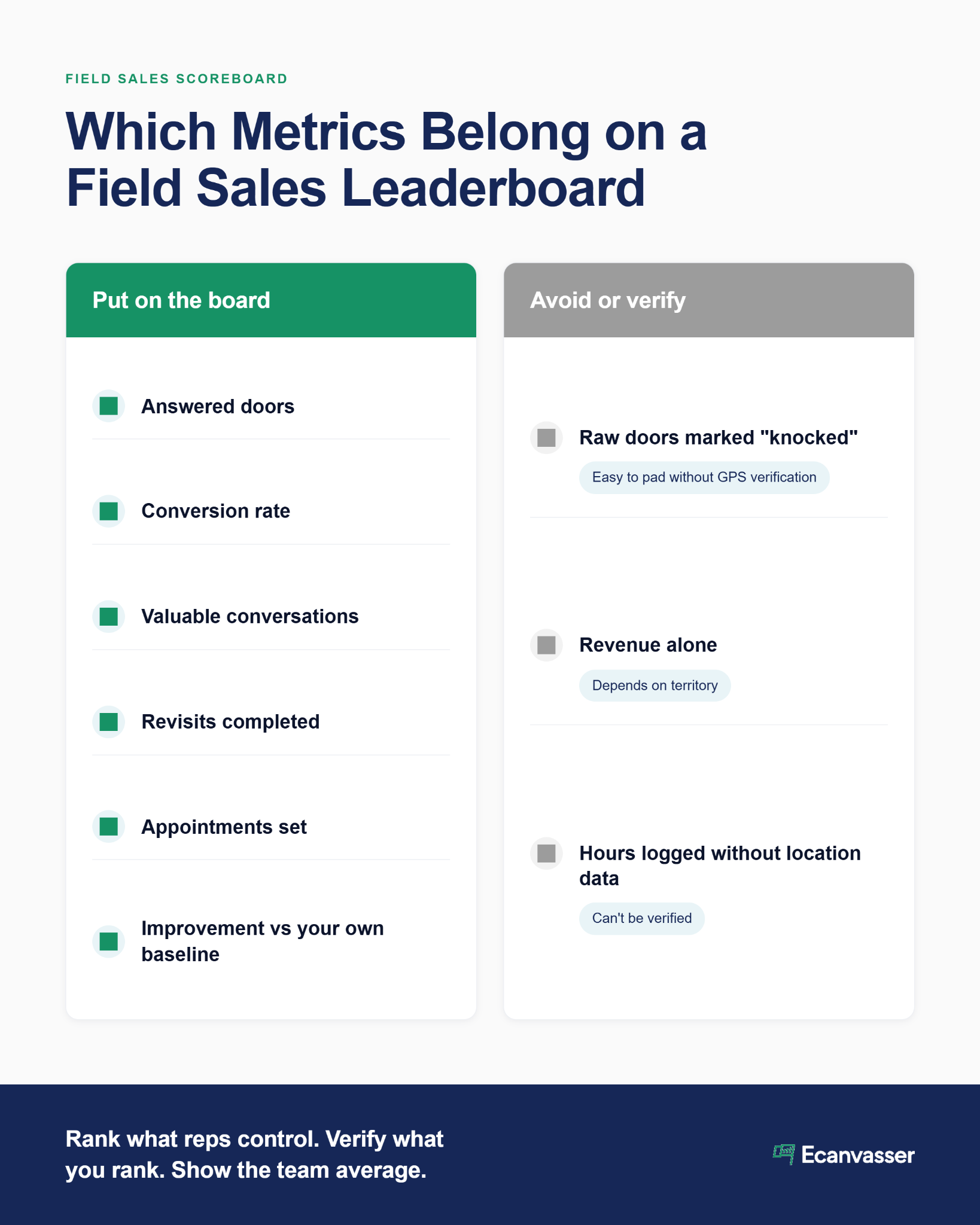
Closes and revenue depend on territory, season and product. Activities depend on the rep. A strong board pairs one outcome metric with two or three activity metrics. So a rep grinding through a tough turf still gets credit.
Our guide to field sales KPIs covers the full set. For a practical starting point, here's the shortlist from someone who reviews these numbers with customers every week:
"The top metrics for field sales managers are time started, time stopped, sales per day, valuable conversations and doors knocked per day." Thomas Hollingsworth, Enterprise Account Executive, Ecanvasser
Raw door counts are the easiest metric on any field board to game. A rep can walk a whole street, mark every house "not home" and never lift a knocker.
Rank these three numbers side by side instead:
Those are the three columns on the Ecanvasser scoreboard, which ranks every rep by attempts, answered doors and conversion rate. Pair them with GPS verification, so each logged interaction has to match where the rep actually was. Anyone padding one number will stand out on the other two. A high attempt count with few answers usually means a rep is rushing streets.
The reps with the most room to grow respond most to a leaderboard. Your stars were already pushing, so their numbers barely move.
In a field experiment, employees at a Fortune 500 distribution center received individual and relative performance feedback. The feedback had its biggest effect on lower performers, who raised their effort when it showed extra effort would pay off (Awaysheh, Bonet and Ortega, Production and Operations Management, 2023).
So put the team average line on the board, and bring it into your one-to-ones. A mid-table rep who sees a gap of six conversations knows exactly what this week asks of them. Rep-facing field sales dashboards make that gap visible without a manager pointing it out.
Resist the urge to pick the prize first. Set the goal, rules, and time box, then choose a reward that costs less than the improvement it buys.
Write the rules down before launch, and share them with every rep.
Make sure to cover:
Keep activity sprints to one or two weeks, and outcome contests to a month at most. Energy fades fast in the field. Post standings at the same time every day, at the morning huddle or end of shift, so momentum builds before the finish.
Individual contests suit experienced, self-driven reps. Team or crew contests suit mixed-tenure teams, and they ease the isolation of working alone all day. Tiered brackets, where new reps only compete against new reps, stop veterans from winning by default.
Mix formats across the quarter so different people get a real shot. Run at least one team format for crews that rarely see each other. Filtering the scoreboard by division makes office-against-office contests simple to set up.
Public recognition is cheap, and it works. Gallup and Workhuman tracked employees from 2022 to 2024. Those who got high-quality recognition were 45% less likely to have left after two years.
The best prize I ever offered cost nothing: the winner picked their own turf for the following week. Reps fought harder for that than for any gift card.
Other cheap wins include an early finish on Friday or a shout-out from the regional VP. Skip anything that pulls reps off the doors. Keep prizes in line with your door-to-door sales commission plan, and watch your sales rep turnover numbers.
The moment a prize goes on the line, someone will test the rules. That's normal, and you can plan for it. Make the board harder to fool than it is to win:
Treat verification as fairness to your honest reps. They're the ones most annoyed by padded numbers. For the wider system, see how to hold field sales reps accountable.
"Lightning Fibre had an issue with guys taking breaks, recording fake people, and not being active. Field Tracking helps track this, and once it was viewed and addressed with the team, we saw better field tracking results: more greens and less red and orange." Jay Lipscomb, Customer Success Manager, Ecanvasser
Read the full Lightning Fibre story.
Picture a home services team running a two-week "most doors" sprint. The leader logged nearly twice the team average, with a conversion rate close to zero. When the manager compared entries against GPS data, whole streets had been marked "not home" from a parked car. The team relaunched on answered doors and appointments set, and the next sprint booked more appointments than the first.
Running the same contest every month is how a leaderboard dies. Rotate your contests so different reps can win, and match each one to a problem you're fixing this month.
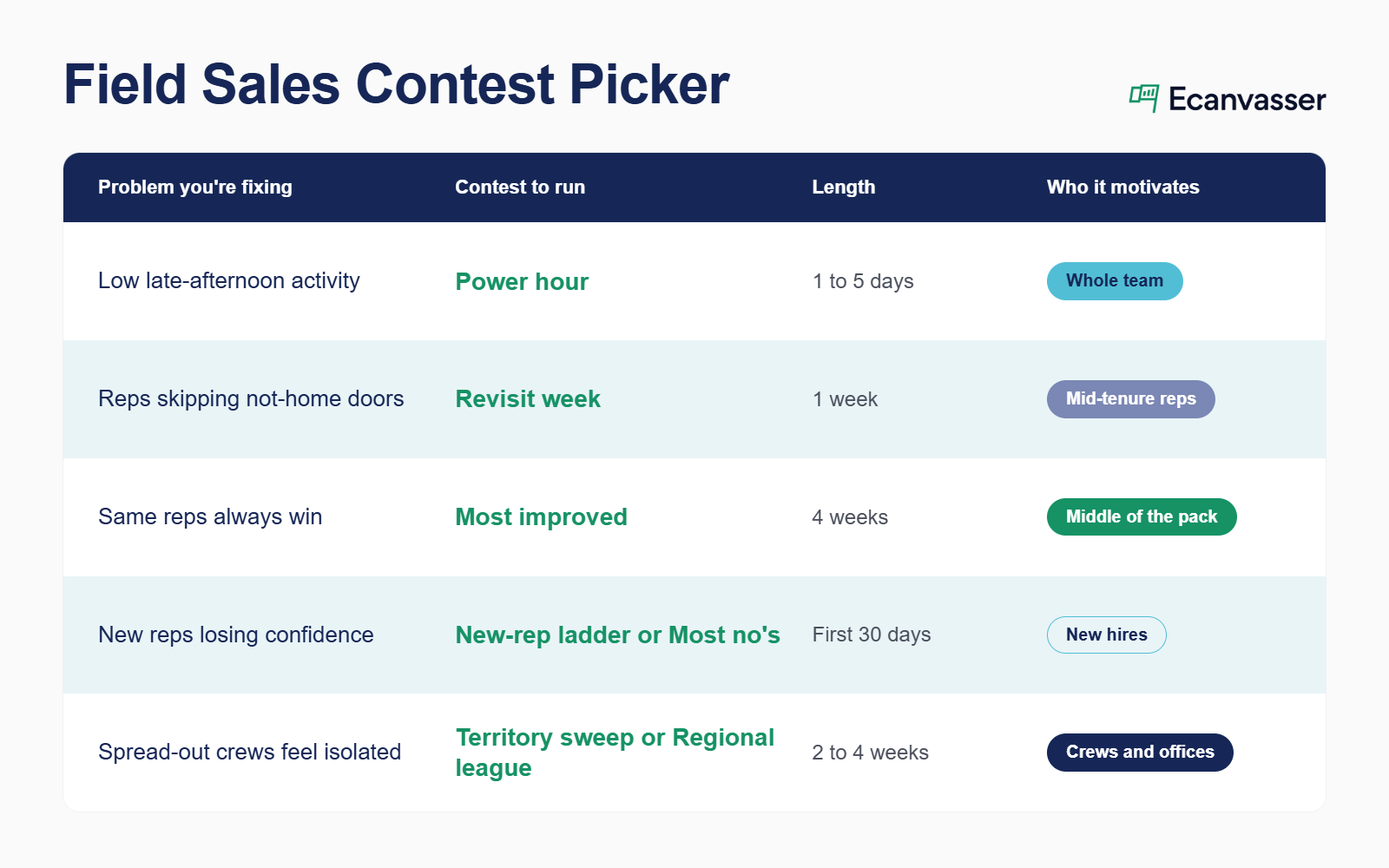
These are great for a quick burst of gamification:
Post standings daily, and keep each sprint short enough that nobody falls out of reach.
Spread-out crews rarely see each other, so team contests give them a reason to talk.
Both formats build peer coaching, because a crew's score depends on its weakest rep. Keep crews to five or six reps so nobody can hide. Ask a crew captain to post a short update each evening. Filter the scoreboard by division, and each office sees its own standing in the league.
These formats are built for the middle of your table:
A daily standard only works when it's clear and countable:
"Doors knocked can help set a standard or measurable goal that reps can work towards, like 100 doors a day. Interactions recorded shows whether they're only knocking once or revisiting. It shows a bit more effort is taking place." Jay Lipscomb, Customer Success Manager, Ecanvasser
Thirty days in, ask whether the program changed selling or just changed logging. Check three things:
Pull the four weeks before launch as your baseline, so you're comparing like with like. If a contest moved logging but not selling, drop it or redesign it. Then decide next month's contest based on what actually moved. Custom dashboards and reports make it easy to track these trends week by week. Fold the results into your regular sales performance management reviews.
I judge every contest by one question: did the reps in the middle get better? If only the leaderboard changed, the program didn't work.
For the wider morale question, read our guide on how to motivate a sales team.
Shopping for sales leaderboard software? Put any tool through these questions:
The Ecanvasser scoreboard ranks reps by attempts, answered doors and conversion rate, fed by real-time field tracking. Pricing doesn't scale per user, so a bigger contest never means a bigger bill. Dedicated gamification platforms go further on mechanics like badges and reward stores, and some field tools sell gamification as a paid add-on.
If you want a board your reps trust, built on verified data, try Ecanvasser free for 7 days. Ask to see the leaderboard with your own territories and reps during the trial.
{{faq-1}}
{{faq-2}}
{{faq-3}}
{{faq-4}}
If you’d like a personalized walk-through of our field sales software, talk to our Sales team.
Yes, as long as the scoreboard runs on verified data and the contests give more than your top reps a chance to win. Door-to-door reps work alone, so visible progress and recognition fill a gap the job leaves open. Rank answered doors and conversion rate alongside attempts, and normalize for territory so the board reflects effort and skill.
Pair one outcome metric, such as sales or appointments per day, with two or three activity metrics your reps control. Good choices include hours active, answered doors, valuable conversations and revisits. Show conversion rate next to volume so quality counts. Then display the team average, so mid-table reps can see the gap they need to close.
Keep activity sprints to between one and five days, and most activity contests to two weeks at most. Outcome contests, like most improved, need around four weeks to show a real trend. Anything longer than a month loses energy in the field. Post standings daily, and reset the contest instead of extending it.
Ecanvasser’s real-time tracking completely transformed our field operations. Through the dashboard, we can plan efficient routes, customize interactions, and monitor our canvas stops in real time to support our team the second they need help. The "verified drops" feature adds an extra layer of accountability, while the reporting tools make it seamless to track hourly visit rates and optimize performance on the fly.




Scale your operations, empower your reps, and deliver predictable, profitable growth with Ecanvasser.