Short on time?
Pick an AI to summarise this article:
Pick an AI to summarise this article:



Let’s say that two of your reps finish the month with the same number of sales. One had a fresh territory full of people who'd never heard your pitch. But the other worked an area your team had already covered again and again.
On the quota report, they look identical. Yet the rep who worked the tougher territory is the one more likely to be pulled aside and asked why their numbers aren't higher.
I've sat in reviews where the number on the screen was really a verdict on the territory. The rep took the blame for a map we drew.
That's the blind spot in a lot of sales performance management advice. It assumes your numbers are accurate and comparable from one rep to the next. When your reps sell away from a desk, they rarely are.
In this guide, we cover field sales performance management built on verified activity, drawing on what we've seen across 15,000+ field teams. You'll get a four-part system for targets, visibility, coaching and consequences, plus a fair way to run a PIP when a rep is underperforming.
Your reps are busy, and the number still won't move. Before you ask for more effort, look at the system they're working inside.
Sales performance management is how you set expectations, see what's really happening, coach to close the gap, and act on the results. Software vendors define it more narrowly, as quota planning, incentive compensation, and forecasting. Those tools matter. They plug into the bigger system: the way you run your team every week.
Pushing harder won't fix a broken system. Gartner found that the traditional fixes of more training, resources, and coaching are no longer improving seller performance. Sellers are already overwhelmed by what the role demands.
So treat performance as a loop with four parts:
Each part depends on the one before it. If your targets are unfair, your visibility tracks the wrong things, and coaching inherits the error. Your sales operations team usually owns the plumbing this loop runs on.
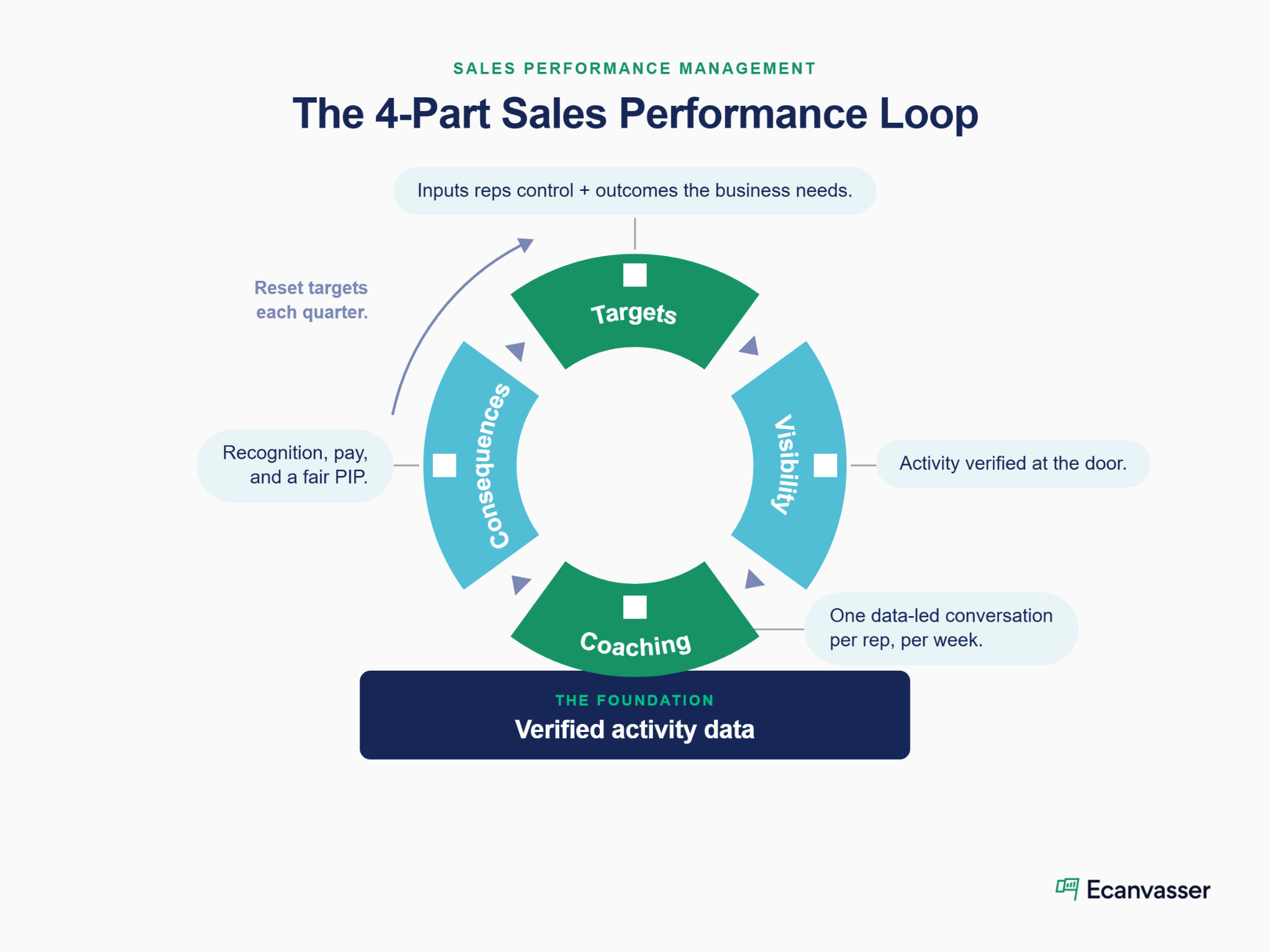
The target sheet is where performance systems break, long before anyone opens a dashboard. A target only changes behavior if a rep can move it this week. Revenue matters, but territory, product availability, and season shape it as much as effort does.
Give every rep two kinds of targets:
The split turns every missed number into a diagnosis. Low outcomes with inputs on target point to skill or territory. Low inputs point to effort or obstacles. Without the split, every review becomes an argument.
The first thing I change on a new team is the target sheet. If a rep can't move a number by Friday, it shouldn't be the number we manage them on.
Copying one quota to every rep assumes every territory is equal. In field sales, they never are. Set outcome targets against each territory's potential: serviceable addresses, knock history, and past conversion in that area. Then hold every rep to the same input targets.
Watch for one trap. Bigger areas make activity look high while coverage quietly suffers.
"If a user has a lot of lists and assignments, it might look like a good thing. Often they find they need to give less territory to control it and the activity better." Jay Lipscomb, Customer Success Manager, Ecanvasser
A UK field marketing agency selling fiber door-to-door learned this firsthand. Its managers used territory mapping and daily allocation to keep agents on structured rotations, plus real-time tracking. Weekly sales climbed from as low as 80 to 90 to a consistent 300+ over six weeks.
A monthly quota tells a rep where they ended up. It doesn't tell them what to do at 10 am on a Tuesday.
Translate your input targets into a daily standard reps can check before lunch. That might be a doors-per-hour pace or a floor for conversations per shift. A rep who sees they're behind at midday can fix it that afternoon. A monthly number tells them three weeks too late. That's the difference between correcting a day and explaining a month.
For the full method, see our guide on how to hold field sales reps accountable.
Inside sales tools log calls and emails automatically. Your field reps' activity is mostly self-reported, or invisible. Build field sales performance management on unverified activity, and you'll reward the reps who report well instead of the reps who sell well.
Picture the end of a long shift. A rep logs the day's doors from memory, rounds up, and adds a few contacts who never answered. Now you're coaching and paying on a story instead of a record.
Verified activity looks different. Each interaction is logged at the door, timestamped and checked against GPS location. The record and the rep's position agree.
One UK fiber team found some reps were taking long breaks and recording contacts who didn't exist. On paper, their activity looked great. Once managers reviewed field tracking with the team and addressed it openly, interactions verified at the door rose and flagged ones fell. For the first time, managers had numbers they could coach from.
You don't need a dashboard with 30 widgets.
Focus on a short list of numbers, and only keep the ones that tell you what to do next:
Use dashboards you can filter by rep, team or territory so you compare like with like. Our field sales KPIs guide goes deeper.
"Some teams think they don't need to log every interaction. They need to be shown the value of it." Thomas Hollingsworth, Enterprise Account Executive, Ecanvasser
Here's the value that convinces reps. Verified data protects your best people.
Remember the rep on the over-knocked streets? With verified inputs, they can show they did more work than the rep with the easy territory. Their effort finally has a record.
So give reps access to their own numbers in the app. Reviews stop holding surprises, and good reps can make their own case. Tracking becomes evidence they own and can point to. That's a fair trade for logging every door.
Ask your managers how often they coach. Then ask your reps. In a Salesloft survey of sellers and managers, 94% of managers said regular coaching is part of their process. Yet 53% of sellers said they're coached quarterly or less, and 37% rarely or never get personalized feedback.
The gap widens in the field, where you can't overhear a call. More coaching hours won't close it. Better choices will.
Your input and outcome split tells you which conversation to have:
Only the last one usually needs a ride-along. Before any coaching session, write the diagnosis in one sentence. If you can't, you're not ready to coach yet. One clear diagnosis keeps the session focused on one fix.
Your reps are spread across a map, so keep the rhythm light and consistent:
Consistency beats length. If a week gets busy, protect the weekly one-to-one first. And make sure your reps see the same numbers you do.
Targets and coaching lose their grip when nothing follows from the results. Follow-through takes three forms: recognition, pay and action on persistent gaps. For the softer side, see our guide to keeping a field team motivated.
Recognize verified inputs as well as outcomes, so reps on tough turf still get seen. Public scoreboards work when they rank numbers that are fair to compare, like conversations per hour. Raw sales across unequal territories just reward the best map. Ecanvasser's scoreboards rank individual stats like sales or door-knocking attempts. For contests and leaderboards, see our guide to sales gamification.
Commission should only pay out on activity and sales your system can confirm. Pay on self-reported numbers, and you end up rewarding creative logging. Reps also deserve to know exactly what counts.
Verified records also settle the disputes every field team knows, like who knocked first or who owns a lead. For plan design, see our guide to door-to-door sales commission.
One bad week is noise. Weather, holidays and territory rotation all swing field results.
Act when a gap persists for three or four weeks on the inputs a rep controls.
Then escalate in steps:
Each step gives the rep a fair chance. None of them should come as a surprise.
Treat a performance improvement plan for sales as the last step of your system. A fair sales PIP uses the same verified numbers the rep has been seeing all along. Nothing in it should surprise them, and nothing in it should be up for debate.
Before you write a PIP, check three things:
If any answer is no, fix the system first and re-measure. Either way, document what you checked. This protects the company too. A PIP built on an unfair comparison is easy to dispute.
I've never regretted pulling a rep's territory data before writing a PIP. I've regretted skipping it.
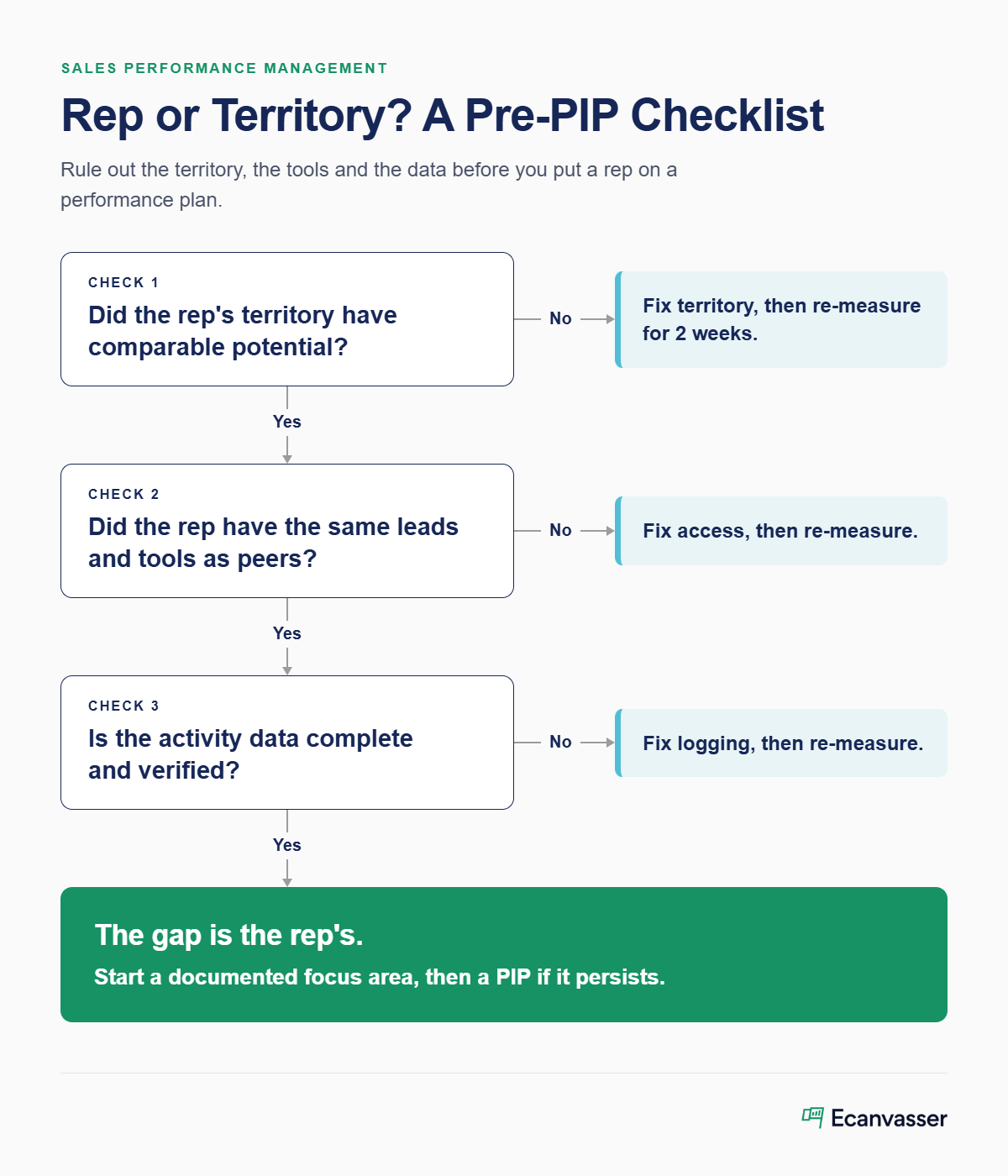
Keep the plan short, specific and written in plain language. One page is usually enough. A strong sales PIP covers:
Weight the input targets most heavily. The rep fully controls them, so they're the fairest sign that things are changing. Share the exact dashboard view the rep will be measured on, so you're both reading the same numbers.
Use 30 days for activity gaps. Allow up to 60 for skill gaps, which need coaching time to show up in the numbers. Review progress weekly on the same dashboard the rep sees, and document every check-in. Bring HR in before the final step.
Some PIPs end in an exit. Keep a steady hiring pipeline so one underperformer never holds a territory hostage. Our guide to sales rep turnover covers that side.
"Keep hiring all the time. Door to door can be a revolving door." Thomas Hollingsworth, Enterprise Account Executive, Ecanvasser
Shopping for sales performance management software? Start by checking what it assumes. Most SPM tools are compensation and quota platforms that expect clean activity data in your CRM. A field team needs that activity layer first.
SPM suites handle quota planning, incentive compensation and forecasting. Field activity platforms capture verified work at the door, map territories and report by rep. If you can't trust your activity data, the second has to come first. A compensation engine can only calculate pay on data that already exists.
Ecanvasser sits in that second category. It connects to your CRM and feeds it verified field activity.
Truespeed shows what that looks like. The full-fibre provider moved off spreadsheets and paper to real-time tracking that spots under- and over-performing reps. Its sales and analytics teams now work from one central data source.
Take these into any software demo:
Question four matters more than it looks. Per-seat pricing turns every new hire into a bigger software bill. That's a strange penalty for growing.
You don't need to rebuild everything at once. Make one change per week, and let each one settle before the next:
By the end of the month, you'll know which numbers you can trust. And your reps will know too.
Want to see verified field activity by rep and territory? Book a call with Sales and we'll show you how it works.
There are four. Targets set what reps should achieve, split into inputs they control and outcomes the business needs. Visibility shows what's really happening, ideally verified at the door. Coaching closes the gap between the two. Consequences, including recognition, pay and PIPs, follow from the results. Software vendors also include incentive compensation and forecasting, which plug into the same loop.
Thirty days works for activity gaps, like a rep who isn't knocking enough doors. Skill gaps need longer, up to 60 days, because coaching takes time to show up in the numbers. Either way, check in weekly using data the rep can see. Involve HR before the final step so the process stays consistent and fair.
Sales management is the day-to-day job of running a team: hiring, scheduling, solving problems and keeping reps moving. Sales performance management is the system underneath that job. It covers the targets, data, coaching and follow-through that make performance measurable. Good sales management runs on it. Without it, decisions rest on instinct. With it, every decision has a number to stand on.

Ecanvasser’s real-time tracking completely transformed our field operations. Through the dashboard, we can plan efficient routes, customize interactions, and monitor our canvas stops in real time to support our team the second they need help. The "verified drops" feature adds an extra layer of accountability, while the reporting tools make it seamless to track hourly visit rates and optimize performance on the fly.




Scale your operations, empower your reps, and deliver predictable, profitable growth with Ecanvasser.