Short on time?
Pick an AI to summarise this article:
Pick an AI to summarise this article:



Sales operations is the function that builds and runs the systems your sales team works from: territories, data standards, lead routing, tools, and reporting. On a field team, those systems also have to work for reps who spend the day knocking doors. When nobody owns them, your numbers stop agreeing with each other.
You may have seen how that plays out. Your VP asks which territory made the most money last quarter, and your regional manager gives one answer. The CRM report shows another, and finance has a third from a spreadsheet that gets updated on Fridays. Each source is counting something slightly different, because nobody wrote down the definitions and rules they should share.
Ecanvasser has worked with more than 15,000 teams, who together have knocked over 100 million doors and imported more than 400 million leads.
Teams that keep their numbers consistent past 50 reps have one thing in common. Someone owns these systems, even if their job title says something else.
When I first tried to build a forecast for a field team, I was working from three spreadsheets that each counted doors differently. We had simply never agreed on what counted as a door.
In this guide, you'll find the five systems field sales ops owns and the field-specific rules that general sales ops advice leaves out. You'll also see who can run ops before you hire for it, plus a checklist for your first 90 days.
So, what is sales operations on a field team, in practice? The core job is the same as for any sales team, but the systems sit in very different places.
On an inside sales team, most of the work happens in the CRM. Reps manage a pipeline from their desks, and activity arrives as logged calls and emails. On a field team, the work is spread across a territory map, the front door, and a rep's phone. That phone is often in an area with weak mobile signal.
That adds four things sales ops has to plan for:
Admin already takes up much of a seller's week. Across sales roles, reps spend just 40% of an average workweek selling and 60% on non-selling work, according to Salesforce's State of Sales.
On a field team, good sales ops reduces that admin load by making territories, data entry, and reporting simpler for reps and managers.
These roles overlap, and when nobody draws clear lines between them, important work goes unowned.
Your field managers and directors are responsible for people and results. They decide who needs coaching and adjust the week's plan when it isn't working on the ground. The field director owns results across the whole operation, while the field sales manager runs the team day to day.
Sales ops builds and maintains what those managers rely on: the written rules, clean data, and working tools.
The sales operations vs. revenue operations question comes down to scope. RevOps applies the same work to marketing and customer success as well as sales. A field team needs sales ops long before it needs RevOps.
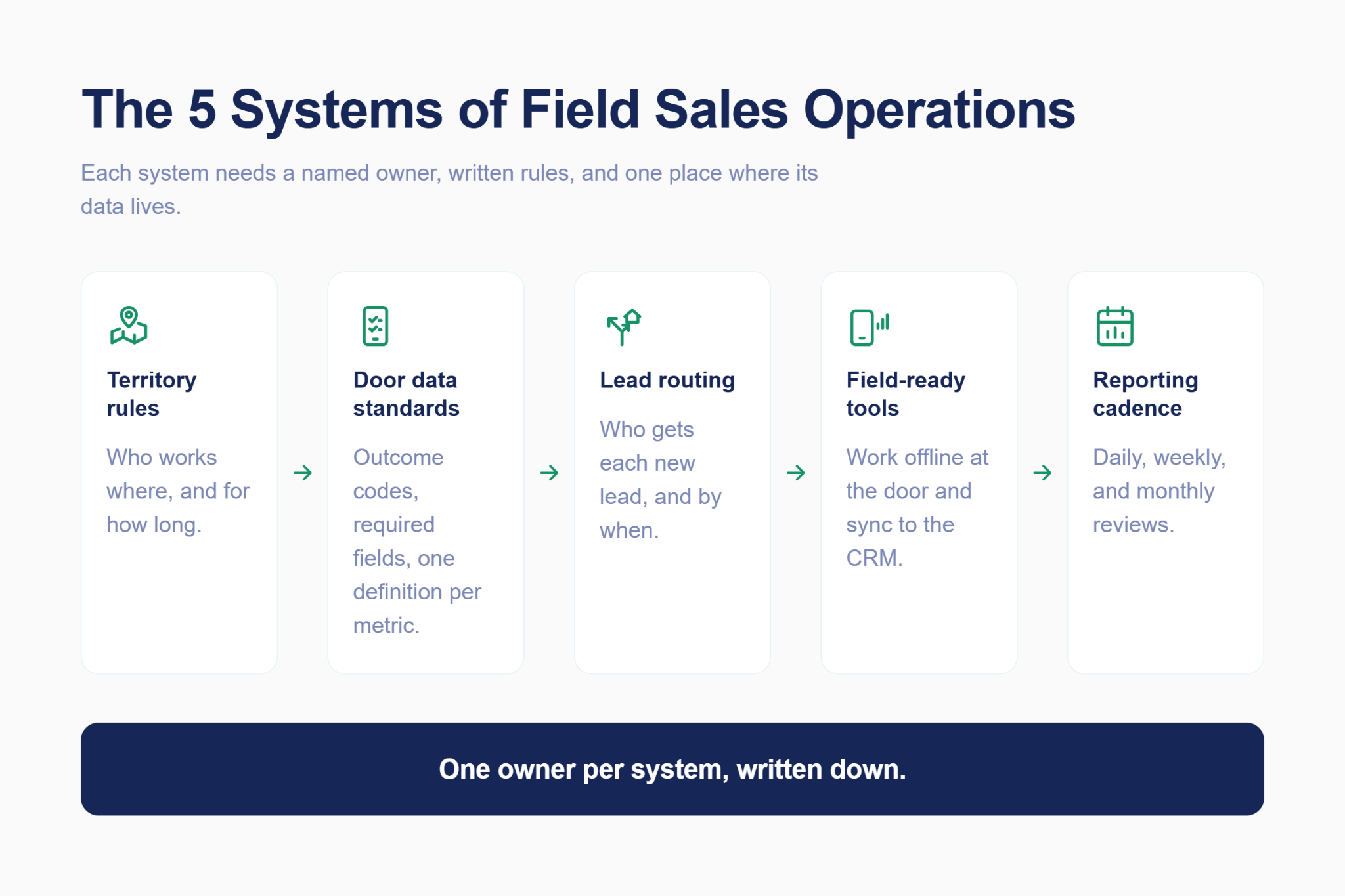
Field sales ops covers five systems. Each one needs a named owner, a written set of rules, and a single place where its data is stored. Without an owner, a system tends to get run by whoever pushes hardest that week, and the rules change with them.
The five systems depend on each other. Territory rules decide where reps go, and data standards decide what they record there. Lead routing decides which new leads they pick up. Your tools hold all of that information, and the reporting cadence turns it into decisions. A problem in any one of them shows up in your weekly numbers.
Your territory plan sets out who should work where, and sales ops turns that plan into rules the whole team follows.
Boundaries are usually drawn around serviceable addresses, housing density, and drive time, and our guide to sales territory planning covers that method in detail. For sales ops, the bigger question is ownership: who can change a boundary, and who has to approve the change. From there, write down how territories are assigned and how long a rep keeps one before it rotates. Also set when access to each area opens and closes.
Controlling access matters because reps will otherwise drift into areas that aren't theirs. With time-bound lists, a list appears in a rep's app when their assignment window starts and disappears when it ends. That keeps reps in their assigned areas without a manager having to check by hand.
I've learned to write the territory rules before anyone draws a boundary. Who gets a territory, how long they keep it, and who keeps the callbacks when it moves cause more arguments than the map itself.
Territory capacity is part of this system too. Multiply the doors one rep can knock per day by the number of working days, then compare the result with the addresses in the territory. If the rep can't realistically cover the area, the territory is too big, and extra effort won't fix it. A full capacity plan involves more than this, but the basic check catches the worst mismatches. Repeat it whenever you add reps or redraw a boundary.
The quality of your field data depends on what a rep can record in the few seconds they have on a doorstep. Whatever your system asks for in that moment is the data you'll end up reporting on, so sales ops has to design it carefully.
Start with a short set of outcome codes, such as not home, not interested, callback booked, sale, and do not knock. Keep the list small enough that a rep can tap through it between doors. Only add required fields where a decision depends on them. Keep free-text notes to a minimum, since they're hard to count or filter in reports.
Bad data is common even in office-based teams. Validity surveyed CRM users for its State of CRM Data Management report. Of those, 76% said less than half of their organization's CRM data is accurate and complete.
Field data is even more exposed, because notes written up in the evening from memory lose detail with every hour. Capturing the outcome at the door, against a standard set by sales ops, avoids most of that loss.
"Before they switch, a lot of teams collect data inconsistently and enter it late, or not at all. It ends up hard to use for targeting or reporting, so it gets treated as admin rather than something of value." Aoife Murphy, Customer Success Manager, Ecanvasser
Our guide to canvassing data covers which fields to capture at the door in more detail.
Sales ops also needs to merge duplicate records, so one household's history isn't split across two entries. It should also write one definition for each metric, so a "contact" means the same thing in every region. Our guide to field sales analytics covers which metrics to build on top of clean data. If the problem is the quality of the lists themselves, our guide to homeowner lists covers sourcing and accuracy.
When a web form comes in on a Tuesday afternoon, someone needs to decide which rep visits that home and when. If it waits until someone happens to check a shared inbox, the lead loses value while it sits there. Sales ops writes a routing rule so the decision happens the same way every time. A simple version looks like this:
Write down the time limit before a lead moves to the next person. Referrals, revisits, and callbacks need the same treatment, so each one ends up on a specific rep's route on a specific day.
Booked visits need a backup plan as well. With an appointment scheduler, managers can reassign meetings based on rep availability, so a rep's sick day doesn't leave a homeowner waiting. For response times and the points where field leads tend to stall, see our guide to speed to lead.
Lead distribution for field teams is a large topic, so start with one written rule and review it after a month. Check how many leads end up on the manager's unassigned list. If that number keeps growing, either your territories or your time limit needs adjusting.
Every tool your reps use should work while they're standing at a door, with weak signal and a homeowner waiting. When a tool doesn't, reps work around it by keeping notes on paper or in their heads, and your data suffers.
Sales ops owns the tool stack and how the tools connect. Your CRM remains the main record for each account. A field sales platform handles what the CRM wasn't designed for. That includes territories and routes, door-level outcomes, and offline capture that syncs when signal returns. That field data then flows back to the CRM through integrations. For more on the CRM side, see our guide to the field sales CRM.
Adding more tools has a cost. Teams not on a single platform use an average of eight standalone tools, according to Salesforce's State of Sales. And 42% of reps say they're overwhelmed by too many tools.
"A lot of teams come to us from an old system, either built in-house or a competitor's tool, that just didn't work anymore. Usually the team started to get bigger or the company started to grow. They needed a new tool." Jay Lipscomb, Customer Success Manager, Ecanvasser
Whether to build or buy is another sales ops decision. An in-house app can match your current process closely, but someone has to maintain it as the team and process change. Our in-house software comparison walks through that trade-off. Pricing models matter here too. Per-seat tools add cost with every new rep, while lead-based pricing ties the cost to the size of your territory.
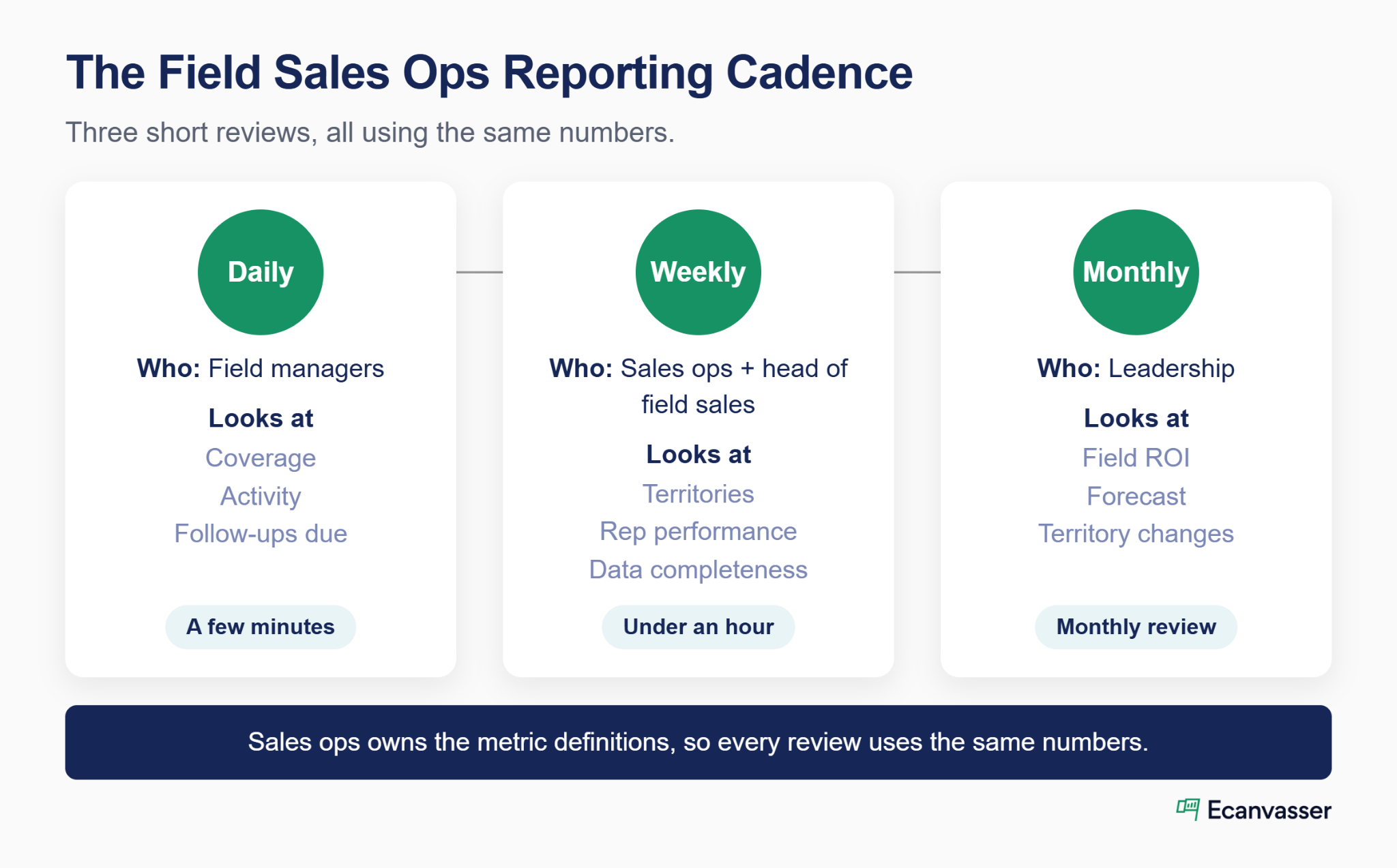
A regular reporting cadence is how you replace those three conflicting answers with one number everyone accepts.
It works in three layers:
Sales ops owns both the metric definitions and the process of combining every team's figures into the weekly report. Because the same person controls both, the weekly number means the same thing in every region. Keep each review short: the daily check should take minutes, and the weekly review should fit within an hour.
For dashboard layout, see our guide to the field sales dashboard. For how managers use the numbers to coach, see our guide to sales performance management.
A single shared data source also settles arguments about whose numbers are right. Truespeed, a full-fibre broadband provider reaching over 170,000 premises in the South West UK, ran door-to-door sales on spreadsheets and paper. Its data was unreliable and easy to lose. After moving to Ecanvasser, its direct sales team and analytics team worked from one central source. Both could see conversion rates per door, which property types convert best, and contract end dates worth following up. Read the Truespeed story.
If your team has 20 to 50 reps, you probably don't have a sales operations manager yet. The work still gets done, but it's spread across you, a capable team lead, and whoever is most comfortable with spreadsheets. Usually, nobody has written down who owns what.
Start by listing the five systems and putting a name next to each one, even if the same name appears three times. That alone makes it clear who to ask when something breaks.
When you're ready to hire for the role, it helps to know what the job covers. On a field team, sales operations manager responsibilities usually include:
Clean commission data prevents a lot of disputes, because disagreements about pay usually come down to whose activity records are correct. See our guide to door-to-door sales commission for plan design.
The role doesn't include coaching reps or running the daily team meeting, which belong to your field managers. Instead, sales ops makes sure those managers go into each conversation with numbers they can trust.
The job also changes as the team grows. At around 30 reps, the role is hands-on: fixing records, redrawing territories, and chasing missing outcomes. At around 150 reps, the sales ops manager spends more time setting rules and building reports, while team leads handle the day-to-day fixes.
Look for someone who is comfortable with both maps and spreadsheets, and ideally someone who has worked a territory themselves. A person who has knocked doors understands why a long form never gets filled in on a doorstep. They also know which rules reps are likely to ignore.
There's no fixed headcount that tells you it's time to hire. These signs are more reliable:
Any one of these means the work has outgrown what someone can handle alongside their main job. Two or more suggest it's already costing you money. Before you hire, write down which of the five systems the new person will own from their first day.
Leadership still needs to own the program after the hire. If the first ops hire is left to build everything alone, the rules won't stick, because nobody with authority is backing them. The new person runs the systems, but you still decide what they're for. For the wider question of organization design, see our guide on how to structure a sales team.
General sales ops advice is mostly written with office-based teams in mind. It rarely covers the rules that only exist because your reps sell door to door. Each rule below needs an owner and a written policy. Write it before a dispute comes up, because a rule written in the middle of an argument can look like it favors one side.
When a rep hands in their notice, you need to know who inherits their territory and who keeps their open callbacks and booked appointments. You also need the knock history to stay attached to each address. Ideally, these rules are written down before anyone leaves.
The knock history is the most valuable part. It tells the next rep which homeowners asked them to come back in the spring. It also shows which streets were worked recently and shouldn't be knocked again yet. For ways to keep reps longer in the first place, see our guide to sales rep turnover.
A 40-rep pest control team rebalanced its territories every quarter. Each time, reps argued over who got paid for callbacks booked in the old territory, and some of those callbacks were never worked. Sales ops wrote one rule: a callback stays with the rep who booked it for 14 days, then moves to the new territory owner. The disputes stopped, and missed callbacks started showing up in the weekly report.
Knocking the same door too often can turn a homeowner who might buy in six months into one who complains. Sales ops sets revisit rules for each outcome, including how long certain doors rest:
The right rest period depends on your product and the season. A solar team with a long sales cycle may rest doors for months. A broadband team may return sooner, timed to a homeowner's contract end date. Set a starting rule, then review it each quarter against the results revisits actually produce.
These rules only work if reps and managers can see when each door was last knocked. Real-time field tracking shows activity as it happens, so managers can spot an area being worked again too soon.
Compliance also needs an owner, and for field teams it starts on the doorstep. In the US, that means local solicitor permits and No Knock registries, which our guide to homeowner lists covers in more detail. In the UK and EU, it means recording consent before you store personal data under GDPR. Check the specific requirements with your own legal counsel.
Sales ops decides what gets captured, when, and where the record is stored. If a customer or regulator asks, you should be able to produce that record in minutes, which is very hard to do with paper forms.
Ringtons, the UK tea and doorstep delivery business, runs 230 van routes across three regions and 20 sales offices. Part of its canvassing team captured data on paper and typed it in later, which left no auditable consent trail. Ecanvasser replaced that process with digital consent captured on the doorstep, along with verified address data. Adoption tracking from day one also showed managers which canvassers weren't capturing data. Read the Ringtons story. To support this kind of process, Ecanvasser includes a data privacy toolkit with built-in tools to protect customer data and support compliance.
If you've just been given responsibility for field ops on a team of 20 to 200 reps, work in three 30-day blocks. Each block ends with something concrete you can show leadership. Avoid making changes in the first few weeks, because changes made before you understand the operation often have to be reversed.
This plan covers the systems themselves. For a field manager's own first three months, see our 30-60-90 day sales plan.
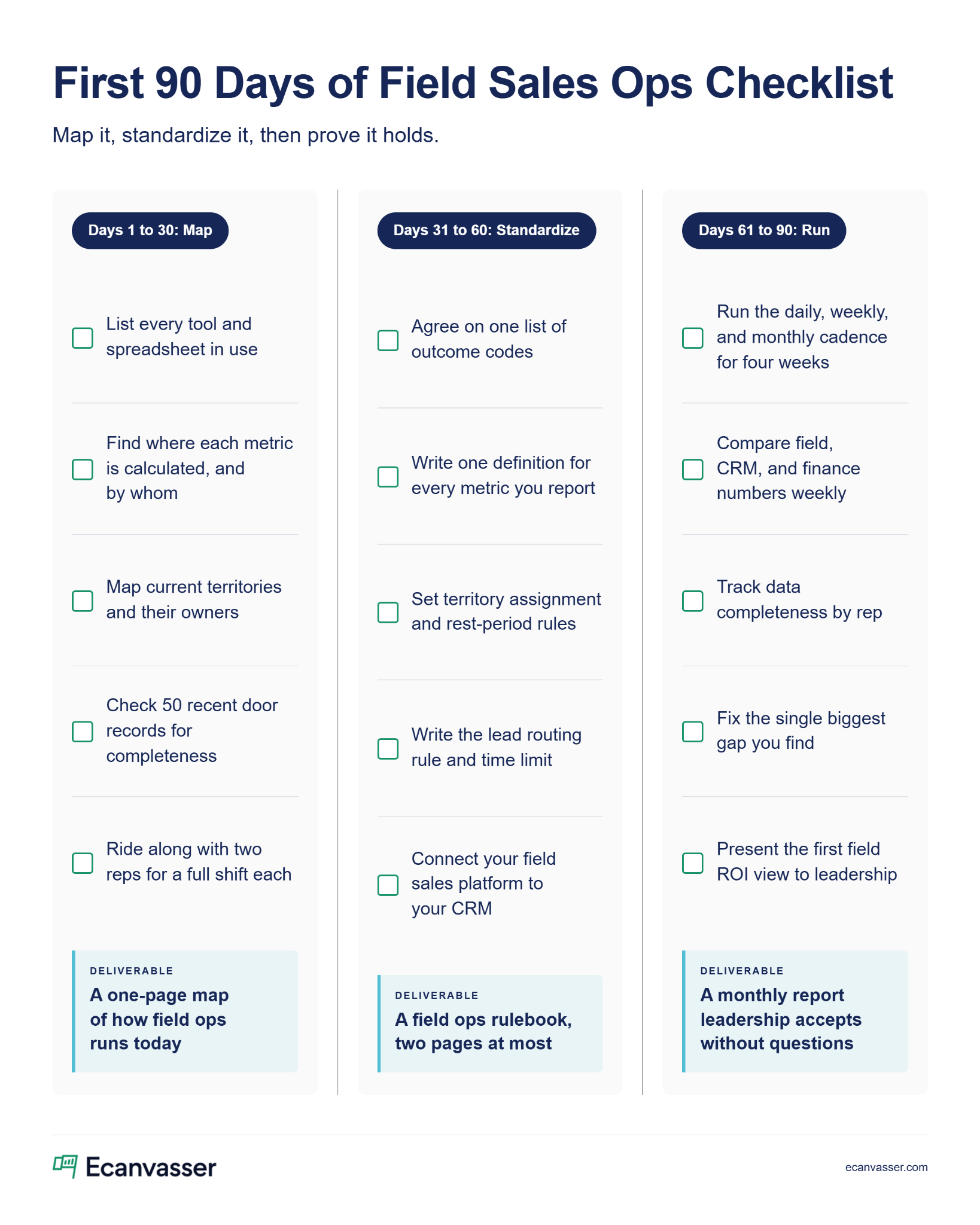
Use the first month to understand how the operation really works and which people it depends on. Talk to reps as well as managers. Reps know which rules are actually followed, while managers know how the weekly numbers really get put together. Write down anything that surprises you, since surprises usually point to a missing rule.
Deliverable: a one-page map of how field ops runs today. Show each of the five systems, who owns it now, and where its data is stored.
In my experience, the first month is when you find the real operating model. It's rarely the one in the slide deck, and it's often held in one manager's head and a shared spreadsheet.
In the second month, write the rules, keeping each one short enough to read on a phone screen. Get managers to agree on each rule before you publish it. If one region ignores a rule, the numbers stop matching again, which defeats the purpose. Change one system at a time, and tell reps what changed and why. Outcome codes are a good place to start, because every other system depends on clean door data.
Deliverable: a written field ops rulebook of two pages at most. Date it, because you'll revise it.
New reps should learn the rulebook on their first day. Make it part of onboarding, so every new hire starts from the same standard.
In the third month, run the new rules through a normal, busy stretch of work to check they hold up. The first two weekly reviews will likely reveal problems. One region may count a metric differently, or a routing rule may send too many leads to the manager's list. Fix these quickly and record each change in the rulebook. By the fourth week, reviews should be getting shorter, which shows the systems are doing the work instead of individual people.
Our guide to field sales ROI covers how to build that view, and the ROI calculator gives you a starting point.
Deliverable: one monthly report that leadership accepts without questioning where the numbers came from.
Field sales operations is working when managers spend less time disputing numbers and more time coaching. The five signals below show whether you're getting there. Each one measures a system rather than an individual rep. Review them in the weekly ops meeting and look at the trend over a quarter. A single bad week can be noise, but several in a row point to a real problem.
For rep-level KPIs, see our guide to field sales analytics.
Don't set hard targets for these signals in your first quarter, because you won't know your baseline yet. Measure for a month, then decide what good looks like for your team. Each signal also points to an owner. Falling data completeness goes to whoever owns data standards, and slow lead assignment goes to whoever owns routing. A rise in disputed numbers usually means someone changed a metric definition without telling anyone.
Pay particular attention to disputed numbers, since they tend to rise first when definitions start to slip. When all five signals move in the right direction, your weekly meeting can focus on coaching and territory decisions.
{{faq-1}}
{{faq-2}}
{{faq-3}}
{{faq-4}}
{{faq-5}}
On a field team, sales operations should report to the head of field sales or VP of sales. That keeps the rules close to the people who use them every day. If you run a broader revenue team across marketing and customer success, ops may sit under revenue leadership instead. Either way, the field leader needs a direct line to whoever owns the systems.
Yes, at first. Plenty of field managers already handle territory rules, data cleanup, and reporting alongside coaching. The risk is that ops work keeps getting pushed aside by urgent problems in the field. Protect a fixed block of time each week for it. When reporting alone takes more than a day a week, it's time for a dedicated hire.
Sales operations builds the systems your team works from, such as territories, data, and reporting. Sales enablement trains reps and gives them scripts and content. A field team needs ops first, because training reps on a process that keeps changing wastes the training. Get the rules and data stable, then add enablement.
Start with three: a CRM for accounts, a field sales platform for territories and door-level data, and dashboards for reporting. The field platform has to work offline and sync back to the CRM. Other tools can wait until those three connect cleanly. Drop any tool your reps can't use at the door.
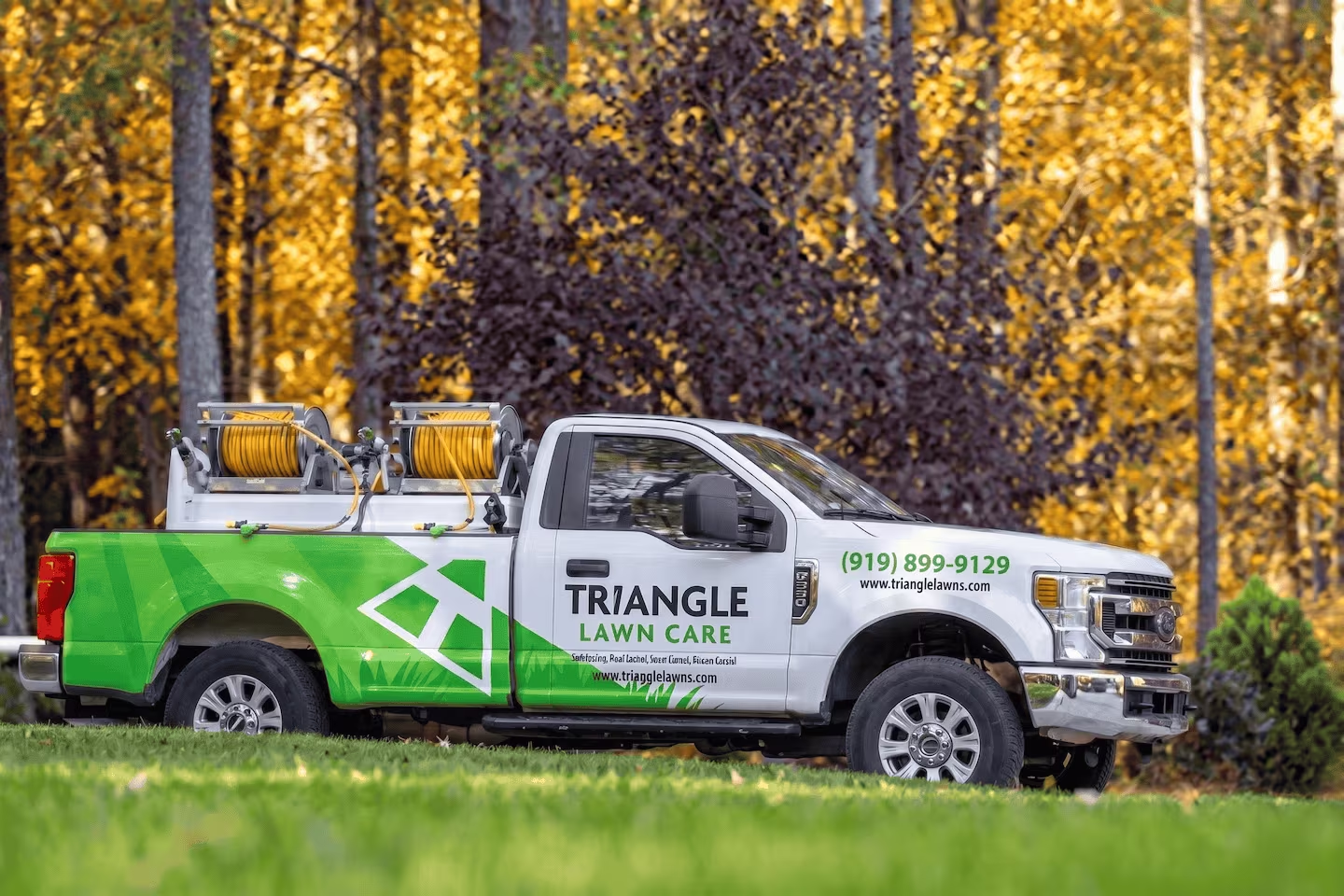
Ecanvasser’s real-time tracking completely transformed our field operations. Through the dashboard, we can plan efficient routes, customize interactions, and monitor our canvas stops in real time to support our team the second they need help. The "verified drops" feature adds an extra layer of accountability, while the reporting tools make it seamless to track hourly visit rates and optimize performance on the fly.




Scale your operations, empower your reps, and deliver predictable, profitable growth with Ecanvasser.